Wednesday, August 18, 2010

Book Review - Elenydd

It might be an idea for some wealthy patriot to buy up all the copies of this pretty little book and pulp them. After all Gwasg Carreg Gwalch's volume will probably sell best to tourists, and before you know it our "last wilderness" will be gone.

Of course this is already happening, with 4x4s churning up mountain tracks and the industrialisation of the skyline with wind-farms of very little environmental benefit.

Anthony Griffiths' photographs prove that if you are prepared to get out and about early, in the morning, especially on bright days in winter, then you'll take excellent photographs. No doubt the pictures' impact are diminished a little by the small format (220x220mm) but the colour reproduction is excellent and at £12 the book is inexpensive.

Despite the bilingual format the further reading list contains no Welsh language books or articles, those by Cledwyn Fychan for example. It does have Erwyd Howells but misses out on Ruth Bidgood. Essentially Elenydd is a tourist book, there are seemingly no people in this wilderness, no ponies, no sheep and no rain. The text is that of an informative visitor's guidebook, there is little room for the old mountain communities and their story here.

Thursday, August 12, 2010

More Normans

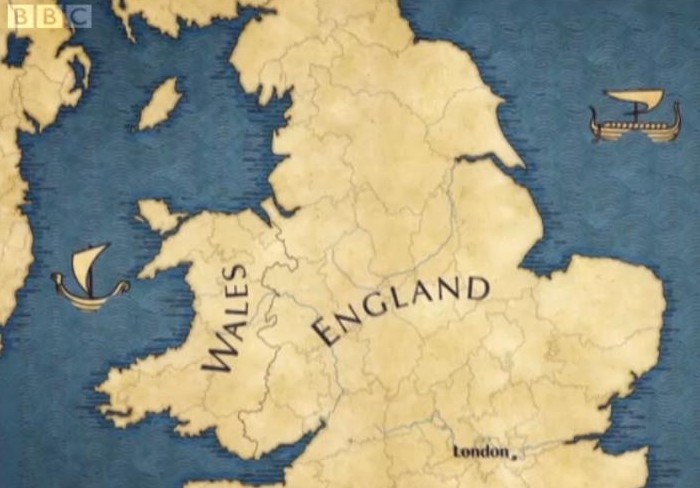
Anyone notice this map used in last night's second episode of Robert Bartlett's The Normans?

Now I know that a few places in Gwent do appear in the Doomsday Book, likewise a handful in Radnorshire, but this can't be mapping that since Flintshire is included in Wales even though numerous places there are in Doomsday. No, this is an attempt to draw the modern border but with Monmouthshire placed in England. An accident or an agenda? Make up your own mind.


Bartlett's BBC2 efforts all seem a bit Arthur Mee, although I'd never heard of the homicidal Alice of Abergavenny, surely an ancestor of Goldie Lookin' Chain's Nutter Missus. The real joy of the series is in the various associated programmes - Nina Ramirez clumping up hillsides and over parquet floors in spiked heels. I know academics on the telly like to have a sartorial gimmick but wouldn't a bow-tie or a deerstalker be less damaging to the environment? Then we had Dan Snow tramping through the Southern March visiting sites chosen for their photogenic qualities rather than their connection with the Norman Invasion. A walk from Wigmore to Abbeycwmhir would have made for a more insightful program - although the perspicacious Radnorians have long-ago recycled the stone from the castles en route. Best bit of Snow's walk was Mrs Lucas-Scudamore of Kentchurch hurriedly directing Dan away from the front door to a gazebo for a chat. She was probably worried about her floors.

Wednesday, August 11, 2010

Blog Watch

Aficionados of women in motorsport should check out this new blog.

As someone who finds modern day rallying and racing about as pointless as bungee jumping, I'm obviously more interested in the old-timers. The pre-war competitors seem much more interesting than their present day sisters. and quite often this is because of their adventures away from the track.

Perhaps this new blog misses out a bit by focusing on the records rather than the characters of those determined individuals - yes, for example, Joan Richmond did compete in the 1932 Monte Carlo Rally, but more interestingly she drove her little Riley to the start ..... overland from Australia.

Have women made any progress at all in motorsport over the last few decades? Back then photographers insisted on taking snaps of the leading racers powdering their noses, nowadays it's soft porn. One group who do have something of the spirit of their predecessors are the female Arab rally drivers from the Middle East featured on the blog. They're certainly challenging the status quo.

Friday, August 06, 2010

Our French Neighbours

While trying to keep up with current events, I found this interesting quote in the 1873 Christmas Eve edition of the Western Mail, it's in a profile of the Breconshire MP Godfrey Morgan:

"It is almost a paradox, but it is, nevertheless, true that Breconshire, throughout the whole of which the Welsh language is constantly in use, is less essentially Welsh than Herefordshire, where the ancient tongue has almost entirely fallen into desuetude. The population of Breconshire consists, in a great measure, of a Norman colony, which has gradually adopted the language of the country in which its lot has been cast, while Herefordshire is a Welsh county whose inhabitants have lost the use of their native tongue."

The writer uses these "ethnological grounds" to explain the Brecknockians supposed aversion to political dissent and "the supremacy of the Conservative cause in the county." Of course the secret ballot soon put paid to that little theory as the Liberals won the seat when Morgan became the 2nd Lord Tredegar in 1875 and held on until it was abolished and merged with Radnorshire in 1918.

Party politics aside there is some truth in lowland Breconshire's French character, after all it was the bard Hywel Dafi who celebrated the French families of Brycheiniog, where he pointed out that "every tribe has the fruit of French blood" - bobllwyth gyda ffrwyth gwaed ffrainc. While French surnames like Havard are still common enough, others, the Bullens and Boys for example adopted the Welsh patronym system to eventually emerge with surnames such as Williams. That excellent little book The Surnames of Wales relates a sad tale of a woman named Walby who sought relief in Crickhowell in the 1880s, her real surname was the fine old Breconshire French name Walbeoff, but her husband had changed it "because people laughed."

Wednesday, August 04, 2010

The Normans

Ever the optimist I'm looking forward to the BBC's new series on the Normans, which starts tonight. Usually my optimism is misplaced, the most recent example being David Dimbleby's anglocentric series Seven Ages of Britain, which informed us that until a few Irish monks turned up in Scotland in the mid 500s, Britain was pagan ...... heaven knows where he thought St Patrick came from. I used to think that such nonsense was born of ignorance rather than deliberate falsification, now I'm not so sure. As Ieuan Brydydd Hir said of an earlier generation of English historians:

The false historians of a polished age
Show that the Saxon has not lost his rage,
Though tamed by arts his rancour still remains:
Beware of Saxons still, ye Cambrian swains.

Monday, July 26, 2010

Bilingual Sign?

We all know that bilingual signs enrage the Colonel Blimp types but isn't this a bit much? First off it isn't a bilingual sign at all - as far as I know the place has never had an English moniker - what it shows are two alternative spellings of the same Welsh name.

Anyone looking at old records knows that until recently placenames and even surnames had no established forms, with folk spelling as the mood took them. I can understand that where a non-standard Welsh spelling has gained wide usage, Rhayader for example, then there's a case for its continued use. Here the sensible thing would have been to stick with the modern standard spelling and ditch the lower one, rather than pretend it's English.

A Radnorshire Romance

Seen by the roadside between Llanfaredd and Aberedw.

Thursday, July 15, 2010

Elenydd < Elenid

I guess this is another book I'll have to think about buying - a photographic essay about the so-called "green desert" that covers the mountainous borderland between Ceredigion and Radnorshire.

Llandrindod blogger in exile Gwenddolen has a post on the book launch in Aberystwyth and raises the interesting question as to whether Elenydd should really be called Elenid. It seems the 13C bards Phylip Brydydd and Iorwerth Fychan plumped for Elenid, which is the clincher as far as I can see - oh and Elenid also won the google fight.

No doubt that fight was swayed by the forename Elenid and Elenydd certainly seems to have gained a wide acceptance in recent years - in any case it's a great improvement on Cambrian Mountains or Mynyddoedd y Cambrian.

Friday, July 09, 2010

Slavery in Radnorshire?

When did slavery end in Radnorshire? Well I guess you could argue that it was in 1948 with the closure of the prisoner of war camps in Newbridge-on-Wye and Presteigne. When my father was demobbed in 1946 one of his first jobs was delivering lorry loads of POWS from the Pendre camp to their various workplaces around the district - didn't some work on the construction of the Claerwen reservoir?

Were these POWs really slaves? Technically they were not, although it must have felt like it. Hostilities had certainly long ceased and they were still being held against their will and used as forced labour in a foreign country. The position of the Italian POWs was particularly interesting as, since 1943, Italy had actually been an ally of the UK.

Perhaps many of these POWs, despite the rationing and harsh winter of 1947, have fond memories of their time in Radnorshire. A number married local girls and others returned to the area on holiday, although some had to wait until the fall of the Berlin Wall in order to do so.

If anyone has any information on these forgotten Radnorshire camps please leave a comment.

Friday, July 02, 2010

Elystan Glodrydd

Now here's a new website the idea of which will gladden the heart of any Radnorian with historical interests. Why it has even made the pages of this week's County Times. The proposed gathering of Elystan's descendants in Llanbister this coming October could be a sizable affair though, as it's doubtful if anyone with the slightest hint of a Radnorian ancestry isn't related many times over to those princes of East Central Wales who claimed descent from old EG.

Of course a lot of folk have no time for heraldry and genealogy, no doubt because of the way it has been hijacked by the likes of the Countess of Wessex. The truth is that they do provide invaluable insights into history. Elystan, his name is actually a Cymicised version of Athelstan, was the patriarch of leaders who led the Welsh resistance, often successfully, for half a millennium, in the lands between the Severn and the Wye.


As that great patriotic bard of the 15C Lewis Glyn Cothi declaimed:

Tarian Elystan fal iâ,
Iddo hon a ddihuna,
Ac ynddi'n meistriol'r drin
Ben baedd yn erbyn byddin.

(The shield of Elystan like ice, is awakening unto itself, and within it mastering the threat, the head of a boar against an army)

That's the ticket.

Wednesday, June 23, 2010

A New Radnor

It's plain enough that the Radnorians who settled Pennsylvania's Welsh Tract at the end of the 17C named the local creek after the river back home. There's some background here.

Monday, June 21, 2010

Up the Fron

When I was a young lad living down the Gravel Road, the Fron - and we always called it the Fron, a translation I guess of Y Fron - was a mere suburb of Crossgates. Nowadays, it seems to have graduated into a place that deserves its own roadsign, which is only right and proper, as it surely had an identity long before Crossgates had a gate.


The 15C bard Lewis Glyn Cothi composed a couple of poems to Dafydd Goch ap Maredudd, a local chieftain from the parish of Llanbadarn Fawr - the 1995 edition of Glyn Cothi's work says Llanbadarn Fynydd but that doesn't make much sense. Firstly because Dafydd's descent group - Llywarch ap Bran - had land in Llanbadarn Fawr but not in Llanbadarn Fynydd, secondly because references to the river Cymaron being in the locality - nowadays misspelt Cwmaran by those who should know better - are much more appropriate to Llanbadarn Fawr. The clincher for me is this line in one of the poems - Yn y ty fry ar y fron - OK you could translate that as "in the house up on the hill" but isn't "in the house up on the Fron" more likely?

Oh I just realised that some readers might not know that the Fron and Crossgates are both in the Radnorshire parish of Llanbadarn Fawr - nothing to do with Aberystwyth.

Sunday, June 20, 2010

Nice Work If You Can Get it

Journo Andrew Gilligan makes the following point in today's Sunday Telegraph:

"For bureaucrats of the Welsh Assembly Government, the retirement age is actually lower, at 50, than the average police officer."

Now I'm sure this will come as news to the average toiler at the Assembly where the retirement age - if they can afford to - is actually 60 like everywhere else in the Colonial Civil Service.

One wonders where Mr Gilligan got this information? Down the pub? From a friendly local Taxi driver? From a pal in UKIP?

Seemingly Mr Gilligan is now away on holiday, hopefully someone will put him straight if he ventures west of Offa's Dyke.

UPDATE: The Sunday Telegraph has a circulation of over half a million, so that's a fair number who will have read Mr Gilligan's ridiculous claim last week that Assembly staff retire at 50. Has anyone from the Assembly refuted the assertion, have any of the Welsh political bloggers mentioned it? Not that I can see. Even the redoubtable Robyn Lewis has failed to get a letter published on the matter. The thing is you need to stamp on these false stories before they get legs. Come the referendum there will be thousands of hard-working souls who believe that Assembly staff retire at 50 whereas they are faced with the prospect of working until 70. The Welsh political class really need to wake up and get their act together.

Sunday, June 13, 2010

The Edge of the Forest

Hay Horse Fair was a good place to go if you enjoyed a fight, at least that was the opinion of the old-timers in my local Radnorian pub when I was growing-up. Nowadays locals surely approach the Hay Literary Festival in much the same way as Amazonian Indians view so-called civilisation, peering out at an alien world from the edge of the forest.

Back in the good old days Welsh writers were more likely to be found in prison than in the pages of the Guardian, now it seems that the present generation can't wait to rub shoulders with the London glitterati in Y Gelli. But wait ..... no-one of consequence noticed that they were even there or that Hay on Wye was actually in Wales. It seems we're missing out on a great marketing opportunity by not raising the Welsh profile at Hay - although none of our politicians seemed bothered when the very successful Biker show was hounded out of Builth for no good reason.

Anyway, ever eager to help here's a suggestion .... why don't the Assembly government arrange for a few "Home Rule" slogans to be painted around the town. It was Paul Theroux who said the English only took an Irishman seriously when he was holding a gun and I guess the same thing applies to the Welsh. Give the glitterati the frisson that they are entering a conflict zone and the Welsh profile of the festival could be raised for the price of a couple of cans of Dulux.

Saturday, June 12, 2010

Nothing on the Telly


YouTube is chock-a-block with Andean huaylas and huayno music - marvellous stuff.

Friday, June 11, 2010

Canberry

Back in the early 1950s when London decided that Wales deserved a capital city, there were those who thought that an out in the sticks sort of place like Llandrindod would make a mighty fine Welsh Canberra.

Now, as young Karen Brockman might say, I've been to Canberra, so I'm glad that Cardiff eventually won out. Stick a few thousand civil servants in the middle of nowhere and pretty soon the main topic of conversation becomes the latest flexitime rules.

Maybe it was Jan Morris who said that Canberra was built for a race of giants, but whoever it was, it's certainly true. Canberra is a great place to cycle but not much fun for a pedestrian, when even marching up to the counter across the huge marble floor of an empty bank is quite a hike.

What fun to point out, after a long stroll to the National Gallery of Australia, that Aussie treasure Sydney Nolan - that's one of his paintings and they're all like that - was actually living back in Presteigne - OK I know The Rodd is a few yards over the border but ... Anyway my last visit there was in 1996, just after another Radnorian resident, Lord Williams of Elvel (and shouldn't that be Elfael) had published his biography of Bradman. Here was a book that contained the great truth that, quite contrary to accepted opinion, it was Englishmen who were cheats and Australians who were whingers. An opinion that, once shared, certainly got Canberrans off the subject of T&S for a while.

Just a Dream on my Mind

I wonder how many people remember the 1986 World Cup in Colombia? OK I know it was actually held in Mexico but originally Colombia had been selected to host the competition. At the time I knew a few Bogotanas - heck I even had a Millonarios football shirt - as well as folk from Barranquilla, Cartagena and even Medellin; finding somewhere to stay would be no problem. Oh and Wales would obviously qualify, having just missed out on Spain in 1982. The great trip was on.

Of course Colombia did had a few problems - guerrillas, drug cartels, murder and kidnapping on the streets. I remember someone telling me that you could hire a hitman for $10 American and after she insisted on showing me her exit wound I was a believer. As it was in early 1983 with no stadium construction underway Colombia admitted defeat and handed the rights to the tournament back to FIFA.

Any hope of Wales qualifying for the rescheduled competition in Mexico ended with another ridiculous penalty decision at Ninian Park the night Big Jock died. I like to think that in some alternate universe Colombia did host the 1986 World Cup, Wales qualified and we were there.

Apologies if you don't like the new-look blog. I was experimenting and have no idea how to get the old settings back.

Saturday, June 05, 2010

Interlude Musical


Down in the dumps? Sheila ought to be able to cheer you up. Still miserable? ....... a few years later Sheila was transformed into Disco Diva Sheila B Devotion, see here. Well I'm happy now anyway.

Friday, June 04, 2010

Sitting Next to a Strange Man is Liable to Make Me Vomit.

There's a jolly article about Turf eccentric Dorothy Paget in today's Mail, by the way the title of this post is taken from a letter she wrote to the Transport authorities requesting that she be allowed to reserve a railway carriage for her own exclusive use - this during the Second World War!

What the article doesn't touch on is Ms Paget's earlier Motor Sport involvement. Firstly Dorothy was a first cousin of the racing driver Whitney Straight and she was, more importantly, the financial backer of Le Mans winner Tim Birkin and the Blower Bentley project. Paget's interest in motor sport ended with Birkin's death. It is suggested that Paget was infatuated with Birkin but given her dislike of men this is debatable. When she greeted her great steeplechaser Golden Miller in the paddock following another victory, a wag suggested that it was the first time she had kissed a male - yes, Dorothy replied, but he is a gelding.

Thursday, June 03, 2010

A Llandrindod Correspondent

The time was that non-conformist Wales was one of the more philo-semitic corners of the planet. There's little left of that world now, apart from the names of a few emptying chapels and Old Testament Welsh surnames such as Moses, Israel and Jeremiah. Nowadays Welsh opinion formers are more likely to take a lead from the increasingly anti-semitic London media than from the traditions of their own country.

Given that historic philo-semtism, Tredegar's anti-Jewish riots of 1911 were something of an aberration. Attacking the businesses of unpopular shopkeepers was fairly common in the nascent revolutionary years of 1910 and 1911 in the coalfield. The attacks on specifically Jewish businesses in Tredegar lasted only a couple of days before being subsumed into more general unrest. Still it would be interesting to discover exactly who the anti-Jewish rioters were, given the ethnic and religious hotchpotch of Edwardian Monmouthshire.

The London press made a meal of the whole thing, comparing the riots to the pogroms of Russia, but Jewish correspondents from South Wales were quick to dismiss such sensationalised journalism in letters to the press. Indeed there was only one letter from Wales, it was published in the Jewish Chronicle, which hinted at any wider anti-semitism in the country. This came from a Jewish minister, Herbert Sandheim of Llandrindod Wells who seemingly blamed Jewish comedians in the music hall for the situation!

So was there something about Llandrindod and its entertainments which caused Mr Sandheim to express opinions not generally shared by his co-religionists? Infact a glance at the 1911 Census shows that Mr Sandheim was a 28 year old Glaswegian - he must have been holidaying in Llandrindod when he wrote the letter as he had been living in Swansea, with his Russian born wife, for at least a year. Radnorshire can have played little part in forming Mr Sandheim's opinions. You can read about the Tredegar riots here.

The illustration shows Staniforth's Dame Wales apologizing to a Jewish shopkeeper for the depredations of the rioters. Nowadays the BBC would probably call them peace activists.