This is a great song. Perhaps there should be something similar for elderly Welsh nationalists completely at odds with the current direction of the movement.
Friday, September 02, 2016

Monday, July 04, 2016
Post Referendum Blues
Class - do you remember the 20th century when class and/or nationalism dominated the discourse. No wonder the elites encouraged us to concentrate on less dangerous causes such as gender or race. War was still fine of course, as long as the slaughter was aimed at the unpeople, those countries that didn't fall in with the globalist world view. Yet in the homelands, the US and the EU, "progressives" became obsessed with minorities of one kind or another, to ideas that posed no threat whatsoever to the elites.
This is why the Leave vote is a bit of a turn up, because suddenly those 20th century issues are back on the agenda. Look at this piece from the Spectator highlighting the class nature of the vote:
"The Brexiteer/Remainer divide splits almost perfectly, and beautifully,
along class lines. Of local authorities that have a high number of
manufacturing jobs, a whopping 86 per cent voted Leave. Of those bits of
Britain with low manufacturing, only 42 per cent did so. Of local
authorities with average house prices of less than £282,000, 79 per cent
voted Leave; where house prices are above that figure, just 28 per cent
did so. Of the 240 local authorities that have low education levels —
i.e. more than a quarter of adults do not have five A to Cs at GCSE — 83
per cent voted Leave. Then there’s pay, the basic gauge of one’s place
in the pecking order: 77 per cent of local authorities in which lots of
people earn a low wage (of less than £23,000) voted Leave, compared with
only 35 per cent of areas with decent pay packets."
How the "progressives" hate it. People who haven't been to university deciding their future!
Wales - another 20th century discourse making something of a comeback after the Brexit vote is Welsh independence. Not independence as might be understood by Americans or Icelanders or most other free peoples but "independence in Europe" by which is meant a desire to be on board the EU train, destination unknown.
Five local authorities in Wales voted to Remain, three following the British pattern (yes British not English vide East Renfrew etc.) of wealthier areas voting for the status quo - the Vale, Monmouth and Cardiff. In Gwynedd and Ceredigion the Welsh language is said to have played a part, although I do wonder about the influence of the university vote.
What is clear is that a segment of Welsh society we might characterise as the clerks voted strongly for Remain. By this I mean people who work, directly or indirectly, for the state in non-manual occupations. In their pique at being outvoted by the great unwashed we see elements of this clerkish class rallying to the cause of Welsh independence, not as a worthwhile aim in itself but as a means of remaining inside a club which they see as protective of their economic interests. I can't see this enthusiasm lasting very long.
Meanwhile the Leave majority are told they are stupid or racist or ungrateful for all that EU largese. Seriously the clerks need to go on some sort of refresher course on engaging with folk who don't share their enthusiasms.
Scotland - according to the polls around a third of SNP voters opted for Leave. Here's an interesting fact, the most pro-Remain councils were hardly hotbeds of separatism. Edinburgh 74% Remain, 39% Indy; East Renfrew 74% Remain, 37% Indy and East Dunbarton 71% Remain, 39% Indy.
Now perhaps there will be enough Remainers who are so enamoured of the EU that they'll dump their unionism and help win a second Indy referendum. Maybe. What then? An independent Scotland will have to negotiate its membership of the club. It will have to adopt the Euro and some of those Operation Fear scares might actually become real - tariffs on trade with the English market, a real border with customs and passport control. Oh and its doubtful if Scotland would be allowed membership if it dumped Nato - so forget about closing Holy Loch as well. Would an SNP government put EU membership to the vote? Would they win?
My own view is if Brexit happens, still a big if of course, then both Scotland and Ireland would have to forget the EU and enter a free trade area with Wales and England, that's the economic and geographic reality.
Thursday, May 19, 2016
The Lads in their Hundreds
When my father had his stroke he would wonder why I couldn't smell the pine oil being extracted from the trees at Holly Barn, his childhood home. We would talk about his father's visit on leave from the Great War and how his older brother had run away rather than face saying goodbye. For him it had happened just the other day. I try to imagine what it must have been like to have to return to the trenches after a brief spell at home.
There was no home leave in my father's war, he sailed from Glasgow in the Queen Mary to eventually arrive in Egypt and on to Italy. He didn't make it back until 1946. Before he left his grandfather, who lost three sons in the Great War, had shook his hand and said they'd likely not meet again.
There was no great European war for my generation and for that we are asked to thank the EU and show our gratitude by voting to remain inside the community. I'm not so sure. How do the people of Serbia or Libya or the Donbas feel about that? Why do so few see the dangers of war with Russia, provoked in part by the EU and especially by what might be termed its military wing - Nato?
I voted to leave in 1975 and will do so again. This means sharing a bed with Empire loyalists, British nationalists, 1950s nostalgists etc. but so what. Look at the company the decent folk on the pro side have to keep, the warmongers and neoliberal elites, it's a wonder the stench doesn't overpower them.
Of course Plaid Cymru think that they can reform the EU from inside, well good luck with that. I believe that there is a very faint chance of the Welsh nation surviving outside the EU and none at all within, although this may be moot given the West's eagerness for confrontation with the East.
Friday, February 19, 2016
The Irish Slave Myth
In 1968, presumably in a spirit of revolutionary fervour, I bought a hardback book entitled Celtic Nationalism. It hardly lived up to the times, consisting of two pedestrian contributions from Gwynfor Evans and Hugh Macdiarmid while more than half the book was taken up with an academic essay on, mainly, 19C Irish nationalism by Owen Dudley Edwards. One thing I did gather from the book was that there had been an element of pro-slavery, anti-black racism within Irish nationalism, especially in the writings of John Mitchel and Arthur Griffith.
Fast forward half a century and we find a Limerick historian, Liam Hogan, valiantly attempting to stem the myth of Irish slavery - a popular and growing meme, especially in the United States. This meme, either through ignorance, me-too-victimhood or out and out dishonesty and anti-black racism, equates chattel slavery with indentured servitude. You can read Hogan's ongoing debunking of the myth - in 5 parts, starting here or here.
The Growth in Social Media Mentions of the Irish Slave Myth - from Hogan

Not the least disservice performed by this pervasive myth is to cast a shadow over the very real historical sufferings of the Irish people while providing ammunition for her enemies. Only last week there was a small example of a Scottish writer's reasonable comment on the Highland Clearances being equated by anti-SNP voices as if it were a Scottish appropriation of the slave myth.
Wednesday, February 17, 2016
Goodbye Wales
Can oblivious Wales please never again mention its historic links to Hughesovka, a city - nowadays called Donetsk - frequently shelled by what purports to be its own government and whose president boasts that its children must cower in cellars instead of going to school.
Thursday, January 21, 2016
Off My Chest
It seems I haven't blogged for a month. Not sure why, perhaps a sense of impending doom - certainly I'm not looking forward to the Assembly elections or the Euro vote. What a choice we have with the Euro vote. Brexit means more Nato, more TTIP but then so does staying in EU. My preference would be an independent Wales outside both of these organisations, but no-one's campaigning for that. On balance Brexit at least allows the possibility of extracting Wales from the union. After all Scotland was allowed a referendum. If you think that Brussels would ever permit the emergence of new states then you're deluded. I think Plaid supporters are also deluding themselves if they think that this year's Assembly election will prove be a breakthrough.
Foyles on the Wye
It shows how out of touch I am with local affairs that I only recently learnt - from Jacothenorth's admirable blog - that the Maesllwch Arms has, with the help of public money, been rebranded as Foyles of Glasbury. The old pub took its name from the nearby gentry house, originally occupied by a branch of the Vaughan family but which passed through many hands before being purchased in 1772 by Walter Wilkins of Brecon; a man who had made his fortune in India where he was governor of Chittagong. In the 19C the house was rebuilt as Maesllwch Castle and the Wilkins family itself adopted the surname De Winton - they never felt the need to rename their seat though.
Foyles on the Wye
It shows how out of touch I am with local affairs that I only recently learnt - from Jacothenorth's admirable blog - that the Maesllwch Arms has, with the help of public money, been rebranded as Foyles of Glasbury. The old pub took its name from the nearby gentry house, originally occupied by a branch of the Vaughan family but which passed through many hands before being purchased in 1772 by Walter Wilkins of Brecon; a man who had made his fortune in India where he was governor of Chittagong. In the 19C the house was rebuilt as Maesllwch Castle and the Wilkins family itself adopted the surname De Winton - they never felt the need to rename their seat though.
I can't say I'm much vexed by this rebranding, the Welsh Government's investment might even prove worthwhile in terms of local employment. It's interesting that of the 19 living-in servants at the Castle in 1871 only 4 were locals, so any improvement on that would be a bonus. These minor symptoms of anglicisation mask a deeper malaise - a national party that's afraid to offend the liberal wing of imperialism springs to for example.
Back in the early 70s I would occasionally frequent a then cluttered Foyles bookshop, a look at my book case shows some slim volumes of Anglo-Welsh poetry purchased there along with a Soviet book on the National Question. I never purchased an expensive and heavy four volume facsimile set of the Poor Man's Guardian although I was sorely tempted on each visit. Interestingly radicalism is so out of fashion nowadays those four books are relatively cheap on the second-hand market, certainly my Welsh language rock albums seem to have proved a far better investment.
I can never say I felt comfortable at Foyles, much the same feeling as I experience in the bookshops of Hay - it's all far too foreign. Foyles of Glasbury should do well if it attracts the same clientele.
The Markets
There was a time when a poor man could make a small living by playing the markets. You bought Investors Chronicle and checked out the expected results for the week ahead. Then you got up at the crack of dawn, looked for a company that had exceeded expectations and instructed your broker to buy. Later in the day the big boys would move in and the following day's papers would drag in smaller buyers. This was the sign to sell and the beauty of the settlement date in those days meant you didn't even have to touch your bank account - instead your broker would send you a cheque.
You could even reassure yourself that you were performing a socially useful function by providing liquidity to the market. The stock market itself resolved the contradiction between the borrower who wanted long term funds at the lowest possible cost and the investor who desired immediate access to their money combined with historically high returns. In the same way the options and futures markets provided a degree of certainty to the real economy with the help of speculators. That was then. Today the speculators have taken over at the expense of the real economy and the tax-payer who foots the bill for their gambles. These people should have been burnt a decade ago (another argument in favour of capitalism was that the stupid should go to the wall) but instead they were bailed out.
Eleanor Bull
While checking out that Foyles of Glasbury nonsense I came across Eleanor Bull, in whose house the playwright and poet Christopher Marlowe was killed. Of course Wikipedia describes her as an English woman although Clifford where she was born was a Welsh speaking parish in the 16C. Was she the niece or great niece of Queen Elizabeth's confidante Blanche Parry? If her mother was Sybil Parry as the article says then she was a niece. Eleanor's family background, the Whitneys, the Parrys, the Vaughans were all bardic patrons. Her grandmother/great grandmother Alice Milbourne was an exception being described by the bard Hywel Dafi as a tall, aging girl of Rowena's seed, advising her future husband to chose a slim 20 year old Welsh girl rather than the daughter of the Englishman of the Shire. The late John Davies described the Herefordshire borderlands as being a Welsh irredenta, it deserves more attention.
The Markets
There was a time when a poor man could make a small living by playing the markets. You bought Investors Chronicle and checked out the expected results for the week ahead. Then you got up at the crack of dawn, looked for a company that had exceeded expectations and instructed your broker to buy. Later in the day the big boys would move in and the following day's papers would drag in smaller buyers. This was the sign to sell and the beauty of the settlement date in those days meant you didn't even have to touch your bank account - instead your broker would send you a cheque.
You could even reassure yourself that you were performing a socially useful function by providing liquidity to the market. The stock market itself resolved the contradiction between the borrower who wanted long term funds at the lowest possible cost and the investor who desired immediate access to their money combined with historically high returns. In the same way the options and futures markets provided a degree of certainty to the real economy with the help of speculators. That was then. Today the speculators have taken over at the expense of the real economy and the tax-payer who foots the bill for their gambles. These people should have been burnt a decade ago (another argument in favour of capitalism was that the stupid should go to the wall) but instead they were bailed out.
Eleanor Bull
While checking out that Foyles of Glasbury nonsense I came across Eleanor Bull, in whose house the playwright and poet Christopher Marlowe was killed. Of course Wikipedia describes her as an English woman although Clifford where she was born was a Welsh speaking parish in the 16C. Was she the niece or great niece of Queen Elizabeth's confidante Blanche Parry? If her mother was Sybil Parry as the article says then she was a niece. Eleanor's family background, the Whitneys, the Parrys, the Vaughans were all bardic patrons. Her grandmother/great grandmother Alice Milbourne was an exception being described by the bard Hywel Dafi as a tall, aging girl of Rowena's seed, advising her future husband to chose a slim 20 year old Welsh girl rather than the daughter of the Englishman of the Shire. The late John Davies described the Herefordshire borderlands as being a Welsh irredenta, it deserves more attention.
Thursday, December 17, 2015
Matters Arising
I read this in the introduction to the Penybont book mentioned in the last post:
"King Harold Godwin's territorial interests near our area ensured that the Norman power which replaced him was soon active nearby. There followed a period of nearly 500 years during which the largely unrestrained authority of the Marcher Lords, and our area especially the Mortimer family, was matched by successive waves of resurgence led by Welsh leaders from other parts of Wales.."
Now this suggests that the 1500 or so households that made up the cantref of Maelienydd had no agency of their own in resisting the Norman incursions. Of course this isn't true as a browse through Brut y Tywysogion would soon make clear. Some examples: in 1136 Madog ab Idnerth and his sons were among the leaders in the battle of Crug Mawr in Ceredigion; in 1165 the sons of Madog ab Idnerth and their host were present at the victory over King Henry at the battle of Crogen; in 1262 the men of Maelienydd seized the castle of Cefnllys - they did so again in 1295 - and, of course, the men of Maelienydd were central to the victory at Bryn Glas in 1402.
The sad truth is that Rhwng Gwy a Hafren is largely ignored or misrepresented by Welsh historians, indeed I'd say that you have to turn to an Englishman - and a UKIP parliamentary candidate to boot - for anything more than a very superficial view of the history of this strategically important part of Wales.
DNA CYMRU
I've only seen a few minutes of this programme but I was interested to read the claim that 18% of Welsh men were descended from just ten men, probably chieftains, born more than a thousand years ago. Of course that has quite fairly been met with a degree of scepticism although I wouldn't be surprised if it were true. Some of the scepticism took the form of denying the accuracy of the older Welsh genealogies. The 15C genealogies were in reality Welsh legal records and it smacks of a colonial mentality to dismiss them while accepting English records without question. Later on the genealogies did indeed become more corrupted, one of my favourite Welsh couplets is this from Sion Tudur (d1602):
Ar frys arfau a roesom,
Arfau ei dad fu raw dom
How speedily we bestow coats of arms, his father's coat of arms was a shovel of shit.
No Mug For Me
DNA CYMRU
I've only seen a few minutes of this programme but I was interested to read the claim that 18% of Welsh men were descended from just ten men, probably chieftains, born more than a thousand years ago. Of course that has quite fairly been met with a degree of scepticism although I wouldn't be surprised if it were true. Some of the scepticism took the form of denying the accuracy of the older Welsh genealogies. The 15C genealogies were in reality Welsh legal records and it smacks of a colonial mentality to dismiss them while accepting English records without question. Later on the genealogies did indeed become more corrupted, one of my favourite Welsh couplets is this from Sion Tudur (d1602):
Ar frys arfau a roesom,
Arfau ei dad fu raw dom
How speedily we bestow coats of arms, his father's coat of arms was a shovel of shit.
No Mug For Me
The Penybont book also covers Llandegley and to a lesser extent Crossgates. According to the powers that be the Welsh language versions of these two names are Llandeglau and Y Groes. Since Llandegle was good enough for Lewis Glyn Cothi shouldn't we resist the imposition of that North Wales AU ending. As for Y Groes, that's a very recent invention and perhaps we'd be better going back to calling the village Llanbadarn Fawr. It seems that Crossgates was itself an invention of the 19C Post Office, fed-up with confusion with the Aberystwyth suburb of the same name.
The first four or five terms of my education were actually spent in Llanbadarn Fawr school, not the modern building in the village, but the old school nearer Penybont. How did I get there from the Gravel Road? I've no memory of walking along the A44 and we certainly didn't have a car. Perhaps approaching senility will unlock such lost childhood memories. I'm not sure if I've actually recovered from the trauma of not receiving a Coronation mug from the good folk of Crossgates in 1953. Gravel Road is in Nantmel parish the organisers of the celebration explained, meanwhile the Nantmel committee insisted it was located in Llanbadarn Fawr. Years later, poring over an old map, I discovered that my old home was actually in an outlier of distant Llanddewi Ystradenni.
Tuesday, December 08, 2015
Radnorshire in Print
Spotted a couple of Radnorshire related books on sale this Christmastide

and this colourful and well-illustrated publication.


and this colourful and well-illustrated publication.
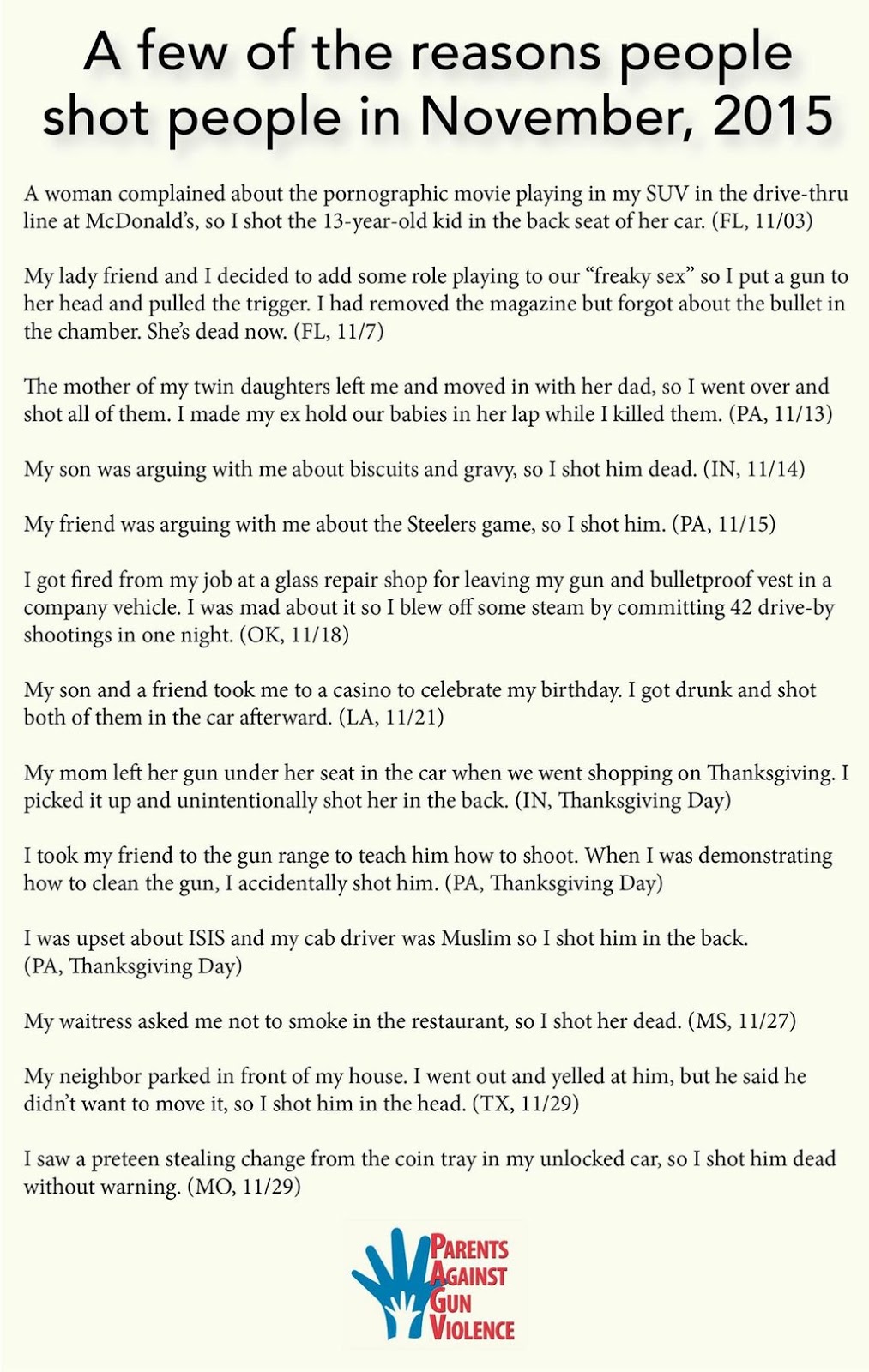
Star Spangled Mayhem
I thought this must be a parody but after googling a few of the crimes listed discovered it was real:

It's a mistake to think this is just about the guns though, it's about a society with more problems than just firearm availibility.
It's a mistake to think this is just about the guns though, it's about a society with more problems than just firearm availibility.
Friday, November 20, 2015
Mr Wigley goes to Riga
Dafydd Wigley, who was recently in Latvia, has produced an article extolling the virtues of EU membership for this small Baltic nation, you can read it here.
Around 35%* of the population of Latvia, Mr Wigley tells us, are ethnic Russians, the consequence of "attempts by Stalin to erode their national identity by flooding Latvia with Russian immigrants." I'm not sure if this is completely true. Certainly only around 9% of the pre-war Latvian population were ethnic Russian, rising to 27% by the end of the 1950s; but then 21% of the Welsh population in the 2011 census were born in England and this population movement can't be laid at the door of a Stalin. The Latvian in-migration was the result of the opening of factories in places such as Daugavpils and the higher standard of living found in the Baltic states. No doubt Latvian nationalists would,argue that these factories should not have been sited in the republic. It's also claimed that in the 1980s many released criminals from elsewhere in the Soviet Union found their way to the republic, something which could never happen here in Wales, of course.
Around 12% of the Latvian population, mainly those of Russian descent find themselves in the position of being non-citizens and thus deprived of various rights, including the right to vote. This non-citizenship can apply not only to those born in the old Soviet Union but also to their children born in Latvia itself. Citizenship can be obtained by passing examinations in Latvian language and state-approved history. In the days before the BBC went full Russophobe they even highlighted examples of these second class Latvian citizens.
I wonder if anyone in Wales would welcome following the Latvian example - Welsh as the sole official language and voting rights denied to migrants and their offspring unless they learnt Welsh and passed a government approved history test?
While highlighting the benefits of EU membership the subsequent decline in Latvian population is only hinted at by Mr Wigley - a 10% drop in population since joining in 2004.
Mr Wigley was also in the news this week calling for an end to the character assassination of Saunders Lewis. I certainly agree with Mr Wigley on this. Lewis seemingly foresaw a clash between a Fascist British state and the Welsh working class. In that event, as the Western Mail reported, he was clearly on the side of the Left: "It is possible that there would be bloodshed in South Wales
if there was a Fascist Government. In such a case the Nationalist Party
must take sides with the popular masses of Wales against Fascist
dictatorship."
In Latvia of course this stand point was obviously put to the test, with hundreds of Latvian nationalists participating in the murder of Jews and others. Instead of confronting this past the Latvian government seeks to dilute these killings by claiming that Soviet repressions also constituted a genocide, indeed Latvia has passed a law imposing sentences of five years imprisonment for denial of the Communist's "genocide".
Instead of acting as a crossroads between Russia and Europe, Latvia has chosen to be at the frontline of a new Cold War. Nato mouthpieces continually warn of (wish for?) Russian military intervention in the Baltic states and any unhappiness amongst the Russian speaking minority is blamed on Moscow meddling rather than Riga's own discriminatory policies.
Wednesday, November 11, 2015
Remembrance Day
Every now and then I look at this page. It contains details of the YPJ fighters killed during the last year or so combating the British elite's favourite cult. Sadly, the list grows longer week by week. Every year our own remembrance day seems to get more pervasive and even bigoted. Meanwhile the women of the YPJ really are fighting for liberty and freedom - something that wasn't true for most of Britain's wars.
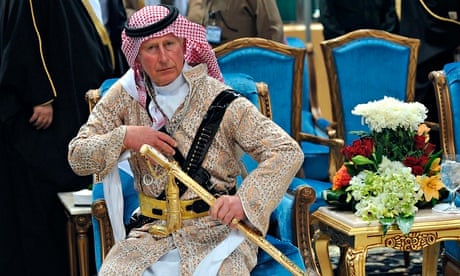
I do hope that the Syrian Kurds resist American pressure to launch an attack on the ISIS capital of Raqqa. The sensible move would be to link up the cantons of Rojava and Afrin which would cut off the Islamist supply lines from their Turkish allies. Raqqa is overwhelmingly Sunni and Arab, so Kurdish involvement wouldn't be welcomed - it's not as if the Americans have even seen fit to supply the Syrian Kurds with decent weaponry over the last year. There is a largely non-Islamist Sunni Arab force which could eventually take Raqqa, Assad's Syrian Army - of course that wouldn't fit in with Western plans at all.
* * * * *
Ever heard of Kate Evans? In 1921 she was imprisoned for seven years for her part in smuggling explosives from the South Wales coalfield to Ireland. A member of the Dowlais Irish community her Breconshire born husband David Humphrey Evans received a similar sentence. I believe they were quietly released after the signing of the Anglo-Irish treaty, what became of them in later years?
This also led me to looking into the names of members of Cumann na mBan killed during the Easter rising of 1916. According to Wikipedia "A number of Cumann na mBan members died in the Rising" and this gets repeated word for word elsewhere on the net. In fact there is a properly researched list of all those killed in the Rising which can be found here. Although a good number of civilian women were killed during the crossfire, there appear to be no women listed amongst the republican dead. If anyone knows any different please comment below.
Monday, October 26, 2015
Thoughts on Tryweryn
I don't have a television so I missed the various programmes commemorating Tryweryn, I gather it even made it on to that cosy comfort blanket of the British middle classes Countryfile. For a Welsh nation so anxious to be patted on the head by their big brother that must have been sweet indeed.
There was no escape though on my twitter feed, which was flooded with cloying terms such as tragedy, open wound, raw, poignant and the occasional trist and colled. Really? There were quite a few tragedies in 20C Wales - the two wars, the depression, deindustrialisation, Senghennydd, Gresford, Aberfan .... But Tryweryn? Meanwhile the on-going ethnic replacement of the Welsh-speaking heartlands continues with barely a murmur from the tweeting classes.
Of course Tryweryn showed the impotence of the Welsh MPs and Welsh opinion in general, but was anyone in any doubt that Wales counted for, still counts for very little? It certainly didn't change the political landscape, with Welsh folk continuing to vote for the usual Unionist time-wasters. Come to think of it the very real crime of Aberfan didn't produce much of a dent on those Unionist voting habits either.
I don't know if any of the commemorations mentioned the fact that the first physical attack on the Tryweryn site was the work of two English speakers from New Tredegar and Bargoed? One thing I did learn from twitter concerned the Gwent village of Pwlldu which was demolished at around the same time as Capel Celyn.
I already knew about Pantywaun, demolished to make way for open cast - you can spot it at the two minute mark of this youtube showing the last train from Newport to Brecon. All history now.
Finally the brouhaha surrounding Tryweryn and Clywedog is supposed to have ended the process whereby Welsh valleys were drowned to supply English cities with water. Maybe that was more the result of declining demand but it certainly helped scupper Labour's plan for a town of 60000, mainly incomers, between Newtown and Llanidloes. For that we have to thank the dynamiteers.
Caveat Emptor

Some 40 years ago I bought a facsimile copy of John Speed's Welsh maps, it cost a remaindered £2.50. Over the years I've wondered how many of the supposedly original, hand-coloured Welsh county maps you see in antique shops were actually sourced from that book. Anyway caveat emptor.
Here's the town plan of New Radnor taken from the book, the earliest plan of any Radnorshire town dating to around 1610. Nothing much has changed except that the castle masonry has disappeared, the perspicacious Radnorians seeing such monuments as a source of building materials.
New Radnor would have had a population of 500 or so and was at that time a Welsh speaking place. No doubt there was a degree of bilingualism since it lay so close to - what were even then - thoroughly English-speaking parishes within Herefordshire.
Saturday, October 10, 2015
Penn Sardin
Although women in France did not get to vote until 1945, the Breton Joséphine Pencalet (1886-1972) was elected to the town council of Douarnenez in 1925. Included on the Communist list it took a few months for the authorities in Paris to notice this flagrant violation of the constitution and declare her election illegal.
Douarnenez at the start of the 1920s was a leftist stronghold, it had elected the French state's first Communist mayor in 1921 and in 1924 thousands of women working in the sardine canneries came out on strike. This song, illustrated by some superb postcards of the sardinieres, recalls their struggle. It should also be remembered that the language of the strikers would have been Breton not French as their slogan pemp real a vo reminds us - a real was 25 centimes and their wage demand was for 1.25 francs an hour.
Thursday, October 01, 2015
A Half-Opened Door
It’s said that if a publisher wants to guarantee good sales for a Welsh historical book they’ll include the name Owain Glyndwr in the title. Maybe this is why one or two decidedly eccentric publications have seen the light of day; an accusation that certainly can’t be levelled at Lolfa’s latest effort Dyddiau Olaf Owain Glyndwr.
This is an investigation of the various stories surrounding the death and burial of our National Hero from the pen of Professor Gruffydd Aled Williams. As befit’s the author’s academic background it is a work that comes complete with footnotes and an extensive bibliography. At the same time the prose is clear and readable, for which anyone with as shaky second language skills as myself will be grateful.
The author examines the various stories associated with the death and burial of Owain in Herefordshire. A new candidate being Kimbolton or Capel Kimbell. Unlike some of the candidates south of the Wye this was in a thoroughly English-speaking district and might be thought an unsuitable location for a Welsh rebel on the run. But then who would have thought that Bin Laden would turn up in Abbottabad rather than the caves of Tora Bora?
It says something that this is the first book I’ve read about Glyndwr which makes as much of his Radnorshire based (and base) daughter Gwenllian - she lived in the parish of St Harmon - as it does of her half-sisters married into the Herefordshire families, the Mortimers, Crofts, Monningtons and Scudamores. Unlike them Gwenllian left no castle or fine house or any privileged descendants, yet for the bards of the 15C she and her family were of far greater importance: a source of patronage, a centre of resistance and a house of learning.
Gwenllian’s husband Philip ap Rhys was a nephew of Rhydderch ab Ieuan Llwyd - owner of one of the treasures of world literature, the White Book of Rhydderch. Philip was also a first-cousin of such leading supporters of the rebellion such as Rhys Ddu and Rhys ap Gruffudd ap Llywelyn Foethus. Like them he was also a kinsman of the great Rhys Gethin himself. There is some evidence to suggest that Philip continued to fight on after the collapse of the main rebellion, certainly it was to him that Owain’s youngest son Siancyn y Glyn turned for a sword.
The author believes that Gwenllian and Philip have the strongest Welsh claim to have protected Owain in his old age, with nearby Cwm Hir as a possible burial site. Mr Williams also turns to the prophetic literature of the 15C to show how the myth of Owain’s return was linked to the cantref of Maelienydd, his possible burial site. On one aspect of this excursion into vaticination we can help the author to make a better case than he does in the book. Mr Williams quotes Lewis Glyn Cothi’s prophetic poem to Dafydd Goch ap Maredudd, who he describes as being from Presteigne, which the author believes to be part of the commote of Llwythyfnwg and hence linked to Maelienydd:
Fo gyfyd i’r byd o’r bedd
Cnawd Owain cyn y diwedd.
(The flesh of Owain will rise up from the grave into the world before the day of judgement.)
In reality Dafydd Goch was only briefly Lord of Stapleton Castle in the Lordship of Lugharness rather than nearby Presteigne. It’s doubtful if Presteigne itself was in Llwythyfnwg which in any case was connected with the cantref of Elfael rather than Maelienydd.
Dafydd Goch’s links with Maelienydd were far stronger than this attempt to link him with the cantref. His home, apart from the brief sojourn at Stapleton in the aftermath of the battle of Mortimer’s Criss, was in the parish of Llanbadarn Fawr in the heart of the cantref, hardly a mile from another location famed in the prophetic poetry, the red ford on the Ieithon.
Of course there is hardly a place in Wales without some legend connecting the locality with Owain Glyndwr. In this sense the authors of the prophetic poetry were correct in saying that he did not die. Attempts to tie Owain down to a single burial place deprive him of his last unassailable power, the power of myth. For the early 20C poet A G Prys-Jones the hero’s resting place was on Radnor Forest. It’s as good a location as any:
And here men say he vanished in the dawn
Leaving no sign save a half-opened door,
His baldric and his naked sword forlorn
In some lone shepherd’s hut below the moor.
And so he passed, but Radnor Forest still
Hides in her wind swept acres, secret lore
Of him whose heart beat one with moor and ghyll,
The hero-heart of Wales that beats no more.
This is an investigation of the various stories surrounding the death and burial of our National Hero from the pen of Professor Gruffydd Aled Williams. As befit’s the author’s academic background it is a work that comes complete with footnotes and an extensive bibliography. At the same time the prose is clear and readable, for which anyone with as shaky second language skills as myself will be grateful.
The author examines the various stories associated with the death and burial of Owain in Herefordshire. A new candidate being Kimbolton or Capel Kimbell. Unlike some of the candidates south of the Wye this was in a thoroughly English-speaking district and might be thought an unsuitable location for a Welsh rebel on the run. But then who would have thought that Bin Laden would turn up in Abbottabad rather than the caves of Tora Bora?
It says something that this is the first book I’ve read about Glyndwr which makes as much of his Radnorshire based (and base) daughter Gwenllian - she lived in the parish of St Harmon - as it does of her half-sisters married into the Herefordshire families, the Mortimers, Crofts, Monningtons and Scudamores. Unlike them Gwenllian left no castle or fine house or any privileged descendants, yet for the bards of the 15C she and her family were of far greater importance: a source of patronage, a centre of resistance and a house of learning.
Gwenllian’s husband Philip ap Rhys was a nephew of Rhydderch ab Ieuan Llwyd - owner of one of the treasures of world literature, the White Book of Rhydderch. Philip was also a first-cousin of such leading supporters of the rebellion such as Rhys Ddu and Rhys ap Gruffudd ap Llywelyn Foethus. Like them he was also a kinsman of the great Rhys Gethin himself. There is some evidence to suggest that Philip continued to fight on after the collapse of the main rebellion, certainly it was to him that Owain’s youngest son Siancyn y Glyn turned for a sword.
The author believes that Gwenllian and Philip have the strongest Welsh claim to have protected Owain in his old age, with nearby Cwm Hir as a possible burial site. Mr Williams also turns to the prophetic literature of the 15C to show how the myth of Owain’s return was linked to the cantref of Maelienydd, his possible burial site. On one aspect of this excursion into vaticination we can help the author to make a better case than he does in the book. Mr Williams quotes Lewis Glyn Cothi’s prophetic poem to Dafydd Goch ap Maredudd, who he describes as being from Presteigne, which the author believes to be part of the commote of Llwythyfnwg and hence linked to Maelienydd:
Fo gyfyd i’r byd o’r bedd
Cnawd Owain cyn y diwedd.
(The flesh of Owain will rise up from the grave into the world before the day of judgement.)
In reality Dafydd Goch was only briefly Lord of Stapleton Castle in the Lordship of Lugharness rather than nearby Presteigne. It’s doubtful if Presteigne itself was in Llwythyfnwg which in any case was connected with the cantref of Elfael rather than Maelienydd.
Dafydd Goch’s links with Maelienydd were far stronger than this attempt to link him with the cantref. His home, apart from the brief sojourn at Stapleton in the aftermath of the battle of Mortimer’s Criss, was in the parish of Llanbadarn Fawr in the heart of the cantref, hardly a mile from another location famed in the prophetic poetry, the red ford on the Ieithon.
Of course there is hardly a place in Wales without some legend connecting the locality with Owain Glyndwr. In this sense the authors of the prophetic poetry were correct in saying that he did not die. Attempts to tie Owain down to a single burial place deprive him of his last unassailable power, the power of myth. For the early 20C poet A G Prys-Jones the hero’s resting place was on Radnor Forest. It’s as good a location as any:
And here men say he vanished in the dawn
Leaving no sign save a half-opened door,
His baldric and his naked sword forlorn
In some lone shepherd’s hut below the moor.
And so he passed, but Radnor Forest still
Hides in her wind swept acres, secret lore
Of him whose heart beat one with moor and ghyll,
The hero-heart of Wales that beats no more.
Tuesday, September 22, 2015
Funny Joanna from Poland
Back in the late 1950s gentlemen in our Radnorshire village would retire to a private lounge in the local pub to watch one of the first television sets in the district, its aerial directed towards, I believe, far-off Wenvoe. A favourite programme was Grandstand, which in the very early 60s would transmit Fight of the Week supplied by America’s NBC channel. Here Radnorians came face to face with the likes of Hurricane Carter and Davey Moore - both later subjects of Bob Dylan songs - and numerous other black fighters of varying degrees of formidableness.
The viewers would also talk of how in their younger days they’d set up a boxing ring in the village’s old mill. Did Rocky Marciano - allegedly stationed with the American troops on Penybont common - really spar with Glyn Evans? Another favourite story was how a sparring partner of the well-known Merthyr boxer Cuthbert Taylor had once visited, only to have his face cut to ribbons by the cracked-leather blood-caked gloves of his opponent. Perhaps this would have been around the time in April 1937 when Taylor headlined a boxing card at Llandrindod’s Grand Pavilion.
Every now and again I would sneak into this all-male club room, my uncle being the pub’s landlord, to devour the various reading matter available; not just Parade but especially the US fight magazines Boxing Illustrated and Ring. These provided one with a social, historical and geographical education not available in the local schools.
Ring magazine, especially, was a revelation. The publisher stroke editor Nat Fleischer was a legendary journalist who had seen every great fighter since before the war - the First World War. When he compared the likes of Jack Johnson, Joe Louis and Cassius Clay, he’d actually seen them fight in the flesh. Ring was a magazine that covered the past as much as the present, so old Welsh fighters were often featured. Fleischer produced an annual list of the greatest ever boxers in the eight traditional weight categories - none of this junior or super nonsense. High in these lists were the famous Welsh pugilists of the early 20C: Jimmy Wilde at flyweight, Freddie Welsh at lightweight and Jem - it was never Jim - Driscoll at featherweight. It all added to my sense of patriotism; so that within a few years Ring, Boxing News and Welsh Nation were finding their way through my letterbox along with (another obsession) Motor Sport and Motoring News.
Working in London in the early 70s I discovered that television gave no sense of the explosive power of a live fight. The boxers often came across as witty, intelligent and decent, which was more than could be said for some in the crowd or the press seats. Gradually I took less and less of an interest in the fight game, even feeling somewhat repulsed by the lack of respect for its practioners on the part of the gate.
Nowadays even the women fight, with Nicola Adams proving one of the more interesting characters to emerge from the last Olympic Games. Women’s professional boxing is largely moribund with the real interest being focused on the cage-fighting practioners of mixed martial arts. A November card in Melbourne headlined by two female title bouts is expected to draw a crowd of 70000, with millions tuning-in worldwide on pay-per-view.
Should women even fight? Well if that’s what they want, who is to stop them. If women’s fighting is a brutal spectacle so too is that involving the men; redeemed to an extent by the heart exhibited by both sexes. All you can hope for is that the new business is governed by rules that offer some protection to the fighters. This seems to be the case, although there should be more female weight categories to prevent the dangers of ridiculous weight loss. This aside I would be more worried about rugby than cage fighting.
In the old days boxers often ended-up punch drunk. Cuthbert Taylor’s online record shows he competed in at least 250 professional contests. In the six months leading up to his Llandrindod bout he fought 9 times, losing on 6 occasions. Nowadays it is the professional rugby player who receives far too many hits to the head. We are already seeing the results of the long-term damage received in a professional sport which needs some serious rule changes in order to limit the number of head-on tackles that players are expected to make week in week out - 13-a-side might help.
One of the champions involved in the Melbourne card is the Pole Joanna Jedrzejczyk whose outstanding skills and infectious bravado remind me of the young Ali. Another is a former Olympic judo medallist Ronda Rousey and here is a problem that the MMA world will have to solve. If the undefeated Rousey can grapple her opponents to the floor she will apply an armbar and win the contest by submission. The fighter best equipped to defeat Rousey will likely be a fellow judoka and how many people would actually pay to watch a judo bout?
Wednesday, September 16, 2015
A Tale of Two Days
It seems that yesterday was Battle of Britain Day, an occasion to celebrate the Few - that happy crew of public school boys, Tories to a man - who saved Britain from Hitler's tyranny. The new Labour leader, it's widely reported, committed sacrilege by attending the cathedral service in a scruffy shirt collar and by failing to sing God Save the Queen, sacrilege in cathedrals only being permissible if carried out in Moscow by feminist punks attacking Putin.
I suppose I should be more supportive of Battle of Britain Day since the 15th of September 1940 would have found my late mother, a few days past her 20th birthday and already a one year veteran in the WAAF. Faced, as a regular, with signing on for a further seven years, she left the airforce in 1942 to work in a factory at Cox's Corner near Watford. Who is to say which service was the more valuable, the mythologised Few - the majority of whom were not public schoolboys by the way - or the Many, including the millions of factory workers who actually won the war. As one expert claims, more people were killed building Spitfires than flying them, although the uniforms were certainly much smarter in the WAAF.
What started out as Civil Defence Day in 1942 was soon hijacked by the RAF and the Beaverbrook press and abandoned in favour of a day that celebrated the elitist Few rather than the proletarian Many:
Which brings us to Owain Glyndwr Day, again not an occasion that is going to get me pumped up with national pride, it being increasingly doubtful if the Welsh will ever get to celebrate a success rather than a glorious failure. Perhaps it would be useful though to mention some Radnorshire connections with the great prince.
Foremost among them was the battle of Bryn Glas when the men of Maelienydd switched sides to win a victory for the Welsh. Our last?
Less well known is the fact that Owain's daughter Gwenllian was the wife of Philip ap Rhys of Cenarth, St Harmon. The couple were the subject of many praise poems by the likes of Lewis Glyn Cothi (some of his finest), Llawdden and one by Ieuan Gyfannedd, which Ffransis Payne considered the best of those composed to the family.
I think it's beyond argument that, Owain's general, Rhys Gethin was from Buellt - a cantref that fits a lot better with those of Radnorshire than half-French Brycheiniog - but less accepted is the claim that his kinsman Philip ap Rhys of Cenarth continued the fight after Owain's son Maredudd called it a day and begged forgiveness from the English king. This reminds me that I should attempt a translation of Llawdden's poem to Philip requesting a sword on behalf of Siancyn y Glyn, another of Owain's sons.
Just the Ticket
I thought that the Celts had been abolished by order of the archaeologists and geneticists, but seemingly not, since next week sees the opening of a great exhibition at the British Museum, see here.
The exhibition promises to dwell not only on the iron age past but also to cover the Celts up to the present day. I wonder if it will be as bold as to reference the claims to Celtic kinship by pro-Confederacy supporters in the US and the use of Celtic crosses by Neo-Nazis in Eastern Europe? Was I wrong to think that the Slavonic interest in Irish music was purely innocent?
I'm also wondering if the exhibition will make as much use of the Welsh language as a similar exhibition in Austria in 1980? There the exhibition catalogue had a Welsh foreword and even the ticket had some Cymraeg, yes really.

Saturday, September 05, 2015
A Radnorshire Pageant
I've seen pictures of the Builth Pageant before and not taken much notice of this Edwardian extravaganza (1909) performed by a cast of 1000. An album covering the event is available online, see here, and it seems I was wrong to dismiss the event as an example of Breconian eccentricity. Actually it seems to have been more of a Radnorshire effort, performed at Llanelwedd Hall with the local vicar as pageant director and the Reverend and Mrs J L Herbert of Diserth receiving second billing in the pageant programme. It says something that when I was a young lad Jimmy Herbert was still spoken of with fondness by the older residents of Howey village.

It seems that pageants were all the rage in the 1900s, there's even a website covering their history and a recent article on the four nations history site outlines Welsh and Scottish variations on the theme.
The Builth pageant tells us little we didn't already know about Edwardian views of Welsh history - Ancient Britons in animal skins, Romans, Normans etc etc. There were certainly plenty of Welsh references and songs - Druids, Saint Cewydd, Lord and Lady Llechryd (an interesting recognition of a barely recognized local historical site - perhaps it was included since it was said to be the original home of the local Vaughan clans and the Chairman of the Finance Committee was a Vaughan)
Like old copies of the Encyclopedia Britannica Welsh history seems to have ended in 1282 but the real ommision were the common folk, just a couple of labourers in agricultural smocks who naturally ended up in the stocks.
One highlight was a recreation of the old Diserth feast with dancing, a Mari Llwyd and Hen Wlad Fy Nhadau. No wonder Jimmy Herbert was still remembered fondly in the parish some sixty years later and, of course, we were hardly past the era when the Society for the Suppression of Parish Feasts and Wakes rooted out such human excesses.
Friday, September 04, 2015
A World Apart
I recently watched the excellent 1988 film A World Apart, the directing debut of Radnorshire based cinematographer Chris Menges. The film covers a few months in the life of a character, based on the South African Communist Ruth First, as seen through the eyes of her 12 year old daughter played by Jodhi May. As I say a fine film and readily available to view from the usual sites.
Could such a film be made today, given the total victory of neoliberalism and its neoconservative twin in the mainstream Western media? I remember how shocked some commentators were at the sight of communist flags at Mandela's funeral - the younger ones being perhaps unaware of the West's support for the most reactionary regimes in South Africa and Latin America in the late 20C. A time when, for all its internal sclerosis, the Soviet world did support progressive forces from Chile to Afghanistan.
The fall of the Soviet Union now means that we are expected to regard heroes like Ruth First as no better, or even worse, than Nazis. The most ridiculous Cold War propaganda, which would have been laughed at in the 1980s, is nowadays treated as fact by readers who have been exposed to nothing else; opposing viewpoints going unanswered and exiled to the obscurer corners of the net.
Subscribe to:
Comments (Atom)