Wednesday, July 27, 2011

The Ageing Process

Looking through old census returns isn't quite as much fun as it used to be. You check out some young fellow of 30 in 1841, follow him through to the age of 60 in 1871 and then fail to find him in 1881. It makes you think. Maybe that shed you've been meaning to tidy up for the last 20 years is actually going to be sorted out by someone else. Good luck to them.

The ageing process must be even more of a problem in the little Radnorshire parish of Bryngwyn. Of course time seems to speed up for all of us but in Bryngwyn it gallops along. Take Edward Williams, a 103 year old resident of the parish, who turns up in the 1881 Census. "Hearty as a two year old" the enumerator notes in the margin of the return. Check back to the 1871 Census and we find Mr Williams has aged twenty years in ten, for he was a stripling of 83 in that year. And between 1861 and 1871 the Nantmel born former agricultural labourer had already aged fifteen years.

Mr Williams died in 1882, which by my reckoning would have made him 107. His wife, being a more conventional timekeeper, informed the authorities that he was in fact 88.

Friday, July 15, 2011

Radnorminster

I don't think that the United Kingdom's decline can be blamed entirely on the abolition of the Radnor Boroughs parliamentary seat in 1885 or even on the disappearance of the Radnorshire constituency in 1918. Although it can't have helped. Now even Brecon and Radnor is set to disappear as Welsh representation at Westminster is reduced from 40 to 30.

What will become of Brecon and Radnor? Will it gain the necessary 23000 extra voters from a dissected Montgomeryshire, making the seat even more of a Liberal stronghold? Perhaps the additional headcount will come from Labour voting seats in the south, after all Cefn Coed and Brynmawr used to be part of Brecknockshire, or will they come from Abergavenny and Monmouth?

Thankfully the days when Radnorshire could have been annexed into Leominster or Hereford are long gone. Although the idea would, doubtless, still appeal to a metropolitan mindset which will happily consign parts of Cornwall into Devonwall.

Radnorian will now be taking a short break to go on what looks likely to be a storm chasing holiday.

Saturday, July 09, 2011

Forgotten Radnorians


Now here's a name that shouts out a Radnorshire origin. His father was from Presteigne but the family roots were in Llanbister, where else.

Friday, July 08, 2011

Musical Interlude


Hi ya hi ya ho

Thursday, July 07, 2011

Mere Welsh

Researchers sometimes fail to note that the boundaries of Wales in the Victorian census records are not the same as the borders we take for granted today. Parishes were assigned to the country where their local workhouse was situated. So in 1891, for example,Welsh language statistics were collected for Bedstone in Shropshire (part of the Knighton Union) but not for Glascwm in Radnorshire (part of the Kington Union).

This anomaly could have been useful if some of the Shropshire parishes where Welsh survived - Llanyblodwel, Sychtyn and Selattyn - had been in a Welsh Union. It would have provided evidence of the language's strength in those districts at the end of the 19C. The inhabitants of many English parishes were indeed asked about their ability to speak Welsh - from the Gloucester parish of Tidenham to Shocklach in Cheshire. Unfortunately none of these places were in areas where one or two old people born in the locality might still have spoken the language, Llanveynoe in Herefordshire for example. As a reader of the blog recently pointed out, there were certainly Welsh speakers native to the neighbouring Monmouthshire parish of Cwmyoy at this time.

Now as it happens there was, until it was transferred to Monmouthshire in 1893, a small detached part of Herefordshire within Cwmyoy parish called Fwthog. And here in 1891 there were still a handful of locally born Herefordians who spoke Welsh, this household for example, click to enlarge.


Sunday, July 03, 2011

Dr Dee

A correspondent informs me that Damon Albarn (ex-Blur) has recently staged the premiere of his English folk opera Dr Dee, here's the BBC report. Now although Radnorian is in favour of anyone who wants to "express something about England" and is "tracing modern English identity" he does wonder if Albarn is aware of Dee's Radnorshire roots. You can find Dr Dee's descent from Bedo Ddu of Nantygroes, Pilleth here.

Albarn is fascinated by Dee's "lasting influence on English identity" which I suppose is correct, although I would say that the influence was in helping create the confusion between "British" and "English" which the junior partners in the Union find so annoying. Before Dee's time "British" meant "Welsh" so I guess his coining of the term "British Empire" and the subsequent history of the word as a useful term to describe the union of the English and Scottish thrones under James the Sixth/First did contribute to the confused modern-day English/British identity.

Turning back to John Dee's pedigree we note that his English mother was called Jane Wilde. It's a fact that from the 1600s on Wilde was a Radnorshire name. Indeed by the 19C a quarter of all the Wilde's in Wales were born in Radnorshire. I wonder if marriages between 16C Radnorians on the make like John Dee's father and English brides might have been responsible for English cousins inheriting land in 17C Radnorshire?

A Brit Pop take on Elizabeth the First is to be welcomed, but if you like your music with tunes then Bob Tai'r Felin's recording of Pan oedd Bess yn teyrnasu can't be bettered. Not on You Tube, shamefully, although there's a brief snatch on Amazon. Certainly Radnorian's first choice for Desert Isamd Discs.

Friday, July 01, 2011

People From Off

This map shows parishes which in 1670 had significant numbers of surnames of English origin not found in the locality at the time of the Acts of Union in the previous century.

It's sometimes said that these incomers were Cromwellian soldiery settled in the county after the Civil War. Infact wills show that some of the more familiar names were settled in Radnorshire before that time: Mantle (1617), Harding (1628), Wilde (1637), Russell (1625), Jarman (1629), Gregory (1620), Mason (1625), Bebb (1620), Bufton (1633), Hamer (1639).

Some of these names and others found in 1670 such as Kinsey, Wozencroft, Wilson, Hatfied, Bright and Ingram are associated with the 16C plantations in Montgomeryshire, see here. One has to ask if something similar happened in some of the parishes in Maelienydd? Because there was no religious divide these newcomers were quickly integrated into the mainstream community.

In the 1540s the Knighton was a very Welsh place with the great majority using patronyms, by 1670 the town had probably doubled in size, to around 600, and some 40% of the householders had English names. Interestingly only a couple of these surnames - Woolley and Norgrove - are used by natives of the town by the time of the 1881 Census. Who were these here today gone tomorrow 17C Knightonians and what became of them?

Tuesday, June 28, 2011

"my name is ap Rhys ap Davy ap Flood"

This map shows how the great majority of Radnorshire folk still adhered to the patronymical naming system at the time of the establishment of the county in the 1540s

In most parishes more than 90% still used the ap and vz formations signifying "son of" and "daughter of", indeed in a majority of such parishes the figure was a 100%.

In the south of the county there was a belt of three parishes, Bryngwyn, Newchurch and Michaelchurch where the figure falls just below 90%. And the same was true of Llangynllo, Knighton and Stanage further north.


Only in and around Presteigne was the traditional Welsh system replaced to any extent by the Anglo-Norman fashion for surnames, although even here Discoed has over 60% with patronyms. The figure falls below 50% in the parishes of Norton, Old Radnor and New Radnor. Presteigne itself has the lowest usage of patronyms in Radnorshire, around 10%.

Note: The map is based on Mr Faraday's publication of the Lay Subsidy of 1543-45 in the 1996 and 2003 editions of the Radnorshire Society Transactions which, although some names are missing, list well over 2000 heads of households in the county. The map could show greater detail as the figures were published for townships - for example Nantmel is made up of four townships - but I have amalgamated these into parish totals. If someone can point me to a good and free map making download please do so, as it is I've had to rely on a parish map. For most of the county this doesn't make much difference but the variety in the various Old Radnor townships is missing, for example Weythel had 100% patronyms whereas Walton had just 12.5%. In a minority of names where an ap or vz is obviously missing I've counted the name as a patronym. The most obvious example is where someone has a father called Bedo (a pet form of Maredudd). More often than not the ap is missing. Why? My theory is that the proximity of a P and a B made ap Bedo sound clumsy - maybe the academics have a word for this.

It's Only Rock and Roll


Ireland meets North Korea, Slightly mad but fascinating ...

Monday, June 27, 2011

A Letter From Radnorshire


Dear Radnorian Exile,

Missing the green green grass of home, filled with nostalgia for a Radnorshire accent? Well here's a You Tube treat for exiles everywhere and as an added bonus it was uploaded by representatives of another fine old Radnorshire tradition - people from off who've established a natural holistic retreat. On their facebook site you can even download a ringtone of some Radnorian sheep.

As they probably say where you are: Enjoy.

Saturday, June 25, 2011

The Liberation of Litton Hill

One man's enclave is another man's exclave and this list shows that such geographical anomalies are more common than one might expect, even within Western Europe.

Until 20th October 1844 Hereforshire ruled the roost over a small enclave in Cascob parish, eastern Radnorshire. You can just about make out the borders of the enclave at the centre of this old map (pictured).


No doubt Radnorian joy at regaining Litton was tempered by the loss, to Brecknockshire, of that part of Glasbury parish lying south of the river Wye.

Coming up to date, it could be argued that the Shropshire hamlets of Brompton and Pentreheyling be transferred to Powys. Although not enclaves they cannot be accessed by road from anywhere in England without crossing into Wales.

UPDATE: Anon in the comments draws my attention to the Baarle Hertog enclaves in Belgium and the Netherlands. This website explains a complicated situation very well.

Thursday, June 23, 2011

Forgotten Voices

In 1946 the headmistress of the primary school in Selattyn, Shropshire, in reply to a query, stated that just 5 of her 46 pupils were fluent in the Welsh language.

I guess for most the obvious riposte to this information is "So what!" After all, at around the same time, there were first language Welsh speakers in John Lennon's class at the Dovedale Primary School in Mossley Hill, Liverpool and compared to the 957,490 pupils currently in English schools, for whom English is not a first language, it's a fact of no importance whatsoever.

At the same time there is a difference between John Lennon's school pals and those million non-English pupils on the one hand and the five stalwarts of Selattyn school on the other. The Shropshire children were speaking a language that was indigenous to their parish and had been spoken by natives of the place for generations.

Thursday, June 16, 2011

Radnorshire Places, Radnorshire Surnames

This week's Radnor Express reports that Mr Trevor Gummer has been appointed manager of Presteigne St Andrews football club, this follows his success in winning the Edwin Traylor Cup with the Under-18 team.

In Radnorshire and Herefordshire the surname Gummer is in all probability derived from the Gumma farm in Discoed (see post below). Of course elsewhere in England the name may well have other origins and that applies to most of the names discussed in this post. What about Traylor? A search of the 1881 Census shows it to be a surname of the Radnorshire border area, see here. I think there must be a chance that, together with the names Trillo and Trelloe, it is derived from another local farm Maes-Treylow, there were certainly Treylowes in the 16C Lay Subsidy.

Some other local surnames in use at one time or another and which were probably derived from places along the Radnorshire/Herefordshire border include: Badland, Barland, Bilymore, Dyke, Gilla, Gore, Hargest/Hergest, Hoddell, Impton. Knill, Knoke, Lingen, Nash, Norton, Radnor, Rodd, Slough, Weston, Whitney and Whitton.

Seeing a surname like Bach or Bache or even Bage, I suppose the obvious derivation is from the Welsh word bach. However names in the historical record such as A'Bache suggest that in Radnorshire the name might instead derive from the Bache farm between Kinnerton and New Radnor. Bache in this case being an Old English word for a stream. Blackbach or Black Patch in Norton parish has the same origin. In the 14C Llywelyn Blackbache was a court official in Maelienydd and the name was common enough in the 16C. The surname seems to have disappeared since then, although Blackpatch Godwin, a Presteigne lass, was found guilty of forcible entry in 1747.

As far as I know local placenames made no contribution to the stock of Radnorshire surnames away from the eastern fringe, although it would be nice if Gwenllian Goustrey came from Gwystre.

UPDATE: Since this was posted the National Library of Wales Journal has been added to Welsh Journals Online site and I see that Rhodri's brother Prys Morgan contributed an article on Welsh surnames derived from placenames. For Radnorshire he lists Badarn, Blayney, Bykeldy, Cascoppe, Hodoll, Radnor, Rayad or Ryatt, Treylowe and Trillo. Some of those names would never have been used in Radnorshire of course - Rayad for example is found in Pembrokeshire but possibly derived from Rhayader. Mr Morgan ignores names like Hargest from just across the present-day border which is fair enough. He also makes a good point in relation to the Inner and Outer Wales theory which has been fashionable for a while - a theory which takes a shifting line, the divide between Welsh and English speaking areas and treats it as if it was some permanent feature. Anyway Morgan's point is that the paucity of surnames derived from places in Radnorshire shows it to have been an area of resistance to rather than penetration of English influence.

Friday, June 10, 2011

Beast House

Here's a pretty little map from the National Museum of Wales showing Welsh dialect words for cowshed.

I think it's obvious from the map that any remaining Welsh speakers in Builth Hundred don't keep cows, or if they do, they all live outside - the cows that is.

I suppose it is possible that the last Welsh speakers around Llanwrtyd and Llangammarch have finally passed away, or more likely the map is based on that 1970s volume The Linguistic Geography of Wales, which for some strange reason consigned Builth Hundred to the lands where the traditional Welsh dialects had died out. Yes I have moaned about this before.

As it happens in the 1970s Welsh speakers made up 48% of the population of Llanwrtyd town, in the Upper Irfon Valley it was 73%, in and around Tirabad 32%, and in and around Llangammarch 37%. Surely some old fellow could have been found to tell the researchers the local Welsh name for a cowshed. The trouble is maps like these may get re-used to tell a story that isn't necessarily true. Who knows what a decision maker with such a map in the back of their mind might decide.

Given that Builth Hundred has been reduced to the ranks of the terminally anglicised - and OK there have been more realistic studies such as this chapter on the dialect of the area, starting at page 97 of this book - is there any chance of a study of the lost Welsh dialect(s) of Radnorshire? I'm sure there is enough material in field names, slander cases and a study of vowel sounds to come up with something worthwhile. Radnorshire would have been an area where the dialects of North, South East and West Wales came into contact. My uneducated guess would be to agree with John Rhys, see here, with perhaps the dialect of Gwent a stronger iinfluence in Painscastle Hundred and up the eastern side of the county.

Anyway all this is inspired by the fact that S4C is screening a series on dialects called Ar Lafar, facebook page here.

Tuesday, June 07, 2011

Chocks Away

I like the cover of this booklet, currently for sale on Ebay.

Will it mention Corbett Wilson landing in a Colfa farmer's field in 1912 or the flying shows held in Llandrindod in 1913 and 1914 by the pioneer aviator Gustav Hamel?

The entrepreneurial Tom Norton should be a central character, his art deco garage still bearing the logo "Aircraft" to mystify travellers through the Spa town. In the 1930s Norton dreamed of running regular air services from Llandrindod's Ddole racecourse and the Rock Park even advertised for a hotel and aerodrome manager. Robert Kronfeld was said to be involved in the plan and two aircraft purchased, an Avro 504K - 9d per passenger mile and a Rolls Royce Falcon engined Bristol Fighter at 1/6.

Adventurous Radnorians, my mother for one, took to the air as paying passengers at 1930s flying demonstrations, piloted from the Ddole field by the likes of Alan Cobham, Campbell Black and Owen Cathcart Jones.

Friday, June 03, 2011

Musical Interlude


A rare glimpse of the girl group genius that was Coventry's The Orchids.

I don't know if Val Jones, Georgina Oliver or Pamela Jarman had Radnorshire roots, but with those surnames they certainly could have.

Tuesday, May 31, 2011

Gwlithyn

If Dansey/Danzey is an unusual forename that often hints at a Radnorian origin then Gwlithyn might be considered its distaff equivalent. Certainly the name is to be found more commonly along the Upper Wye and its tributaries than anywhere else. I used to think this was because it was the made-up name of a character in a novel by a local author - something by Hilda Vaughan perhaps? But no, the first recorded use of the forename dates back a little earlier to the birth of Gwlithyn Pugh of Coedmynach, Cwmteuddwr in October 1877.

The child Gwlithyn was commemorated in a weak poem probably composed by a regular paying guest at Coedmynach, a retired solicitor from Bridgnorth called Hubert Smith. The poem was for many years pinned to the inside of a cupboard door at the farm and the tale written up in the Radnorshire Transactions for 1965, with a follow-up letter in the 1966 edition identifying the young girl's family. Gwlithyn's parents Llewelyn Pugh (1850-1899) born in St Harmon, and Catherine Evans (1857-1930) born in Cwmteuddwr, are both recorded as Welsh speakers in the Census returns, something which was not true for any of their fourteen children. What an impact on the linguistic position in the area if the parents of large families like this had chosen not to raise their children as English monoglots. In the Victorian period failure to pass on the language didn't neccessarily indicate a rejection of Welsh identity, the Pughs being quite happy to give Welsh names to some of their children - Gwlithyn, Llewelyn, Esyllt, Aneurin.

Hubert Smith was the author of a book Tent Life with English Gypsies in Norway and it was in that country in 1874 that the 51 year old town clerk married the teenage Romani juval Esmeralda Lock - photo, the groom proudly announcing the fact in the Times - in the Romani language. Smith and his bride spent a fortnight at Coedmynach in the autumn of 1874 but the spirited Esmeralda soon eloped to Cardiff with the young folklorist Francis Hindes Groome. The subsequent divorce case in 1876 was the subject of much hilarity in the popular press, with the cuckold Smith admitting that he occasionally boxed Esmeralda's ears, in self-defence, he claimed, and she always replied in kind. It's said, possibly in error, that Esmeralda Lock was a model for the painter Dante Gabriel Rossetti, she eventually left Groome and returned to the open road, dying in a traffic accident in Rhyl in 1939.

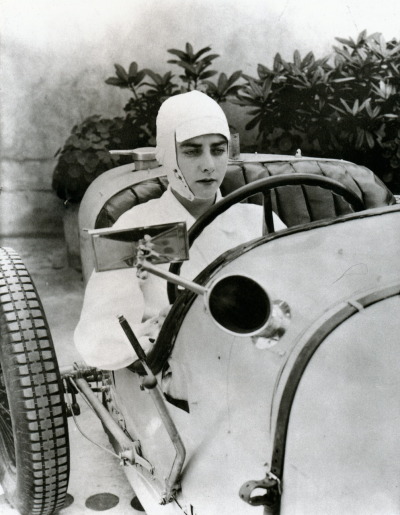
Who's That Girl?

There may not be much about Dame Annie in the press at the moment, but I did wonder about this 12" single cover.

It looks like a posed photo to me, for a start where are her goggles? Don't recognize the pilot or the voiturette. Maybe from an old film or a magazine, like this Vogue shoot from 1927 featuring actress Colette Salomon, who I believe may actually have competed in a race or two.

Saturday, May 28, 2011

Lingogidda?

See, see the wide horizons glorious blaze!
The setting sun descending low,
Beyond the fervid mountain's brow.
And high Carnedda's top reflects the lingering rays:
But now yon russet heath attracts our eyes,
Where sable Lingogidda's vapours rise.

Here oft 'tis said
The wand'ring spirits of the dead,
By magic's awful art confin'd,
Th' affrghted hind and rustic dame
See glowing in the lambent flame,
Hear howling in the wind.

These are the closing lines of the poem Petraeia by the artist Thomas Jones of Pencerrig and published in a book of 1791 "Picturesque Guide to the Beauties of South Wales."

Now the reference to the Carneddau hills is clear enough and on a late summer evening the sun certainly does reflect from its brow as the painter says, but can anyone tell me about Lingogidda? I guess the poem refers to corpse candles, the spontaneous combustion of methane and phosphane you get over bogland and, no doubt, bogland around Pencerrig. Lingogidda? Llyn Gogidda? There's a verb gogyddio - which refers to making millstones but who knows?


Friday, May 27, 2011

Comment is Free ..ish

It's always interesting when readers comment on posts that have disappeared off the front page months or even years before. Since they are moderated, unlike more immediate posts, I get to read them, but who else? I think this recent anonymous comment is the longest one the blog has ever received and it makes some good points. So rather than let it languish in the depths I'm reposting it here:

"I think what the Elystan Glodrydd event at Llanbister last year showed was that there is not enough knowledge of the area's history, and many people outside Wales had not realised how intimately connected they were to Radnorshire, not that this area had been a rich centre of welsh culture or that there had been any local welsh rulers and princes, but assumed it was just pure marcher territory.

This is one of the many reasons why Dai Hawkins' translation of Ffrancis Payne's work is of such importance - he has unlocked a treasure-trove of knowledge and rich welsh culture that was only otherwise available to those who could read Payne's work in Welsh.

The princes and kingdoms of Gwynedd, Powys and Deheubarth are all often quoted by historians, culture experts and tourism promoters, but Rhwng Gwy a Hafren, Mealienydd and Elfael are names almost completely unknown to the vast majority of people in Britain. Go into any major bookshop in Britain and look at the history section allotted to Wales - less than a dozen books are squeezed in, almost as an after-sight. Ireland and Scotland have overflowing shelves. This in part must speak to a lack of connectivity to Welsh roots. If you are a McTavish (etc), you know not only what clan you belong to but exactly where in the world your people came from - not just 'Scotland' but the precise locale. So, consciousness of Scottishness and kinship is easy to gain, and there is interest all over the world. Some may say "oh but its all such bunkum" etc. Some of it may be, but the numbers of people who came from across the planet to share in the celebration of the year of homecoming in Scotland is testament to the power of a sense of a belonging and identity, and the historical threads that bring people together. Each year in Scotland, clan gatherings occur, bringing people from the world to the place, powerfully harnessing history and family together in celebration, to enjoy the ties of kinship.

The day at Llanbister last October had a special quality about it, which only those who were there could fully appreciate. It was not designed to be mournful like the event at Cilmeri, nor nationalistic, but rather a simple celebration of a forgotten history and the bringing together of long-separated branches of a family to mark a thousand year anniversary. It was a chance for people to come from all over Britain, and places as far away as California to visit and learn about a place from where they sprung and have a great time doing so.

Most importantly it was a fun and thoroughly enjoyable warm-hearted, family gathering that connected people to a very old song that hadn't been sung for hundreds of years. When was the last time that the elegy to Cadwallon ap Madog, prince of Maelienydd, written by Cynddelw Brydydd Mawr had been read out in Welsh to such a gathering in Radnorshire? When else have any of the ‘5 Royal Tribes of Wales’ gathered happily together, without coming to blows! It was a quite historical gathering of related families, with a shared history.

We all had an enjoyable time and the day was full of smiles, pleasure, and joy at discovering how good it was to have a shared Welsh origin and a strong connection with a history that has been almost completely forgotten. It was positive, embracing and welcoming, leaving cheerful and pleasurable memories for people to hold forever. It enabled the misty history of the past to catch up with the present in a happy way.

In so doing, it played a part in bringing Radnorshire to the fore and the story of the place’s history to people from afar who had no idea how beautiful the place is, nor how fascinating its history and hospitable its local community.

I’m sure Rebecca didn’t mind that for just one day, the name of Elystan rang out joyfully in the hills around Llanbister, echoing along with the names of people like Cadwallon ap Madog, Einion Clud and Phylip Dorddu, and a wonderfully enjoyable and special day was shared by many."