Saturday, January 17, 2015

Jessica's Radnorshire Roots


Not having access to a television - well at least one where I have any control of the remote - I'd never heard of the actress Jessica Raine, she was the star of the BBC series Call the Midwife.  I came across her name while checking out some Kington history, Raine is an ex-pupil of the town's Lady Hawkins school.

Like another ex-pupil, the singer Ellie Goulding, there seems to be some ambiguity about Jessica's nationality, she being described in various mainstream articles as a Welsh actress.  The cause of this mix-up in Goulding's case was the inability of Warburton's Wales's national newspaper to distinguish between Kington and Knighton.  In the case of Raine it seems to stem from an early interview where she said she was from near Hay-on-Wye, no doubt correctly surmising that this was the only place anywhere near her home in Eardisley, Herefordshire a London journalist might conceivably have heard of.

Ms Raine herself has had something to say about borderland ambiguities, remarking on the "Welsh twang" of her local accent and that she "grew up in Herefordshire on the borders with Wales, so it was neither one nor the other."  All quite interesting but more was to follow when I discovered that her real surname was Lloyd and that she was connected to the Lloyds of Baynham Hall, Michaelchurch-on-Arrow, a branch of the well-known family of Radnorshire bonesetters.

In the days when agriculture was less mechanized than it is today a bad back could easily bring ruin to a family.  Radnorshire farmers had little faith in the medical profession to be of any assistance, whereas bonesetters were trusted and sought after.  An interesting article here.  Many of these local bonesetters were descendants of Hugh Lloyd 1770-1856, as indeed is Ms Raine.  In 1969 Jessica's father unveiled a memorial tablet in Michaelchurch parish church to commemorate the original Hugh Lloyd.  The memorial repeats the verse on the bonesetter's original tombstone.

A talent rare by him possessed
T'adjust the bones of the distressed
Whenever called he ne'er refused
But cheerfully his talent used
But now he lies beneath this tomb
Till Jesus comes t'adjust his own.

A few year's ago I may have done something to cast doubt on the family's connection with that figure of local folklore Silver John, see here.  It was not my intention as there is usually some element truth in these old legends.

Monday, January 12, 2015

Welsh DNA

Dafydd Iwan "descended from Welsh kings who ruled England" said the headline in the Daily Post, which seems all to typical of the high falutin' claims that usually ensue when DNA meets MSM.

This was all publicity of course for an upcoming project, backed by S4C, the Post and the Western Mail:


Other celebrities will be tested including Kath and Bryn and also members of the general public who will have paid up to £200 for the privilege - I'm guessing the celebs will get a freebie.  So what we have here will be a self-selecting sample and a good deal of what the project may well tell us we already know.  South Wales is full of folk with ancestors from Ireland, the West of England and further afield for example.

Mind you even more rigorous sampling gets things wrong, remember the Blood of the Vikings series which picked out Llanidloes as a likely place to find Welsh DNA.  Of course the town is slap bang in the middle of the 16C Arwystli plantation, typified by surnames such as Wigley, Ashton, Chapman, Jarman, Peate etc.  You could end up with Y-chromosome results more typical of Derbyshire and Lancashire than Montgomeryshire.

Of course a large sample of Welsh DNA is to be welcomed and hopefully that is what the project will achieve. It could find out more about the supposed Balkan hotspot around Abergele or the hinted "Pictish" DNA in Central Wales or who knows what else.

A large pinch of salt however, conclusions in this branch of science are open to frequent revision.  Time was  there was no Neanderthal blood in modern humans, then there was, then there wasn't, now there is.  Same goes for the out-of-Africa theory.

Meanwhile things could get a bit bothersome for S4C as a result of the controversy between the scientists behind the project and those at UCL.  It's already been the subject of an editorial in the magazine Nature and UCL have dedicated a section of their website to the matter.  Scroll down on this page to 24 September 2014 for a taster.

Anyone interested in joining the project can do so here.  Hopefully they'll get involved in the hope of uncovering something about the prehistory and unrecorded history of Wales and the Welsh people rather than just to bore the pants off us all with daft claims of being descended from Svein the Viking.  

Saturday, January 03, 2015

The Old Block

Feeling a bit of sympathy for Andy Mountbatten - hasn't the guy done his level best to win Central Asia for the West?  And how is he repaid?  By having his face splashed all over the front page.  What is the point of the cleptocracy owning the media if they can't keep an officer and a gentleman out of the papers.

Anyway this blog needs to get in touch with its yé-yé girl roots, so for Andy and especially his dad here's the best-connected woman in the history of pop to sing a little ditty:


Saturday, December 27, 2014

Radnorshire's lost plygain tradition

If you were to sum up Wales with one of those fashionable hundred-object lists then surely a recording of this plygain carol would have to be included.


There was a time when the plygain tradition held sway in Radnorshire. Ffransis Payne recounted the evidence of a Glascwm farmer, born circa 1820, who recalled the Christmas morning plygain service held in the parish church. The church bells were rung from 3am until the service commenced at 05.30, then traditional carols and hymns would be sung in the highly illuminated building - a lesser known element of the tradition -  and all this in the Welsh language.

Rhayader's plygain was abandoned, seemingly because of drunkenness, while in Llanbister the service was called pelygen.  After the tradition retreated from the state church it lived on in the chapels and even farmhouses.  In St Harmon the local chapel was still holding plygain services in the 1870s and the Primitive Methodists of Presteigne persisted until the 1890s, although this last example would have certainly been conducted in English.

Wednesday, December 17, 2014

The Black Belt, Hillbillies and Reds

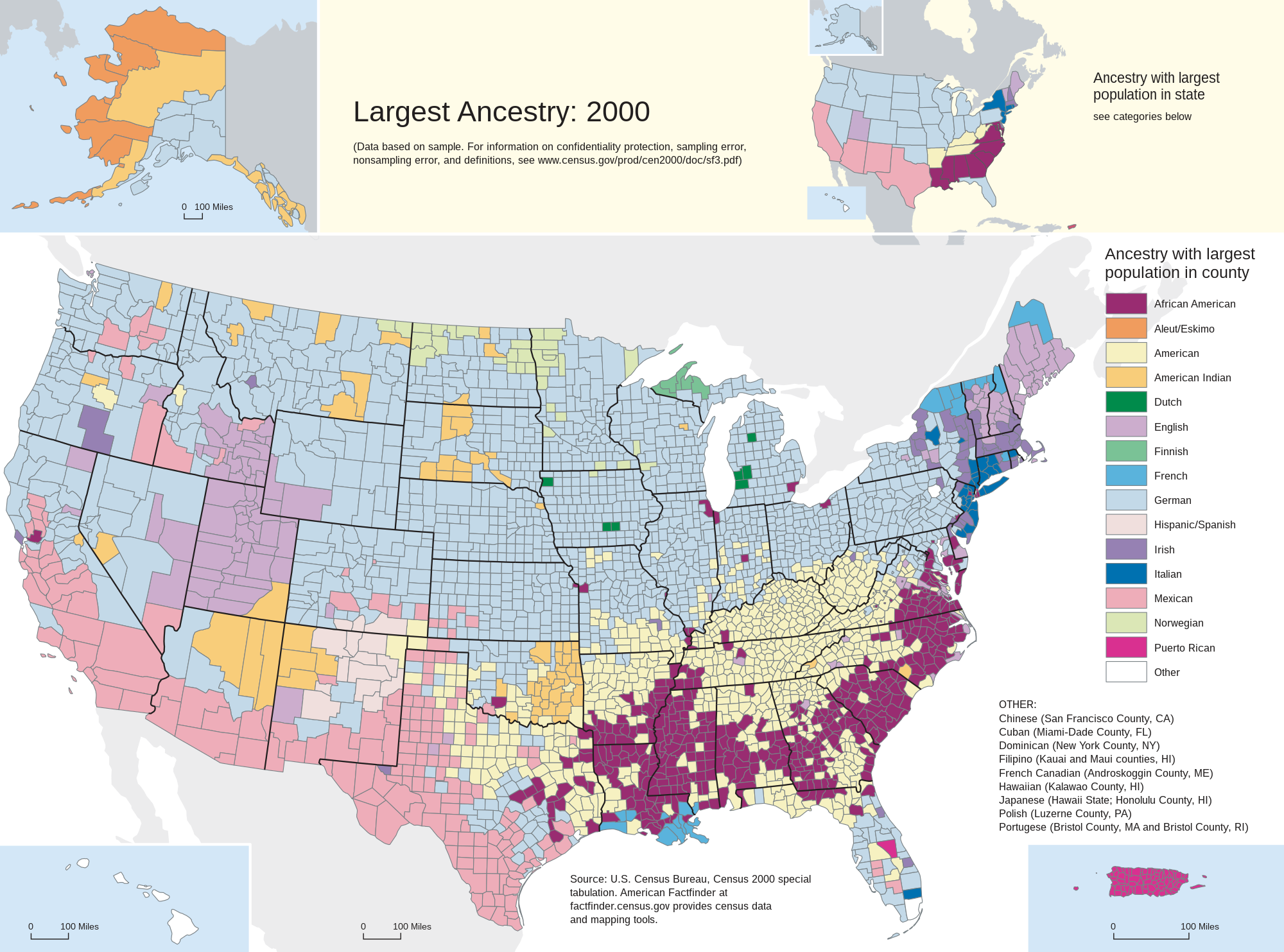
My previous post on the national question in the USA, see here, was written before I saw this fascinating map detailing individuals' perceived ethnic origins as recorded by the 2000 US census. The map shows the largest group in each county.  It illustrates some of the issues discussed before - the French element in New England and Louisiana and the Hispanic element in the South West, these being cultures which did not migrate to the United States but were already in situ when the US expanded to take over their lands.  We can also see the scattered remnants of the original inhabitants of the continent and how, for example, Hawaiians have been overwhelmed while indigenous Alaskans still have some degree of territorial integrity.

Turning to the mainstream - those who willingly migrated or were forcibly removed to America - it's interesting to note that the most widespread ethnicity mapped are not the English but the Germans.  In fact it's possible to travel from the Atlantic to the Pacific without leaving a German predominant county.

Two other groups stand-out, the African Americans of the deep South (there are around 100 counties with an absolute black majority) and the group, mainly in the South, especially Appalachia, who do not list any ethnicity other than being American.

In 1928, at the behest of activists like Harry Haywood, the Comintern accepted that the African Americans of the Black Belt constituted a nation as defined by Stalin "a historically constituted, stable community of people, formed on the basis of a common language, territory, economic life, and psychological make-up manifested in a common culture."  This led to the CPUSA defining the inhabitants of the Black Belt as an oppressed nation with the right to national self-determination, up to and including secession from the United States.  This line was largely abandoned in 1935 but is still held by small leftist and black nationalist groups.  Communist activity in pre-Second World War America has largely been forgotten - there were 2000 CPUSA members in Alabama alone - so it is easy to underestimate the strength of this idea at a time when sharecropping was still a major economic factor affecting millions.

There are those who would argue that the poor whites of southern Appalachia also have the characteristics of a distinct nation. The problems associated with internal colonialism and post-industrialisation echo those of South Wales.  I'd argue that the mockery directed at rednecks and hillbillies also has echoes in Wales, these being communities elites feel able to denigrate without any of the comeback associated with political correctness.

The small independence movements in Texas and Alaska don't seem to have much interest in their Spanish speaking or native American minorities, instead they are usually dismissed as being right-wingers unhappy with Washington rule.  As Washington rule is so closely allied with clepto-capitalism that's not necessarily a bad thing and perhaps we need to be reading Ralph Nader's book Unstoppable: The Emerging Left-Right Alliance to Dismantle the Corporate State.

Oh and here are some Americans dancing in the days before the corporations started filling their food with high fructose corn syrup.


Saturday, December 13, 2014

Around Radnorshire - Llanfair Llwyth Yfnwg

While looking at Estyn reports on Radnorshire schools I was taken by this comment in the inspection for Gladestry primary "all learners speak English, although some use the local dialect." How often has mention of the local dialect turned up in an official government publication? What next, official status?

Readers may be disappointed that there's not a lot about the "Radnorshire" dialect on this blog.  The dialect is characteristic of the north and the east of the county rather than the south and west and I do get annoyed at folk, not natural speakers, who put-on "thees, thous, bists and wunnas" as a form of mockery. At the same time a broad Radnorshire accent is a wonderful thing and listening to elderly dialect speakers negotiating a supermarket makes a welcome change from the more usual London and Midlands voices.  

The names of the Gladestry school's catchment area would surely have given Housman a run for his money in the quietest-places-under-the sun stakes: Gladestry, Colva, Michaelchurch-on-Arrow, Burlingjobb, and across the border, Huntington and Brilley.  The quarry at Dolyhir not so much.  I was surprised by the presence of Herefordshire pupils in a Welsh school but seemingly this is quite common, with over 2000 children from England attending state schools in Wales and even more making the journey east.

Census figures which show the Welsh language making ground in East Radnorshire -  the 2011 figures are more realistic than those of 2001 -  have always seemed a bit suspicious. I've put it down to monoglot parents over-estimating the linguistic abilities of their offspring.  Yet perhaps this viewpoint is too pessimistic given the report's description of language use in the school: "Their use of English and Welsh in both oral and written work is extremely advanced and nearly all transfer between the languages confidently and easily."

I'm sure there may be one or two locals who see the revival of the old Welsh placenames of the area as the perverse invention of some rabid nationalist in the county's Highways Department.  Infact the earliest reference to Llanfair Llwyth Yfnwg (Gladestry) dates back to 1291.  Lewis Glyn Cothi came here in the 15C to praise its inns - serving the ales of Llwydlo (Ludlow) and Gweble (Weobley) - and to receive the gift of a mantle from Elis Hol, comparing it in some striking dyfalu to the Golden Fleece and the mantle of Tegau Eurfron.  And of course we are just a mile or so from Hergest, a place of real importance to everything that makes Wales an idea worth defending.

Brulhai (Brilley) was the home of Phelpod ap Rhys, a cyfarwyddyd (storyteller) with a whole world of stories within his head, a master of the seven arts who knew all the chronicles of the island.  Glyn Cothi calls this district Bro Gintun (the vale of Kington) and so did the muleteers of the pre-railroad age bringing coal from South Wales: yn mynd a llawer llwyth o lo, ar hyd y fro i Gyntyn.

The area was still Welsh-speaking in the 18C when a local was taken to court for slander "Di gyrn di dorrws y twlle sydd in di hatt di" - "your horns tore the holes in your hat."  Note the southern verb ending  - ws.  But by the start of the 19C language shift was probably complete, although the Radnorshire antiquarian Mr Cole reported that his grandparents - who farmed Redborough between Llannewydd (Newchurch) and Llanfihangel Dyffryn Arwy (Michaelchurch on Arrow) - still knew Welsh in the middle of that century.  Only Burlingjobb lacks a Welsh name, although 16C spellings such as Byrchop and Berchoppe suggest that, at that time, the name had been cymricised to something like Bersiob.

With the Welsh language spoken in the village school's two classrooms and on public display, at least on the Radnorshire side, we can say that these are small victories in a war whose major battles are being fought, and probably lost, far to the west.

Friday, November 14, 2014

Herefordshire's Welsh Field Names

After bragging-up access to historical records in Wales as compared to England, I have to admit that this is not the case with 19C field names, where we certainly lag behind some of the border counties - see Herefordshire, Cheshire and Shropshire.

The Herefordshire and Cheshire databases are searchable, so to get a quick idea of the distribution of Welsh survivals what better element to look-up than the word cae - field.  I was surprised that this element is found fairly widely in two Cheshire parishes - Malpas and Shocklach.  The Shropshire maps aren't searchable, so I'll leave them alone and instead  look forward to the publication of the planned volume on Welsh placenames in that county.

The map shows those Herefordshire parishes which in 1841 had at least six fields containing the cae element. Most have far more - 83 such fields in Michaelchurch Escley, 61 in Clifford, 47 in Rowlestone, 45 in Craswell and so on, nearly 600 in total.  As you can see there is a pretty close correlation with the parishes where Welsh patronyms were common in the 16C - see post below.  I don't believe there is any great antiquity to most of these field names, instead they reflected a fairly recent acquaintance with the Welsh language.

Despite the widespread occurrence of Welsh surnames there's little evidence for any surviving Welsh national feeling in this Cambria irredenta. I did identify a greater tendency in the 2011 census to opt for a British identity rather than an English only identity in a selection of these parishes - see below.  Perhaps that that reflects some ethnic ambiguity?

On the whole though, while I dislike the use of the term anglicised for any population within Wales, its use here is appropriate -  just like the Germanised Slavs who make up a fair proportion of the  population of eastern Germany.

Let England keep these parishes, although you would think that the locals might take some interest in their own history.


Herefordshire average:  English-only 64% Welsh-only 4% British-only 16%
Clifford:  English-only 52% Welsh-only 8% British-only 28%
Cusop:  English-only 51% Welsh-only 15% British-only 19%
Dorstone:  English-only 54% Welsh-only 7% British-only 26%
Newton:  English-only 55% Welsh-only 9% British-only 27%
Abbeydore:  English-only 55% Welsh-only 5% British-only 23%
Longtown:  English-only 53% Welsh-only 11% British-only 21%
Llangarron:  English-only 56% Welsh-only 8% British-only 24%
Welsh Newton:  English-only 47% Welsh-only 8% British-only 30%
Ganarew:  English-only 50% Welsh-only 12% British-only 26%
Rowlestone:  English-only 50% Welsh-only 8% British-only 26% 

Monday, November 10, 2014

Four Welshwomen in Spain

I don't think that anyone can really argue that Welsh historians are not guilty of writing women out of our country's history, and that's certainly the case with these four youthful participants in the Spanish Civil War.  Margaret Powell and Thora Silverthorne do make an appearance in Rob Stradling's Wales and the Spanish Civil War, but only as a footnote to explain the lack of "gender inclusiveness" in his prose.  Meanwhile Fifi Roberts, whose story is perhaps the best remembered, makes the text but not the index.  Esyllt Scott-Ellis is not mentioned at all, prossibly because the author was unaware of her Welsh links.

Margaret Powell 1913-1990 was born on a farm in Llangenny near Crickhowell.  Some reports say that her father died when she was a child and that her brothers ended up being sent to Canada as part of Barnardo's unlamented scheme to populate the Empire.  Her daughter doesn't mention this in her brief summary of Margaret's life so perhaps it isn't the case.  What is clear is that Margaret trained as a nurse and midwife in London, was anxious to go out to Spain where she worked on the frontline during the Aragon offensive - assisting in a thousand operations and eventually ending up as a document-less refugee in the French camps.  In 1950 Margaret married the Communist journalist Sam Lesser, they lived in Moscow between 1955 and 1959 where her husband was the Daily Worker correspondent.

Another Welsh Communist nurse was Thora Silverthorne 1910-1999 from Abertillery. Better remembered than Margaret Powell there's a good summary of her life here. Thora worked hard to unionise the nursing profession, setting up her Association of Nurses in opposition to the Royal College, it later merged with NUPE.  When Thora died there were obituaries in the Guardian and the Independent.

It was interesting to learn that while Thora couldn't speak Welsh her elder sister did.  This seems to have been commonplace in industrial South Wales with figures like Nye Bevan and Gwyn Thomas speaking no Welsh while their older siblings did.  I remember being amazed in the 1970s to discover that my mother's elder sister could still understand Welsh even though she had lived in Hertfordshire since the 1930s.  Why did families suddenly stop passing on the language to younger siblings around the time of the First World War?

Nowadays we are supposed to equate Communists like Margaret and Thora with the Fascists and Nazis.  Shrill East European governments with murky histories and bought-and-paid-for journalists and authors demand that we accept that the Stalinists were even worse than Hitler.  I'm increasingly suspicious of such claims, even of those crimes admitted by Khrushchev and Gorbachev.  Indeed I fear for a future which sees the likes of Margaret Powell and Thora Silverthorne as villains, rather than the heroes they certainly were.

As mentioned above, the story of Fifi Roberts, the twenty year old daughter of a Penarth sea-captain,  is fairly well-known.  Fifi accompanied her father's vessel, the Seven Sea Spray, when it broke the blockade of Bilbao in April 1937.  This made Miss Roberts something of a celebrity, both in the Basque country and in newspapers around the world.  What is less well known is that Florence also sent reports on her visit to the News Chronicle, including some from Guernica soon after the town had been bombed - you can see her photographs and hear her recollections of the visit here.

Esyllt Scott-Ellis 1916-1983, better known as Priscilla or Pip, was a daughter of the 8th Lord Howard de Walden of Chirk Castle, remembered now as a leading patron of Welsh drama and literature.  Inspired by events in Spain and with some very basic nursing training this twenty-year-old aristocrat went out to Spain and was soon witnessing the battle for Teruel and the subsequent Aragon Offensive.  During the Second World War she was evacuated - as part of a British medical team - from Dunkirk. She later married the actor and author Jose Luis de Vilallonga and lived for many years in Argentina.  Before Plaid supporters get too excited about this largely forgotten member of a family with links to pre-war Welsh nationalism, they'll need to recall that Pip was a volunteer for Franco.  Heaven knows what Tim Williams would make of that!

Friday, November 07, 2014

Cynefin

Anyone with an interest in local history is well-served in Wales as old newspapers, wills, bardic genealogies etc are available on-line and free of charge.  Only photocopied parish registers and civil registration records have been handed over to the fee-devouring private sector.  The latest treat we are promised are on-line tithe maps together with the schedules detailing field names etc.  The map for Llanelwedd has already been uploaded, see here, accompanied by a short article, here. 

The tithe maps and schedules date back to the 1840s, a time when language shift in most of Radnorshire was either in progress or had only recently been completed.  The extent and nature of Welsh language field names should provide clues to the situation in the county's varied parishes, as well as information on dialect, social history and nature.

Friday, October 31, 2014

November 1st. International Day of Solidarity with Kobane

In the documentary Carnets d'un combattant kurde a young Kurdish fighter mused on the beauty of the mountains, for her the most beautiful places are those where there is hope.  Rojava is surely such a place, This was International Women's Day in the capital Qamishlo:


Monday, October 20, 2014

One Language under God?

The USA is certainly an exceptional country, indeed it is so exceptional that the National Question is seemingly of no importance whatsoever.  Lesser countries may have to confront their national problems: Spain, Turkey, the United Kingdom, but the USA?

Only one of the 50 states has an official minority language - Hawaii - but with less than 1% of the population speaking the indigenous tongue that official status would seem to be largely symbolic.  A fifth of the US population speak a hearth language* other than English, but then why should recent immigrants expect any official recognition for the language of a country they have left behind?  According to the US Census Bureau's Community Survey more than 2200 claim Welsh as their hearth language, a figure that sounds as credible as the 22000 Irish and the 1400 Scottish Gaels. It is ridiculous to suggest that these languages or even those more widely spoken like Russian, Chinese or Italian should have official status.

Of course the speakers of Native American languages are not recent immigrants, but there's no official status for any of them either - a total of 374000 being estimated as speaking an indigenous language at home, nearly half of them speakers of Navajo - in Arizona and especially New Mexico where they make up 4% of population.  It's sad to relate that many well-known tribes have less hearth speakers than the figure claimed for the Americanwyr Cymraeg - Blackfoot, Paiute, Mohawk, Seneca, Kiowa, Comanche, Cree, Shawnee, Pawnee etc.

Now there's a final category who are often overlooked - these being folk who speak a European language but whose ancestors never migrated to the United States, rather the United States came, uninvited, to them.

There are a number of French speakers in New England, especially Maine (5%).  Were these people recent migrants to the US from French Canada?  The border between Maine and Canada was not finally agreed until 1842 and it seems safe to assume that some at least of the 18% of the population of Aroostock County who speak French will be descended from folk who never migrated to the USA.  More well-known than the New England French are those of Louisiana, with 3.5% of the state's population speaking the language at home - mainly in a concentrated area, with some parishes having up to 30% of hearth speakers.  Again this national group, including the Acadians expelled from Canada by the British, never migrated to the USA. In recent years, in contrast to the oppressive policies of the earlier 20C, there have been moves to encourage the use of French in Louisiana schools, aided by teachers from Francophone countries.

We hear a lot about the border fence and the problems associated with latino migration to the American South West.  What is often forgotten is that these states were originally part of the Spanish Empire - New Mexico and Arizona joining the Union as recently as 1912.  Texas became a state in 1845 and California in 1850, both as the result of war with Mexico.  I've no idea what continuity there is between the original Spanish speaking population of these areas and the present day, no doubt the majority are more recent migrants; but given the continuous history and the substantial numbers involved  - California 28%, Arizona 21%, New Mexico 28%, Texas 29% - there seems little reason why Spanish shouldn't regain its former status as an official language.


* Hearth language is a useful term from the 19C, meaning the language used by a family in their own home.

Thursday, October 16, 2014

Rojava

The Empire rather lost control of the narrative last week.  The western media had a grandstand view of the fighting in Kobane and, for once, perhaps inspired by the woman fighters of the YPJ, they actually reported what they saw rather than what they were told.

This forced Washington's hand and, despite the objections of its Turkish ally, the United States engaged in some PR bombing of the ISIS forces massed in and around the town.  At first this was half-hearted but for the last few days it has been carried out successfully because of co-ordination with the forces on the ground defending the Kobane.


It's said that the western media's attention span doesn't extend much beyond ten days and already the Kobane grandstand is emptying.  So what happens next?  The United States has so far failed to arm the Syrian Kurds, indeed they still regard them as a terrorist group.  With the media gone will they accede to Turkey's demand that a buffer zone be set up in northern Syria - a zone which coincidentally would see the suppression of the secular and democratic cantons of Rojava.  Cantons based on the confederalist theories of the imprisoned PKK leader Öcalan -  an experiment in decency and common-sense that the Islamist Turkish government is determined to snuff out. 

While the Iraqi army and even the Peshmerga fled when confronted by the Islamic State's 7C terrorist playbook, it was the armed forces of Rojava - the YPG and the YPJ - who were largely responsible for rescuing the Yazidi Kurds from Singal mountain. Alone among the forces confronting ISIS these Rojavans - they also include some local Arabs and Assyrians - have a record for fighting rather than capitulating and are the least likely group to indulge in murderous sectarianism.

Meanwhile the US and EU are allied with the sponsors of Islamic terrorism - the Turks, the Saudis and the Gulf Arabs.  You can tell an empire by the company it keeps, whether it is East European neo-Nazis, Central American death squads or the godfathers of the headchoppers. The life loving girl fighters of the YPJ must be like garlic to sour old vampires like McCain and Hillary.

Musical Interlude

Paul Gubarev is currently hospitalized following an assassination attempt, a few weeks ago he and his family were enjoying this cheerful ditty celebrating the Russian lands from Alaska to Odessa.


Wednesday, October 01, 2014

We're All Fascists Now

The IWA site Click on Wales currently hosts articles on fascism from three of the country's more interesting pensmen Tim Williams, David Melding and Robert Stradling - oh and some of the comments are quite thought-provoking as well.

Now these articles do not discuss the current resurgence of murderous far-right nationalism in Eastern Europe - nurtured and sponsored in the main by the United States and the governments of the EU - nothing so controversial.  No, these articles are concerned with the Wales of 70 and 80 years ago and, you've guessed it, our old pal Saunders Lewis.

Tim Williams has a special talent for getting up people's noses even when he is right.  Surely he is correct when he says that Wales is "wending its inexorable way towards a monoglot English-speaking status." It's not the statement so much as the relish which we imagine he feels at the prospect.  I doubt that even a 1930s Catholic would disagree with his statement that Catholicism was "not on the side of human freedom and progress."  In pre-liberation theology times wasn't that rather the point?  But in any case this plain speaking is hardly likely to endear him to two of the country's larger population segments.

David Melding ably demolishes Williams' attempt to equate fascism with right-wing Catholicism.  Fascism for example worshipped the modern in a way which was anathema to the likes of  a "crank" such as Saunders Lewis.  In a way is Tim Williams something of a crank himself?  While Saunders Lewis wanted to turn the clock back to a rural, Catholic, monoglot elitist past, Williams' sympathies lie with the despised people he sees as having created modern Wales "and the political tool of the majority - industrial Wales and the Labour party."  A valley Wales which to all intents and purposes is as dead as perchentyaeth* and the itinerant bard tramping the countryside between the halls of his patrons.

Robert Stradling contrasts the Wales of the 1930s, proletarian and socialist, with an Ireland largely sympathetic to the right-wing Catholic dictatorships, and possessing the largest fascist party in Europe not in power.  Thinking perhaps of Lewis and his allies Stradling quotes Gwyn Alf Williams "it was as well for Wales that there was an English channel in 1940."  This is a common viewpoint that seems to think that a Nazi victory would have led to a Welsh puppet regime. I doubt this would have been the case - many in the English elite would have been eager to co-operate with a victorious Germany and the anglophile Hitler would have been happy enough to indulge them.  More likely Wales would have been the scene of some violent resistance in the Valleys, bloodily suppressed by London's quislings.  Where would Saunders Lewis have stood?  Well we have his own words, as reported in the Western Mail, to help us decide:  "It is possible, he added, that there would be bloodshed in South Wales if there was a Fascist Government. In such a case the Nationalist Party must take sides with the popular masses of Wales against Fascist dictatorship."

Is there a purpose, beyond entertaining history buffs such as myself, in this continuing discussion of the minutiae of Welsh history.  It's doubtful, although I would love to read a work about real Welsh fascists, rather than the imaginary ones puffed-up for shabby political advantage.   I've blogged about some here and here.  This is quite interesting as an illustration of current academic standards east of the Dyke.

Far better to discuss the present-day, the way in which Communism and Nazism are now treated as two sides of the same coin for example.  What in the 1980s were considered to be the viewpoints of over-the-top cold-war ideologues and emigres with unsavory backstories are now the mainstream. It won't be long before Hitler and Nazism are declared the lesser evil, all of which suits those elites who see the now disorganised working class as a latent threat to their hegemony.

Today the Ukraine is like some 1940s re-enactment park, except the refugees, the shelled working-class districts and the tortured bodies are real enough.  All this hushed-up by a neo-conservative mass media and given the green-light by the likes of Merkel.  Meanwhile the European and Anglo-American elites plan their Transatlantic Trade and Investment Partnership, a perfect recipe for the corporate state.

The question we should be discussing isn't whether Saunders Lewis was fascist but are we?

*  To those unfamiliar with this term I don't believe it to mean home ownership which seems to be the wikipedia version of the word.  Rather it is the obligation towards wider society placed upon those privileged to enjoy wealth.

Monday, September 22, 2014

That Scottish Vote

I'd been hoping to read some of my favourite Welsh bloggers' analysis of the Scottish vote - not much so far, perhaps they're disappointed?  If so they're surely wrong, as that 45% was a deathblow to the glorious Union.  Here's what I think:

1. If the Scottish pattern for English-born voters was reflected in Wales, the Welsh-born would have to vote 57-43% Yes in order to scrape a victory.  We shouldn't allow political correctness to block-out this reality.

2. The 65-and-overs voted No by a 3 to 1 margin and won the referendum for the Union.  They are the luckiest generation in history - of course they were going to stick with a status quo that has served them well.

3. Ah but what about all those folk who lost their jobs in heavy industry? Well they probably didn't live long enough to vote last Thursday - life expectancy for Glasgow men, for example, being 68 years compared with 76 years in solidly pro-Union East Renfrewshire.

4. One thing is certain, everyday some elderly No-voter kicks the bucket and a young Yes-voter becomes eligible to join the register.

5.  You can't just blame the OAPs, the Yes side were weak on their exit strategy.  Plan B?  Just print your own fiat currency like everyone else and let it find its own exchange rate - it's not as if Brown and Darling have much of a record on financial matters.

6.  The EU?  If they don't want you then just go it alone,  oil-rich Norway isn't doing too badly is it?  In any case a truly independent Scotland would have a far stronger voice in the UNECE, the body that really draws up the economic rulebook.

7.  Don't assume the British government would have honoured a Yes vote.  There would have been hardball negotiations followed by an insistence on a second referendum - Operation Fear on steroids.

8.  Jack Straw thinks it perfectly reasonable to pass a law that makes any vote for the break-up of the UK illegal without the go-ahead of the English MPs.  The only fly in the ointment for this cunning plan is the American Irish lobby who will insist it doesn't apply to the Six Counties.

9.  In the Ukraine the British government and media show their true colours when it comes to democracy, ethnic cleansing and the killing of ordinary folk.  Don't think it couldn't happen here - the times they are a-changin' and Scotland has it's very own Right Sector, ripe for exploitation by the London government, in the form of the Britannia singing unionist thugs attacking the Yes supporters in Glasgow's George Square.

10.  One benefit of the No vote - we're not stuck in a room with just England and the Ulster Orangemen for company.


Friday, September 19, 2014

Musical Interlude


They spilt your blood yesterday
They put your head on an oaken post
A little way from your corpse.

Saturday, September 13, 2014

Radnorshire, some Scottish connections

Britishness died with the British Empire and the vote in Scotland is more about sorting out the estate of a recently departed and somewhat unloved relative.  While we await the long-delayed funeral arrangements of this increasingly putrid corpse, let's spare a thought for some of Radnorshire's Scottish connections.

When the racing driver Innes Ireland moved to Downton House near New Radnor in 1960 he claimed that it was the nearest place to London that reminded him of the Scottish Highlands and perhaps that has been the motivation for other Scots who made Radnorshire their home.  Despite his Caledonian baronetage there was precious little Scottish about a previous occupant of Downton, Sir William Cockburn of that Ilk.  Cockburn helpfully informed the authors of the Blue Books that "New Radnor was planted as a Saxon colony by Harold, after his victory here over the Britons, two years before his death at Hastings. This people have never since had any sympathies with the Welsh in language, nor many in habits." Hogwash of course but given the prejudices of the time perhaps he thought he was doing his neighbours a favour.  The current occupant of Downton, Sir Andrew Duff Gordon, might well be the last of the Lewises of Harpton, a family that once patronised the bards but which long ago declined into Britishness.

The most famous Scot to find a home in Radnorshire was, of course, James Watt - so famous that he graces the £50 note.  In 1801 he purchased Doldowlod, then a local farmhouse, to enjoy as his summer retreat. We cannot blame the elder Watt for the enmity his family subsequently engendered by their attempts to extract rent from the occupants of the tai un nos on their recently purchased crown manors.  It all led to a court case that had to be retried in Hereford, the local jury having "perversely" found in favour of the squatters.  A minor land war ensued with bailiffs battling the populace and the destruction of the Watt's property by Rebeccaite gangs.

Who knew that Walter Scott's novel The Betrothed had a Radnorshire setting.  It was based on the story of Moll Walbee and the disastrous Welsh attempt to lay siege to Painscastle in 1198.  Don't all rush out to get a copy though, it's been described as a work that "would score high marks in a competition to decide which was the dreariest and stupidest book ever produced by a writer of genius."

A few years ago Hugh Trevor-Roper wrote a tome called the Invention of Scotland, one of those "look what I've discovered works" that excite the metropolitan elites.  Much of what passed for a Scottish identity, the author claimed - including the Osian poems - was made-up. Of course Roper discovered nothing that wasn't well-know to anyone with even a cursory interest in Scotland.  The poems having long ago been exposed, not least by Radnorshire's Edward Davies (1756-1831) - he was born at Hendre Einion in Llanfaredd parish. You can read his book, published in 1825, demolishing the Ossian forgery here.

Scottish bailiffs and gamekeepers could always find employment with local landowners suspicious of devolving responsibility to the untrustworthy locals.  Julian Fellowes of Downton Abbey fame - beloved by arch-snobs everywhere - is descended from one such bailiff called Mackintosh employed by Lord Ormathwaite.  The bailiff's daughter, Fellowes' grandmother, regailed the youngster with tales of life at Penybont Hall where she worked as a maid.  Perhaps Radnorshire should claim a share of the export earnings?

Scottish shepherds also found employment on the Radnorshire hills, one such family by the name of Scott arrived in Cwmteuddwr in the early 1800s from Roxburghshire.  Look at a list of the last Radnorshire natives clinging on to a knowledge of Welsh well into the 20C and the surname Scott is one of the most striking.


Tuesday, September 09, 2014

Welsh patronyms in Herefordshire c1540

To do a proper job on patronyms in 16C Herefordshire you'd have to use the Lay Subsidy but with second hand copies of Mr Faraday's transcription selling for over £60 I've used his Muster Rolls instead.  These are lists of men aged over 16 liable for military service - against a French invasion in 1539 (it never happened) and a war against the Scots in 1542 which did.

I have counted all names containing an ap and also triple or quadruple names which don't, but which are obvious patronyms eg Davyd John Gwylym Gryffyth.  I could have counted adjectival names such as John Vaure and patronymicals where the ap had disappeared but the apparent 'surname' probably changed in each generation, I chose not to do so.  The map therefore underestimates the amount of Welshness in 16C Herefordshire, where even occupational surnames may hide a Welshman.

Three new hundreds had been formed by the Act of Union from lordships transferred to the county from the March of Wales.  Ewias Lacy was very Welsh as was most of the new hundred of Huntington, Wigmore however was very English with only a handful of small Welsh districts around Presteigne. 

A puzzle is the rarity of patronyms in that part of the old cantref of Ergyng covered by Wormilow hundred.  There are many Welsh placenames in the area and Welsh surnames were common.  Perhaps language shift had already occurred or there was some other cultural factor at work.

The isolated parishes in the east of the county surely shows the impact of recent or even temporary settlers rather than any long term survival.  The same must be true of the road into Hereford from the west and lying north of the Wye.  In Hereford City itself the muster roll for 1539 had 11% Welsh patronyms rising to 14% in 1542. Clearly the city was a magnet for Welsh people in a way that other towns, Leominster for example, were not.

My base map shows modern parish boundaries and these were sometimes different from the townships used in the 16C.  For example there were parts of Eardisley and Vowchurch which were quite Welsh and others which were more English, my map doesn't show these minor variations.

It's easy to spot that the Teme and Lugg valleys were open to the influence of very English areas in North Herefordshire, the Wye valley less so. This would have had an impact on subsequent language shift in Radnorshire.

Monday, September 01, 2014

It's not possible to be a decent person and vote no?

I expect most readers will have already seen former British ambassador Craig Murray's description of the United Kingdom as a rogue state - if not then it's well worth a listen.  Now I don't usually have much time for the tribal nonsense that sees, for example, a Carwyn Jones, or heaven forbid a Tony Blair, as being somehow morally superior to their Tory opponents, so can a 'no voter' be a decent person?  Well I suppose you could argue that as the SNP hopes to remain a  member of both NATO and the increasingly aggressive EU, then plus ça change.

What a yes vote will do is pose an existentialist threat to one of the cornerstones of the rogue alliance currently headed-up by America's out-of-control neocons - both the New York Times and the Washington Post carried frankly insane, pro-war opinion pieces this last weekend.  At least the SNP want to kick the nuclear missiles out of Scotland, there are those in Washington and London who sound all-to-eager to use them.

If I was a Scot I would certainly vote Yes, despite the timorous attitude of their leaders towards real independence - a currency and a foreign policy of their own.  I wouldn't think a Yes vote would lead to independence though, the rogue state has a lot more tricks up its sleeve before it would allow that to happen.

Tuesday, August 26, 2014

The County Radnor

As well as being one of the more familiar Irish premiers to those of us this side of the water Garret Fitzgerald also took time out from his official duties to research  the decline of the Irish Language.  Somehow I can't see Carwyn or Cameron doing something similarly esoteric in their spare hours, but you never know.  Fitzgerald's method was to look at the census figures for the 60 plus age group in order to deduce the linguistic situation in a particular district half a century or more earlier.  You can find his work on the 1911 census here - although without the all important maps.

It says something about the relative strengths of Welsh and Irish at the beginning of the 20th century that if thoroughly "anglicised" Radnorshire had been treated as if it belonged in the list of Irish counties, then it would have been 12th in a list of 32 (11.5% of the oldest cohort speaking Welsh) just ahead of Tipperary (11.4% speaking Irish).  In the Rhayader District Council area - roughly the A470 north of Newbridge-on-Wye and the A44 west of Crossgates - the figure was 28.2%, the majority locally born.  Of course this meant little to the Welsh speaking intelligensia of the day; for them every Radnorshire lass in trouble was further evidence of the moral decay they associated with the English language.

Why Ireland should have suffered such a severe language shift - in Carlow, Dublin, Kildare, Laois, Longford, Offaly, West Meath, Wexford, Wicklow, Antrim, Belfast, Down and Fermanagh Irish speakers were even rarer than Welsh speakers in the Knighton-Presteigne-New Radnor area - has never been that successfully explained.  Clearly a good many had ditched Irish long before the famine. Plantations played a part, a similar 16C plantation in the Llanidloes-Trefeglwys-Llanbrynmair area is remembered now only in surnames like Wigley, Jarman and Peate.  It had no long-term effect on the local language situation, probably because both natives and newcomers were protestants and thus easily assimilated.

Language shift in Radnorshire is similar to that in Ireland, with the language retreating 20 miles in a generation. As for explanations, firstly this from the county's historian Jonathan Williams writing in the early 1800s and speaking of the border parish of Bugeildy:

"An increased intercourse with England, a more general interchange of the commodities and produce of these two countries respectively, and, above all, the introduction of that jurisprudence with which the inhabitants of Wales found it necessary to be familiarized, as well as the diction in which all legal pleadings, deeds, conveyances, processes, &c., are executed, soon undermined that predilection for their mother tongue which was before their distinguishing character, and rendered the study and acquisition of the English language necessary, not only as an accomplishment, but also as a matter of indispensable interest."

Secondly a 19C Irish explanation for language shift in Limerick:

"the growing public feeling that Irish was a dying language, a mark of a degraded people who were not 'decent' - all this combined to produce a new people who from youth were pledged to speak no Irish. And so in West Limerick you had many who persisted in trying to speak a broken English and never again uttered a word in the old tongue they knew so well."