Thursday, June 16, 2011

Radnorshire Places, Radnorshire Surnames

This week's Radnor Express reports that Mr Trevor Gummer has been appointed manager of Presteigne St Andrews football club, this follows his success in winning the Edwin Traylor Cup with the Under-18 team.

In Radnorshire and Herefordshire the surname Gummer is in all probability derived from the Gumma farm in Discoed (see post below). Of course elsewhere in England the name may well have other origins and that applies to most of the names discussed in this post. What about Traylor? A search of the 1881 Census shows it to be a surname of the Radnorshire border area, see here. I think there must be a chance that, together with the names Trillo and Trelloe, it is derived from another local farm Maes-Treylow, there were certainly Treylowes in the 16C Lay Subsidy.

Some other local surnames in use at one time or another and which were probably derived from places along the Radnorshire/Herefordshire border include: Badland, Barland, Bilymore, Dyke, Gilla, Gore, Hargest/Hergest, Hoddell, Impton. Knill, Knoke, Lingen, Nash, Norton, Radnor, Rodd, Slough, Weston, Whitney and Whitton.

Seeing a surname like Bach or Bache or even Bage, I suppose the obvious derivation is from the Welsh word bach. However names in the historical record such as A'Bache suggest that in Radnorshire the name might instead derive from the Bache farm between Kinnerton and New Radnor. Bache in this case being an Old English word for a stream. Blackbach or Black Patch in Norton parish has the same origin. In the 14C Llywelyn Blackbache was a court official in Maelienydd and the name was common enough in the 16C. The surname seems to have disappeared since then, although Blackpatch Godwin, a Presteigne lass, was found guilty of forcible entry in 1747.

As far as I know local placenames made no contribution to the stock of Radnorshire surnames away from the eastern fringe, although it would be nice if Gwenllian Goustrey came from Gwystre.

UPDATE: Since this was posted the National Library of Wales Journal has been added to Welsh Journals Online site and I see that Rhodri's brother Prys Morgan contributed an article on Welsh surnames derived from placenames. For Radnorshire he lists Badarn, Blayney, Bykeldy, Cascoppe, Hodoll, Radnor, Rayad or Ryatt, Treylowe and Trillo. Some of those names would never have been used in Radnorshire of course - Rayad for example is found in Pembrokeshire but possibly derived from Rhayader. Mr Morgan ignores names like Hargest from just across the present-day border which is fair enough. He also makes a good point in relation to the Inner and Outer Wales theory which has been fashionable for a while - a theory which takes a shifting line, the divide between Welsh and English speaking areas and treats it as if it was some permanent feature. Anyway Morgan's point is that the paucity of surnames derived from places in Radnorshire shows it to have been an area of resistance to rather than penetration of English influence.

Friday, June 10, 2011

Beast House

Here's a pretty little map from the National Museum of Wales showing Welsh dialect words for cowshed.

I think it's obvious from the map that any remaining Welsh speakers in Builth Hundred don't keep cows, or if they do, they all live outside - the cows that is.

I suppose it is possible that the last Welsh speakers around Llanwrtyd and Llangammarch have finally passed away, or more likely the map is based on that 1970s volume The Linguistic Geography of Wales, which for some strange reason consigned Builth Hundred to the lands where the traditional Welsh dialects had died out. Yes I have moaned about this before.

As it happens in the 1970s Welsh speakers made up 48% of the population of Llanwrtyd town, in the Upper Irfon Valley it was 73%, in and around Tirabad 32%, and in and around Llangammarch 37%. Surely some old fellow could have been found to tell the researchers the local Welsh name for a cowshed. The trouble is maps like these may get re-used to tell a story that isn't necessarily true. Who knows what a decision maker with such a map in the back of their mind might decide.

Given that Builth Hundred has been reduced to the ranks of the terminally anglicised - and OK there have been more realistic studies such as this chapter on the dialect of the area, starting at page 97 of this book - is there any chance of a study of the lost Welsh dialect(s) of Radnorshire? I'm sure there is enough material in field names, slander cases and a study of vowel sounds to come up with something worthwhile. Radnorshire would have been an area where the dialects of North, South East and West Wales came into contact. My uneducated guess would be to agree with John Rhys, see here, with perhaps the dialect of Gwent a stronger iinfluence in Painscastle Hundred and up the eastern side of the county.

Anyway all this is inspired by the fact that S4C is screening a series on dialects called Ar Lafar, facebook page here.

Tuesday, June 07, 2011

Chocks Away

I like the cover of this booklet, currently for sale on Ebay.

Will it mention Corbett Wilson landing in a Colfa farmer's field in 1912 or the flying shows held in Llandrindod in 1913 and 1914 by the pioneer aviator Gustav Hamel?

The entrepreneurial Tom Norton should be a central character, his art deco garage still bearing the logo "Aircraft" to mystify travellers through the Spa town. In the 1930s Norton dreamed of running regular air services from Llandrindod's Ddole racecourse and the Rock Park even advertised for a hotel and aerodrome manager. Robert Kronfeld was said to be involved in the plan and two aircraft purchased, an Avro 504K - 9d per passenger mile and a Rolls Royce Falcon engined Bristol Fighter at 1/6.

Adventurous Radnorians, my mother for one, took to the air as paying passengers at 1930s flying demonstrations, piloted from the Ddole field by the likes of Alan Cobham, Campbell Black and Owen Cathcart Jones.

Friday, June 03, 2011

Musical Interlude


A rare glimpse of the girl group genius that was Coventry's The Orchids.

I don't know if Val Jones, Georgina Oliver or Pamela Jarman had Radnorshire roots, but with those surnames they certainly could have.

Tuesday, May 31, 2011

Gwlithyn

If Dansey/Danzey is an unusual forename that often hints at a Radnorian origin then Gwlithyn might be considered its distaff equivalent. Certainly the name is to be found more commonly along the Upper Wye and its tributaries than anywhere else. I used to think this was because it was the made-up name of a character in a novel by a local author - something by Hilda Vaughan perhaps? But no, the first recorded use of the forename dates back a little earlier to the birth of Gwlithyn Pugh of Coedmynach, Cwmteuddwr in October 1877.

The child Gwlithyn was commemorated in a weak poem probably composed by a regular paying guest at Coedmynach, a retired solicitor from Bridgnorth called Hubert Smith. The poem was for many years pinned to the inside of a cupboard door at the farm and the tale written up in the Radnorshire Transactions for 1965, with a follow-up letter in the 1966 edition identifying the young girl's family. Gwlithyn's parents Llewelyn Pugh (1850-1899) born in St Harmon, and Catherine Evans (1857-1930) born in Cwmteuddwr, are both recorded as Welsh speakers in the Census returns, something which was not true for any of their fourteen children. What an impact on the linguistic position in the area if the parents of large families like this had chosen not to raise their children as English monoglots. In the Victorian period failure to pass on the language didn't neccessarily indicate a rejection of Welsh identity, the Pughs being quite happy to give Welsh names to some of their children - Gwlithyn, Llewelyn, Esyllt, Aneurin.

Hubert Smith was the author of a book Tent Life with English Gypsies in Norway and it was in that country in 1874 that the 51 year old town clerk married the teenage Romani juval Esmeralda Lock - photo, the groom proudly announcing the fact in the Times - in the Romani language. Smith and his bride spent a fortnight at Coedmynach in the autumn of 1874 but the spirited Esmeralda soon eloped to Cardiff with the young folklorist Francis Hindes Groome. The subsequent divorce case in 1876 was the subject of much hilarity in the popular press, with the cuckold Smith admitting that he occasionally boxed Esmeralda's ears, in self-defence, he claimed, and she always replied in kind. It's said, possibly in error, that Esmeralda Lock was a model for the painter Dante Gabriel Rossetti, she eventually left Groome and returned to the open road, dying in a traffic accident in Rhyl in 1939.

Who's That Girl?

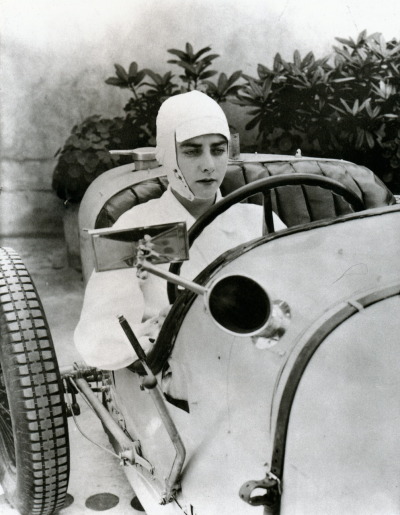
There may not be much about Dame Annie in the press at the moment, but I did wonder about this 12" single cover.

It looks like a posed photo to me, for a start where are her goggles? Don't recognize the pilot or the voiturette. Maybe from an old film or a magazine, like this Vogue shoot from 1927 featuring actress Colette Salomon, who I believe may actually have competed in a race or two.

Saturday, May 28, 2011

Lingogidda?

See, see the wide horizons glorious blaze!
The setting sun descending low,
Beyond the fervid mountain's brow.
And high Carnedda's top reflects the lingering rays:
But now yon russet heath attracts our eyes,
Where sable Lingogidda's vapours rise.

Here oft 'tis said
The wand'ring spirits of the dead,
By magic's awful art confin'd,
Th' affrghted hind and rustic dame
See glowing in the lambent flame,
Hear howling in the wind.

These are the closing lines of the poem Petraeia by the artist Thomas Jones of Pencerrig and published in a book of 1791 "Picturesque Guide to the Beauties of South Wales."

Now the reference to the Carneddau hills is clear enough and on a late summer evening the sun certainly does reflect from its brow as the painter says, but can anyone tell me about Lingogidda? I guess the poem refers to corpse candles, the spontaneous combustion of methane and phosphane you get over bogland and, no doubt, bogland around Pencerrig. Lingogidda? Llyn Gogidda? There's a verb gogyddio - which refers to making millstones but who knows?


Friday, May 27, 2011

Comment is Free ..ish

It's always interesting when readers comment on posts that have disappeared off the front page months or even years before. Since they are moderated, unlike more immediate posts, I get to read them, but who else? I think this recent anonymous comment is the longest one the blog has ever received and it makes some good points. So rather than let it languish in the depths I'm reposting it here:

"I think what the Elystan Glodrydd event at Llanbister last year showed was that there is not enough knowledge of the area's history, and many people outside Wales had not realised how intimately connected they were to Radnorshire, not that this area had been a rich centre of welsh culture or that there had been any local welsh rulers and princes, but assumed it was just pure marcher territory.

This is one of the many reasons why Dai Hawkins' translation of Ffrancis Payne's work is of such importance - he has unlocked a treasure-trove of knowledge and rich welsh culture that was only otherwise available to those who could read Payne's work in Welsh.

The princes and kingdoms of Gwynedd, Powys and Deheubarth are all often quoted by historians, culture experts and tourism promoters, but Rhwng Gwy a Hafren, Mealienydd and Elfael are names almost completely unknown to the vast majority of people in Britain. Go into any major bookshop in Britain and look at the history section allotted to Wales - less than a dozen books are squeezed in, almost as an after-sight. Ireland and Scotland have overflowing shelves. This in part must speak to a lack of connectivity to Welsh roots. If you are a McTavish (etc), you know not only what clan you belong to but exactly where in the world your people came from - not just 'Scotland' but the precise locale. So, consciousness of Scottishness and kinship is easy to gain, and there is interest all over the world. Some may say "oh but its all such bunkum" etc. Some of it may be, but the numbers of people who came from across the planet to share in the celebration of the year of homecoming in Scotland is testament to the power of a sense of a belonging and identity, and the historical threads that bring people together. Each year in Scotland, clan gatherings occur, bringing people from the world to the place, powerfully harnessing history and family together in celebration, to enjoy the ties of kinship.

The day at Llanbister last October had a special quality about it, which only those who were there could fully appreciate. It was not designed to be mournful like the event at Cilmeri, nor nationalistic, but rather a simple celebration of a forgotten history and the bringing together of long-separated branches of a family to mark a thousand year anniversary. It was a chance for people to come from all over Britain, and places as far away as California to visit and learn about a place from where they sprung and have a great time doing so.

Most importantly it was a fun and thoroughly enjoyable warm-hearted, family gathering that connected people to a very old song that hadn't been sung for hundreds of years. When was the last time that the elegy to Cadwallon ap Madog, prince of Maelienydd, written by Cynddelw Brydydd Mawr had been read out in Welsh to such a gathering in Radnorshire? When else have any of the ‘5 Royal Tribes of Wales’ gathered happily together, without coming to blows! It was a quite historical gathering of related families, with a shared history.

We all had an enjoyable time and the day was full of smiles, pleasure, and joy at discovering how good it was to have a shared Welsh origin and a strong connection with a history that has been almost completely forgotten. It was positive, embracing and welcoming, leaving cheerful and pleasurable memories for people to hold forever. It enabled the misty history of the past to catch up with the present in a happy way.

In so doing, it played a part in bringing Radnorshire to the fore and the story of the place’s history to people from afar who had no idea how beautiful the place is, nor how fascinating its history and hospitable its local community.

I’m sure Rebecca didn’t mind that for just one day, the name of Elystan rang out joyfully in the hills around Llanbister, echoing along with the names of people like Cadwallon ap Madog, Einion Clud and Phylip Dorddu, and a wonderfully enjoyable and special day was shared by many."

Wednesday, May 25, 2011

Aliz D'Eberveni


I wonder how many Welsh folk are like me and look up Wales in the index pages while browsing in bookshops. You'll rarely find anything, even when there is plenty to say, since English historians tend to block out Wales in much the same way as Salopians and Herefordians block out the Welsh element in their county histories. How many inhabitants of those border counties know that a Celtic language continued to be spoken in some of their parishes long after proud Cornwall had lost its native tongue?

The Irish are little better with their ghastly lumping together of their neighbours, even the inhabitants of the Gaelic Western Isles, under the catch-all term Brits - a term that historically would be better applied to the Welsh alone. Anyway I did manage to see a recent episode of the BBC series The Story of Ireland with Fergal Keane. Far from breaking new ground the episode that I saw resembled nothing more than a school textbook retelling, and a pretty dull and unquestioning textbook at that.

From a Welsh point of view the episode was particularly annoying - the Norman conquest of Ireland was seemingly achieved by the English or, at best, the Anglo-Normans. A better term for these half-Welsh conquerors, few of whom would have even been able to speak English, is Cambro-Normans. Frustrated by their failure to make progress in Wales these descendants of Princess Nest turned to a more profitable field of conquest. I suppose Irish pride is better served by blaming the English rather than admitting the role of men like Robert Fitz Stephen who boasted of his Trojan, that is his Welsh blood:

"We derive our descent, originally, in part from the blood of the Trojans, and partly we are of the French race. From the one we have our native courage, from the other the use of armour. Since, then, inheriting such generous blood on both sides, we are not only brave, but well armed."

If the Cambro-Norman element in the conquest of Ireland is ignored then I suppose it is not surprising that Keane gave a new name, Alice the Vicious, to the murderous lady who axed 70 Irish prisoners to death. Her story is found in the French verse chronicle Chanson de Dermot et du comte where she is know as Aliz D'Eberveni or Alice of Abergavenny. If only she had been called something like Alice of Guildford she might have more easily fitted the victim agenda that the BBC claim the series avoids.

By the way this is a lively discussion site for keeping up with Irish happenings, history, prejudices etc.

Friday, May 20, 2011

Brecon and Radnor - Regional List Vote

The Brecon and Radnor constituency voted as follows on the Regional List at the recent Assembly Elections:

Tory 9181 (32.5%), Lib Dem 8271 (29.3%), Labour 5091 (18%), Plaid 2071 (7.3%), UKIP 1371 (4.8%), Green 1251 (4.4%), Socialist Labour 471 (1.7%), BNP 291 (1%), Christian 193 (0.7%), Communist 75 (0.3%)

Not much change from 2007 when the Tories also won on the regional list - Tories down 0.4%, Liberals down 2.1%, Labour up 5.3%, Plaid down 0.6%, UKIP up 0.3%, Greens no change, BNP down 1.7%

Vote in the actual constituency vote is here.

Tuesday, May 17, 2011

Gummer or Gummey

I can't say that I'm a great fan of the politician John Selwyn Gummer although I did applaud when he encouraged his young daughter to eat a nourishing beefburger during the CJD panic a few years ago. It's well known that Gummer's father was a South Walian but how many are aware that his family originated on the Radnorshire/Herefordshire border? Gummer's grandfather was born in Kington and his great-grandfather in Lyonshall, although to agricultural labouring Radnorshire parents from Old Radnor, who sensibly moved back over the border.

So who were these Gummers or Gumma as it is sometimes recorded in the census returns? For although the name is found elsewhere in England there is certainly a hotspot in the Presteigne and Kington areas. The obvious answer would be that it is derived from the Gumma farm on the road between Discoed and Presteigne, after all there's a Ieuan Voghan Gumma mentioned in a document dated 1481 and brought to light in E J L Cole's article Clandestine Marriages, The Awful Evidence From A Consistory Court, which appeared in the Radnorshire Society Transactions for 1976. Of course you can't be sure of such a connection without a lot more evidence and it's true that there are no Gummers in subsequent records such as the 1670 Hearth Tax. What you do find are names like Gummey, Gommey etc. which could, I suppose, be derived from another local placename Combe - there's a Rees Combe mentioned in Mr Cole's article along with his wife Deylee Wythell (I used to imagine that could be translated as Irish Deylee but it's more likely to be another local placename Weythell). Mr Cole considers that the name Agomey indeed means "of Gumma" so perhaps Baron Deben's roots are to be found in that particular farm after all.

Ramblings aside it is clear that the eastern fringe of Radnorshire - and it is very much a fringe in a county where the Welsh patronymic system predominated - did give rise to hereditary surnames derived from local villages and farms. I'll look at some of them later.


Thursday, May 12, 2011

Radnorshire Names - Introduction

I suppose the classic work on Welsh surnames is the book of that name by T J and Prys Morgan, the father and brother of the blessed Rhodri. Another book well worth purchasing is The Surnames of Wales by John and Sheila Rowlands. I particularly like this latter book, which maps the geographical distribution of surnames based on marriages from the period 1813-1837. The maps reveal overlooked facts and pose a variety of questions. For example surnames as supposedly ubiquitous as Jones and Davies are shown to have quite striking regional strengths and weaknesses, being comparatively absent from some administrative hundreds.

Radnorshire contributes its share of puzzles, it falls for example within the South Wales range of the surname Gwynn which disappears in North Wales to be replaced by Wynn. Meredith seems to be a particularly Radnorian surname although one which spreads north west into Montgomeryshire and Merioneth. Of course Radnorshire, along with North Breconshire, is also the heartland for surnames formed from AP - Powell, Price, Prosser, Probert etc.

One wonders if these local variations are purely random or whether they reveal some cultural difference. If you look at Christian names in the 1670 Hearth Tax for Radnorshire you find some distinct variations between Rhayader and Painscastle Hundreds. In Painscastle names like Roger and Robert are fairly common whereas they are rare in Rhayader. Conversely Edward is a common Christian name in Rhayader Hundred but virtually absent from Painscastle. Does it mean anything?

Anyone growing up in Radnorshire would be aware of local surnames that don't quite fit the usual pattern of those names derived from the Welsh patronymic system - the Joneses, Davieses, Evanses and so on. You could call them English surnames if you wished, although some would have originated in the east of the county or just across the modern day border - Knill, Hargest, Rodd, Gummey, Whitney etc. and many others - Jarman, Cleaton, Ingram, Kinsey, Bound etc. - spread into the county from Montgomeryshire. Certainly numbers of such surnames have been in Radnorshire for as long as the "Welsh" surnames, since these were only adopted by Radnorshire folk in the late 16th to 18th Centuries - tor example there were Mantles living in Llanbister by the end of the 16C and the Buftons appeared on the scene before the Civil War.

While most Radnorians will be familiar with surnames like Hamer, Bywater, Bumford, Wosencraft, Weale, Wilding and so forth, some old names might well have dipped beneath the radar. In my case I wasn't aware of the longevity of surnames like Minton, Boulter and Tudge. It seems to me that it would be well worth examining the story of various Radnorian surnames (and Christian names) on the blog, not forgetting the added spice of the surnames of the Presteigne area, which are somewhat different to the rest of the county. Expect more posts on these topics.

Sunday, May 08, 2011

Union Jock

So I guess circa 2016 the Union flag could look something like this.

Sunday, April 24, 2011

Old Soldier

I thought this was quite an interesting cutting (click to enlarge) when I originally posted it back in 2007, but it hasn't attracted many hits. I guess that's because there weren't enough key words in the post for the search engines to pick up.

The Zulu prince who Joe Davenport and his companions from the 24th Foot captured was Dabulamanzi kaMpande who commanded the Zulu force at Rorke's Drift and fought at Isandlwana. The capture of Cetshwayo caused something of a controversy as Lord Giifard was awarded a £300 gratuity by Parliament which many felt should have gone to Major Marter, whose patrol actually captured the Zulu king.

Mr Davenport's three sons who were killed in the First World War are commemorated on this plaque in Howey Church. Unfortunately their name is spelt incorrectly. To compound that error the website has reassigned St David's church to St George. Heaven forbid!

Wednesday, April 20, 2011

For Sale


Bankers with £500K+ to spare might be interested in this Aston Martin DB 2/4 Cabriolet which Bonhams will be selling at the Goodwood Festival of Speed. Did Innes Ireland once own the car? Well Bonhams say he did, so it must be true.

I know Ireland drove Aston Martin roadcars for many years while Sir David Brown was involved with the company. Employed as a Consulting Engineer his onerous task was to use the latest Aston as his daily transport and report back occasionally on the car's performance.

Innes was particularly fond of a Bahama Yellow DBS V8 which, like the others he drove, was actually the property of the company, not Ireland himself. Eventually the car had to be swapped for a less colourful version, it had became too well known to speed cops up and down the country.

The car driven by Roger Moore in the youtube clip above taken from the 1970s TV show The Persuaders is actually a faux version of Innes's car, an older six cylinder version badged up to look like the V8.

Monday, April 18, 2011

A Beautiful Prison?

How many of our local councillors and administrators ever use a local bus service? I'd hazard a guess that it would be a fairly rare event, although they might find it instructive to occasionally leave the comfort zone of the car.

For example I remember overhearing some elderly widows on a once-a-week Radnorshire bus service discussing the problems of being stuck in the countryside without transport. Having retired to the area from England, with no relatives within a hundred miles and their car driving husbands having subsequently kicked the bucket, Radnorshire was indeed their beautiful prison.

Some Belfast academics have been examining migration into the community council areas of Diserth and Llanyre. You can download a summary of their findings here.

Thursday, April 14, 2011

From Melbourne to Monte Carlo

The posh and not-so-posh totty who raced around Brooklands and other pre-war motor circuits really were a remarkable bunch. Adventurers, mistresses, devourers of family fortunes, serial divorcees, admirers of Hitler, consumers of toyboys and members of the aristocracy competed against the top male racers of the day and sometimes beat them. One who did just that was the Australian Joan Richmond who drove her Riley to the start of the 1932 Monte Carlo Rally ..... from Melbourne! Later that year, with co-driver Elsie Wisdom, she took on the men in the Brooklands 1000 Mile race and won.

It's a shame that the exploits of these ladies have escaped much attention. Miranda Seymour wrote a book about the French racer Helle-Nice which gained a lot of media attention, having been written by a famous author; and Fay Taylour merited a biography which mainly concentrated on her speedway career. Meanwhile the likes of the stylish Kay Petre and Gwenda Hawkes, two of just sixteen racers to have lapped Brooklands at more than 130mph, are forgotten. Indeed Barbara Cartland's pathetic faux-race at Brooklands is better remembered than their real achievements.

Anyway it seems that a short book about Joan Richmond is being published in Australia, see here.

Thursday, April 07, 2011

Llananno Girl?

I think my favourite Radnorian poem is Lewis Glyn Cothi's 15C request for a bed, made to four local good women. Here's a short extract followed by my attempted at a translation:

Y nos y câr fy nisyn,
Fwrw ei led ar gylched gwyn,
Cysgu awr, o cwsg erof
Estynnu uwch sidan of.
Tew o led, motlai ydyw,
Tyner rhag y tanrhew yw.
Lle meddal mal y plu man
Lle esmyth oll i hwsman.
Dis ysgwâr o gadas gwyn
Dôr uchel rhwng dau erchwyn,
Erw o ddillad werdd wellwell,
Allor gwsg yn llawr y gell.

My little dice loves the night, he throws himself on the white coverlet, to sleep an hour, stretched out on pure silk, away from me. It is thick and many coloured, tender against the scorching frost, a soft place of small feathers, a place of rest for a labourer. Square dice of white braid, a high door between two bed walls, an acre of superior green bedding, an altar of sleep on the cell floor.

Of course what the bard is really describing is the grave, in a poem which recalls, by the use of the words fy nisyn - my little dice, the well known elergy to his small son Siôn y Glyn:

Fy nwy ais, farw fy nisyn,
Y sy'n glaf am Siôn y Glyn.
Udo fyth yr ydwyf i
Am benaig mabinogi.

My ribs ache for Siôn y Glyn, my little dice is dead. I'll weep for evermore for a chieftain of childhood games.

So who were the four goodwomen? The editor of the 1995 edition of the bard's work identifies them as Gwenllian, the daughter of Owain Glyndwr who lived at Cenarth, St Harmon; Efa vz Llywelyn of Rhayader and Elen, a daughter of one Gruffudd Goch. His fourth identification Mallt, the daughter of Ieuan Fychan of the descent group of Rhys ap Tewdwr doesn't seem right at all to me. That Mallt came from Bryn Coch in Llansantffraid-yn-Elfael whereas the Mallt of this poem is described as:

Mallt ferch Ieuan Fychan fydd
Moliannus ym Maelienydd;
Elystan yn Llananno,
Hon yw y ferch o'i hyn fo.

Mallt the daughter of Ieuan Fychan will be praised in Maelienydd; this girl in Llananno is formed from the being of Elystan.

Now I don't know how accurate my translation is, but it seems to me that the bard is saying that she comes from Llananno and is descended from Elystan Glodrydd. A candidate might be an unnamed daughter of Ieuan Fychan of the small local descent group of Y Dean Du, her mother would have been from one of the many families claiming descent from Elystan.

Radnor Lad in a Daft Hat

A great snap of Innes Ireland pursuing one of his favourite hobbies, stalking game birds. In 1962 Innes earned £32,000 - anywhere between £500K and a million in present day terms. Mind you he did earn it, as his record for that year shows:

11/2, Daytona, 3 Hr, Ferrari 250 SWB, No7, retired lap 59
23/3, Sebring, 3 Hr, Austin Healey Sprite, No17, 7th
24/3, Sebring, GP d'Endurance Ferrari 250 TRI, No26, disq lap 128
1/4, Heysel, Brussels GP, Lotus 18/21, No2, 3rd
7/4, Oulton Park, GT Race, Ferrari 250 GTO, No3, 4th
7/4, Oulton Park, SC Race, Lotus 19, 1st
14/4, Snetterton, Lombank Tphy, Lotus 18/21, No6, retired lap 7
23/4, Goodwood, Glover Trophy, Lotus 18/21-Climax, No8, 3rd
23/4, Sussex Trophy, Lotus 19, No71, 1st
28/4, Aintree, 200, Lotus 18/21-Climax, No8, retired
28/4, Aintree, SC Race, Lotus 19, 1st
1/5, Circuit of Garda, Abarth 1000, No52, 2nd
12/5, Silverstone, Ferrari 156, No9, 4th
12/5, Silverstone, SC Race, Lotus 19, 1st
12/5, Silverstone, Saloon Car Race, Ford Zodiac, 1st in class
20/5, Zandvoort, Dutch GP, Lotus 24-Climax, No9, retired lap 61
27/5, Brands Hatch, BRSCC, Ferrari 250 GTO, 1st
3/6, Monaco GP, Lotus 24-Climax, No34, retired lap 63
9/6, Mosport, Players 200, Ferrari 246S, retired
11/6, Crystal Palace, Trophy, Lotus 24_BRM, 1st
17/6, Spa, Belgian GP, Lotus 24-Climax, No20, retired lap 8
23.24/6, Le Mans, 24 Hour Race, Ferrari 250 GTO, No20, retired lap 165, with Masten Gregory
1/7, Reims Grand Prix, Lotus 24-Climax, No30, 3rd
8/7, Rouen, French Grand Prix, Lotus 24-Climax, No36, retired lap 1
21/7, Aintree, British Grand Prix, Lotus 24-Climax, No32, retired lap 16
29/7. Indianapolis, Hoosier Grand Prix, Lotus 24-Climax, No11, retired
5/8, Brands Hatch, Guards Tphy, Lotus 19, 2nd
5/8, Brands Hatch, Peco Tphy, Ferrari 250 GTO, No76, 3rd
12/8, Karlskoga, Kannonloppet, Lotus 24-Climax, No4, 4th
18/8, Goodwood, Tourist Trophy, Ferrari 250 GTO, No15, 1st
18/8, Goodwood, SC Race, Lotus Monte Carlo, No11, 1st
26/8, Roskilde, Danish GP, Lotus 24-Climax, No10, 3rd
1/9, Oulton Park, Gold Cup, Lotus 24-Climax, No14, retired
1/9, Oulton Park, SC Race, Lotus 19, No15, 1st
11/9, Monza, Italian Grand Prix, Lotus 24-Climax, No40, retired lap45
22/9, Mosport, Canadian GP, Lotus 19, retired
30/9, Kent, Pacific NW GP, Lotus 19, retired
7/10, Watkins Glen, American Grand Prix, No15, 8th
14/10, Riverside LA Times GP, Lotus 19, 5th overall, 1st in class
21/10 Laguna Seca, Pacific GP, Lotus 19, retired
4/11, Mexico City, Mexican Grand Prix, Lotus 24-Climax, No15, 3rd
2/12, Nassau, TT prelim, Ferrari 250 GTO, No4, 2nd
2/12, Nassau Tourist Trphy, Ferrari 250 GTO, No 4, 3rd
8/12, Nassau, Texas Race, Ferrari 250 GTO, No4, 3rd
9/12, Nassau, Governor's Trophy, Lotus 19, No 6, 1st
16/12, Kyalami, Rand Grand Prix, Lotus 24-Climax, No5, retired
29/12, East London, South African Grand Prix, Lotus 24-Climax, No11, 5th

This was at the start of the jet set age with Innes able to race in Canada on a Saturday afternoon and still make it back for a Formula One race at Crystal Palace on Whit Monday - no time to practice though, Ireland started at the back of the grid, passed everyone and won the race. Making the Rand Grand Prix in South Africa, however, meant missing the prize-giving evening at Nassau in the Bahamas. The organisers were so pleased they withheld Ireland's race winnings.

At a time when most of our rock-stars were still pimply faced youths, racing drivers like Innes and actors such as Burton were pioneering the hell-raising lifestyle emulated by so many in the years to come. A good thing? Check out your local High Street on a Friday night.

Wednesday, April 06, 2011

A Little Local Colour

What a pleasure, after the minus 20C temperatures of December, to find the hedgerows and fields of Radnorshire festooned once again with colour. Yes, the Assembly Election approaches and our Liberal and Tory supporters have been out in the sunshine planting their bright Kirsty and Chris placards.

How different things are today, with both parties in happy union at Westminster, compared to the bitter rivalries of the 1890s. Then the Welsh Land Commission was set up by Gladstone to conduct "a thorough, searching, impartial and dispassionate inquiry" into Welsh agriculture and its problems. For the Tories this meant extolling the virtues of landlordism, while the Liberals were able to once again relate the iniquities of tenants being evicted for voting Liberal or for attending the wrong church.

Whereas in much of Wales this all harked back to the last non-secret vote of 1868, in Radnorshire the accusations were of a more recent nature. Evan Bufton, a Llandrindod auctioneer who had recently lost his Liberal seat on Radnorshire County Council to a Tory, accused J P Severn of Penybont Hall and his elderly sister of evicting tenants for refusing to say which way they would vote.

The tenants were unwilling to testify in person but Jeffrey Jones, a thirty something Llandovery born haulier and prominent Llandrindod Liberal - he was later proprietor of the Brynawel (now the Glen Usk) Hotel - was willing to stand up and be counted. Interestingly Thomas Owen, the 78 year old Abbeycwmhir born gardener Miss Severn was accused of dismissing from her employ, was recorded in the 1891 Census as being a Welsh speaker.

Sunday, March 27, 2011

Last of the old school, first of the new

Surprised to see an article about Innes Ireland in today's Sunday Herald newspaper.

Also very surprised to find that my long deceased Innes Ireland website has reappeared on the web, albeit in zombie like form.

Saturday, March 26, 2011

Brampton Bryan

Following on from the previous post, most of Sion Ceri's praise poems were composed to patrons living in Montgomeryshire although a few do concern Radnorshire folk. One example is a praise poem to Siams ap Rhys (James Price) of Mynachdy (Monaughty).

According to the editor of the 1996 edition of Sion Ceri's work there was a puzzle about whom and where one of the couplets in the poem referred:

Iarlles oedd i'r llys heddiw,
A'i braint o nen Brontyn yw.

No doubt this little mystery was cleared up long ago, but if not I'd say it refers to Siams' second wife Elsbedd Harley of Brampton Bryan.

If that's the case the Welsh name of the Herefordshire village must have been Brontyn.

UPDATE: Would just like to clarify that Brontyn would have been a Cymricised version of an original English name, just like Prestatyn and Rhyl.

The People's Castle

I'd quite forgotten about the moves to purchase the site of Knucklas Castle for the nation. Like most local castles, the perspicacious Radnorians have long ago plundered the stone here for other purposes. Anyway the group behind the move have a blog which, like myself, readers may have overlooked, see here.

Of course Knucklas - and isn't the name unusual this far east in Wales for being partly Irish in origin - was linked by the medieval bards with King Arthur and Guinevere. Nearby Heyop was also a place of some significance, the 16C bard Sion Ceri comparing the town of Oswestry to the former glories of Heiob. Perhaps a lost tale would have explained the comparison.

All very mysterious. The Cornish have built a tourist industry on less.

Thursday, March 24, 2011

Just Saying

Look I'm no expert but why do Welsh language media and bloggers, including the BBC and Golwg, use the name Gaddafi, surely it should be Gadaffi? After all the guy himself spells/spelt his name القذافي and that should be transliterated according to the rules of the Welsh alphabet, not that of its next door neighbour.

Monday, March 21, 2011

Thought Police

Google frightens me, I just had a hit from a keyword search for Seven Ages of Britain Anglocentric and I hadn't even posted anything like that, although I was certainly thinking about it. So since I've already been outed, here goes. I really shouldn't watch history programmes since I just end up shouting at the screen, which was why I stopped watching Question Time about 20 years ago.

Bettany Hughes on Roman Britain in the Seven Ages of Britain series on C4 was a case in point. Ms H didn't mention Wales, which was fair enough, no such country existed during that period, although England and the English seemed to crop-up fairly often. There was no mention of Caratacus or the slaughter of the Druids in Anglesey although Boudica did feature, more as some frustrated proto-UKIP supporter opposed by all those right-thinking Brits who'd signed up for the European project. Although she didn't have much time for the locals Ms Hughes also slipped in another bit of modern day PCism by trumpeting the multi-cultural nature of Roman Britain ( I wonder where all these folk are in the DNA record, it would be fascinating if they turned up). Her quotes from the tomb of Regina, the British wife of a Syrian flag-seller were revealing. Ms H read out the, well she called it Palmirian, inscription in an all-purpose Middle-Eastern accent, but the Latin sections in her normal RP voice. Couldn't she have used a cod-Italian accent for the Latin? Maybe public-school types see themselves as successors to the Patricians and therefore in no need of a silly accent when mangling Latin? Anyway we never did find out why flag-selling was such a profitable business in Roman "England."

Meanwhile ......... the Western Mail announces "a month-long investigation by the top historians of Wales into those people and concepts viewed as saints and sinners throughout Welsh history." The announcement comes complete with pen-portraits of the top historians and examples of their own personal heroes and villains. These tend to be decidedly boring: Bush, Murdoch, Thatcher (yawn) . I think I could enjoy a pint with the fellow who lists Tom Pryce as a hero and a pair of "snivelling traitors" from 1283 as villains though. Pride of place in the eccentricity stakes must go to the historian who lists Mike German as a hero and Lloyd George as a villain.

Sunday, March 20, 2011

Magnificent Mid Wales

Tuesday, March 15, 2011

Chattering Classes

The usual crowd are up in arms because Midsomer Murders employs no Black actors and therefore doesn't reflect contemporary Britain. Oh yes it does reply the usual crowd, since there are certainly no blacks here in Scratchy Bottom or wherever.

Er .... haven't any of these people noticed that Midsomer is a fantasy? There are no Scots in Midsomer, no Irish, no Geordies or Brummies or Scousers. No working class characters, (OK you might glimpse the occasional cleaning lady) no council houses, no houses with unthatched roofs for that matter. Yet surely the English middle class should be allowed their magic realism? Costume dramas no, but after all foreigners seem to like John Nettles and it's made by ITV, so no poor people have been dragged through the courts in order to pay for it.

No, what I object to is the one ethnic minority who have been featured in Midsomer ...the Welsh. An episode that was actually filmed in North Wales, that starred Sharon Morgan - for my Builth readers, she's the one who played the topless French bird in Grand Slam. Good heavens the soundtrack even featured Myfanwy. This can only mean that the fantasy world of the English middle class encompasses the Welsh - Welsh scenery and male voice choirs at least. How wrong is that!

UPDATE: A spoilsport points out that DS Ben Jones was also Welsh, this is true but is rarely mentioned, also he was from Cardiff and hence only mildly exotic.

Friday, March 11, 2011

Is Batman Welsh?

Radnorians with an interest in family history are quite well served by the internet. As well as the collection of pre-1858 wills mentioned in the last post, there is also the huge collection of pre-1600 genealogies compiled by the late P C Bartrum - and yes it does seem as if Batman was Welsh. With the digitisation of the Radnorshire Transactions, the 1670 Hearth Tax return for the county is now available on-line, as is the Lay Subsidy of 1543-45, another record which lists hundreds of heads of households in the county at the time of its formation.

Looking at the Lay Subsidy the overwhelming majority of Radnorians alive when the Acts of Union were passed were still using the patronymic system. Surprisingly this is true even for Stanage in the far east of the county. Only in and around Presteigne do surnames predominate, some of very local origin. In the town itself we find the Welsh bard Morgan Elfael listed, as well as a harper and a crwth player. Apart from the occasional plague it must have been an interesting place with its mix of languages and probable bilingualism. Knighton, on the other hand is a smaller and much more Welsh place in 1543 compared to 1670. In the rest of the county surnames are rare and the occasional Tailer or Smyth is clearly a job description rather than an hereditary surname.

Around 200 of the heads of household listed in the county are women and some 90% use patronyms, mostly using the vz = ferch formula. Welsh forenames are still common, around 20% are called Gwenllian and versions of Angharad, Goleu, Tanglust and Dyddgu make the top ten of most popular names. Other Welsh names are Gwenhwyfar, Tudo, Lleucu and a name which one comes across in Radnorshire and only rarely elsewhere: Deili. Other popular female names are versions of (spelling wasn't formalised in the 16C) Margaret, Agnes, Maud, Elen and Catherine.

Thursday, March 10, 2011

Roots in the Air

The 16th Century wills transcribed by the late Mr E J L Cole in numerous editions of the Radnorshire Society Transactions must have been an eye-opener to any member labouring under the misapprehension that the county was somehow not part and parcel of mainstream Wales. After all the likes of Angharad verch Lello Bedo ap Madock of Llanvihangell Rhidython (1563) or Jevan ap Hoell ap Gwallter of Nantmell (1587) were hardly likely to have sprung out of an anglicised society. Indeed for the majority of Radnorians, not able to grapple with the extensive bardic literature or the elegant prose of Mr Payne's book Crwydro Sir Faesyfed, these wills must have been a most obvious confirmation of the area's Cymric heritage.

As one of those for whom the word mañana suggests an unnecessary degree of urgency, I'm full of admiration for the likes of Mr Cole, beavering away in the archives during their leisure time, and long before the internet made most Radnorshire wills available at the click of a mouse. Mr Cole also had that tabloid sense for a good story which makes history more accessible, this for example.

What to make of this enigmatic article by Mr Cole in the Radnorshire Transactions? Radnorians should be able to guess the location of "the great rock that stands close to the church of Paternus" and with the census available on-line, at a price, it's now easy enough to identify the people, but what was Mr Cole's relationship to the old lady who in true Radnorshire fashion would not want to see her name in print "bringing shame and notoriety on her family."

Saturday, March 05, 2011

The Time Between


Here's Innes Ireland explaining to British Racing Partnership chief mechanic Tony Robinson how he has just crashed out of the 1964 French Grand Prix at 135 mph. This is from an old BP film, the full version of which also has some footage of Innes flying his plane and at home in Radnorshire.

A feature of the film I found interesting was that Innes and Graham Hill, neither of whom came from well-off backgrounds, speak with those posh 1950s accents you hear in films of that period, while Mike Hailwood, a millionaire's son, doesn't. Mike was ten years younger than Innes and Graham and, I guess, a product of the more egalitarian 1960s.

Motor sport fans can spot Bette Hill, Bruce McLaren, his wife Pattie is on the pit counter, Americans Phil Hill and race winner Dan Gurney, Jack Brabham, Stirling Moss, Raymond Mays, Tim Parnell and is the bearded mechanic jazz musician Owen Maddock? I'd like to know who the kohl-eyed lass in the BRP pit is though.

Thursday, March 03, 2011

Elephant on the Doorstep

Well my fears for the referendum proved groundless with a resounding swing across all parts of Wales. People rightly complain about the turn-out but there's nothing to suggest that the stay-at-homes would have voted any differently.

This is the result we should have had in 1979, but which, thanks mainly to the Kinnockites, was delayed for a third of a century. The future belongs to those who have no memory of that defeat and the shrinking band who oppose Home Rule have to realise that there's a rather large elephant sat on their doorstep.

Tuesday, March 01, 2011

A Sad Tale

WDL came from what was described as a respectable and well-connected Radnorshire family. Maybe it was this that landed the young clerk his job as a relieving officer with the Builth Poor Law Union in the early 1870s. Of course the Builth Union included the Colwyn District of Radnorshire, all except for WDL's home parish of Glascwm which was hived off to the Kington Union.

Young WDL, he was in his early twenties, married and proceeded to father a sizeable family. Yet somewhere along the way he started to go off the rails. At that time next of kin were expected to make a financial contribution towards the keep of their relatives in the newly built Builth workhouse . It was part of WDL's job to collect such funds. Unfortunately the money handed over by the likes of Mr Powell of Disserth, Mr Williams of Crossgates and Mr Worthing of Llanyre ended up in WDL's pocket rather than the coffers of the Union.

Worse was to come when WDL cashed a cheque for £50 at Builth's National Provincial Bank, money meant for distribution to the poor. Instead the relieving officer took to his heels, with Sergeant Flye and Constable Meade in hot pursuit. A month later he was apprehended on the streets of London. Sentence, at the Breconshire Sessions, 12 months imprisonment.

Unfortunately this was not the last time WDL's name appeared in the press. A year after being released he was back before the Breconshire courts charged with embezzling his employer, a local brewer. WDL conducted his own defence and so ably that the jury found him not guilty. This despite more that a dozen recent convictions for drunkenness, assaulting the police and damaging railway carriages. Leaving the Court a free man WDL was immediately rearrested on another charge.

This new charge was heard before the Cardiff police court, WDL - described as living at Pendre Villa, Builth - having borrowed £34 from a Cardiff moneylender, Solomon Blaiberg, by forging his father's signature on a promissory note. His father, by now living in Hundred House, explained to the court that he could not infact sign his name.

A few months later WDL was before the Bristol Quarter Session accused of stealing books from a local hotel. Again he defended himself and such was his eloquence in the face of overwhelming evidence that the jury found him not guilty. The judge somehow failed to notice this detail and sent the delinquent to jail. The next day his honour, having been made aware of his mistake, was forced to bring the newly shorn prisoner back from prison to be released.

WDL's unfortunate wife, together with her young family, had by this time been dispatched to Builth workhouse, where she was to spend the next 30 years or more, firstly as an inmate and then as an employee. What happened to WDL? By 1891 his wife was describing herself as a widow. Who knows, he may indeed have been dead.

Monday, February 28, 2011

Gwynt Teg

I see that Llandod blogger and defeated LibDem councillor David Peter would like Powys to "re-join" England. I'm guessing this isn't official LibDem policy. Surely there must be an easier way for Mr Peter to escape the clutches of Greater Cardiff?

UPDATE: With the Republic having recently given up its hard-won independence in exchange for a loan to pay off other people's debts and now with Ireland beating "the Hun" at cricket, perhaps we'll soon be seeing the 26 counties "re-joining" England. Lord help them.

Tuesday, February 22, 2011

Once We Were Heroes


Thanks to Karen for these snaps of the fabulous Llandod football team of the early Sixties.

The great thing about that all-conquering team - check out their League record in the 1961-62 season, 3 points dropped and an average 4 goals a game - was that so many of the team were Radnorians, not mercenaries from Swansea or Liverpool.

It was my delight to cycle in to Llandrindod on my Triumph Palm Beach, newly purchased for passing the 11 plus, to watch the men in blue. Sometimes for lack of funds we'd be forced to sneak onto the Broadway field, across the brook and through the hedge, to avoid paying at the gate. Then positioned beside the goal to watch ace forward Barrie Gittoes knock in a few more winners.

Sad to relate Barrie has just passed away - in my memory at least his goals were all spectacular and like the very best players he had aeons of time - a trap, a turn and a thunderous shot into the back of the net.

Monday, February 21, 2011

Thought for the Day

Andrew Pierce, a columnist at the Daily Mail, contrasts the political representation of Wales and Massachusetts. The American state, he says, has a mere ten elected representatives while Wales has 40 MPs and 60 AMs. Pierce forgot about the 4 MEPS.

So is Massachusetts really run by just 10 representatives? Of course not. Apart from its 2 US Senators and 10 Congressmen, it also has 40 State Senators and 160 members of the State House of Representatives.

It's an unfortunate fact but a lie does indeed go half way around the world before the truth gets its slippers on.

Epynt Races, Part 2


There's a great site detailing the Epynt races of the late 40s and early 50s, see here.

Hope the site owner won't mind me ripping this fabulous snap showing the start of a race in 1948. It's not just the bikes but the people in the crowd which reminds me of how things used to be. The past another country? Indeed.

Epynt Races, Part 1

Thanks to Builth remembrancer SGP for showing me this programme from the 1951 Epynt motor cycle races.

Someone should revive these races, but for historic bikes. Would make a change from the ghastly over-painted, over-powered, often badly driven rally cars which dominate the hills nowadays.

Tuesday, February 15, 2011

Shebeening

Shebeening isn't a word that you find very often in the popular press nowadays. Back in Victorian times it was common enough and not just in Ireland or the Scottish Gaeldom. Shebeening, the keeping of an unlicensed drinking establishment was also found in Radnorshire during the building of the Elan Valley dams.

Policemen disguised as navvies roamed the hillsides, calling at lonely farmsteads and asking for a glass of ale. Farmers or their wives who obliged and accepted payment were dragged off to court to be fined - £10 plus costs or a month in jail for example- more than £4000 in comparison with today's average earnings.

Monday, February 14, 2011

One for Miss Marple

So is this latest piece of Innes Ireland Memorabilia really worth £35? At least it's genuine, unlike many of the "original" photographs you currently see for sale. Originally copied from magazines and books that is.

Llandrindod Cover Girl

Curigwen Lewis (1936)

Saturday, February 12, 2011

The Spike

It comes as something of a shock to realise that I'm old enough to have worked with a fellow who was born in Rhayader workhouse, or the Spike as they were called. Anyway Radnorshire had an interesting relationship with the New Poor Law responsible for such places, some of which is explored here. Indeed Thomas Frankland Lewis of Harpton, New Radnor was chairman of the gang of three Commisioners who oversaw the operation of the new act in England and Wales, he was succeeded by his son George Cornewall Lewis in 1839.

Edmund Head, who we recently met endorsing the view that the Welsh were a "miserable race of Celtic savages", was the assistant commissioner responsible for Central Wales and Herefordshire. One of his tasks being to set-up the six Poor Law Unions covering Radnorshire - Rhayader, Builth, Hay, Knighton, Kington and Presteigne. Mr Parker's article, linked to above, shows that Head deliberately sought to weaken Radnorshire influence over these Unions:

"The inhabitants of the central part of Radnorshire are exceedingly ill disposed towards the Board ... the only way of enforcing the Act is to unite as many (parishes) as possible with unions in England or on its borders."

By doing so Head hoped to "raise the character of the Radnorshire farmers." elected to serve as Guardians overseeing the Unions and would, presumably, learn from the superior character of their fellow Guardians from east of the border.

Of course Head was correct to mistrust the good folk of Radnorshire who were surely ill-disposed towards the Malthusian world-view which inspired the new laws. Builth Union - which included 10 Radnorshire parishes - resisted building a workhouse for 38 years until forced to do so in 1875, while Rhayader Union resisted until 1878. The Radnorshire guardians seemingly happy to continue with the outdoor relief, often in cash, which our Malthusians saw as an encouragement to the poor to breed.

Sunday, February 06, 2011

thirtysomethings

Here's some jolly correspondence between three thirtysomething pals dating back to 1837, which might provide a clue as to the atmosphere that marked the rapid retreat of the Welsh language in Radnorshire during the early decades of the Nineteenth Century.

First off we have George Clive, future Liberal MP for Hereford, expressing his "fervent prayer" that the devil would fly away with the Welsh or "this miserable race of Celtic savages" as he describes them/us.

"Amen" echoes the recipient of the diatribe Ed Head, a future Privy Councillor and Governor of Canada, who in deference to the third of our correspondents asserts that "Wales begins just beyond New Radnor". Ed does however see some hope for the Welsh since "the railroads .... may civilize them in about three centuries."

The third of our Liberal pals is George Cornewall Lewis, "Radnorshire's most distinguished son" and a future Home Secretary and Chancellor of the Exchequer, whose monument once dominated the main road into Mid Wales. Of course Lewis lived at Harpton, hence the need for friend Head to push the English border a couple of miles further west. Six generations of marriage to English brides combined with an Eton education had certainly expunged any memory of what had once been a distinguished Welsh family and Lewis is quick to agree with Clive's opinion of the intelligence of the Welsh. However, he laments "how that intelligence is to be raised, while they retain their villainous Celtic language, it is not easy to see."

Cornewall-Lewis considered the Welsh to be cowardly and timid, perhaps he had a point. His letters are available here.

Tuesday, February 01, 2011

Coming Soon - Hopefully

A couple of frustrations this morning, firstly it's impossible to get on to the London government's new site "police.uk" to check out local crime, but more importantly the National Library's Welsh Journals site is playing up. Now for the good news: it's obvious that they have just added the Radnorshire Society Transactions to the journals available online. Hopefully the present search difficulties will be sorted out soon.

I've never been a member of the Radnorshire Society, it always seemed far too bourgeois an organization for a young council house hot-head such as myself. OK no doubt I got that all wrong and it is infact a wonderfully welcoming society open to all. One gripe I still have though, why is it I can pick up a current copy of Brycheiniog - journal of the Brecknock society - in local bookshops, but not the Radnorshire Transactions? Surely it, and especially works as important as the recent translation of Payne's Crwydro Faesyfed, should be available to as wide an audience as possible?

Anyway it looks as if those earlier, hard to find issues of the Transactions will soon be on-line for all to read.

UPDATE: Four of the top ten violent streets in England and Wales turn out to be in Wales. Not very good considering that on a population basis it should be one in the top twenty. Perhaps it's time to hand over law & order to the Assembly.

FURTHER UPDATE: Radnorshire Transactions are there now. See here. Bravo!

Sunday, January 30, 2011

Green Green Grass

I suppose most informed Welsh people will already know that Mrs Mubarak's mother was born in Llwynypia, although obviously not Welsh Office dinosaur David Jones. It's even been said that she once lived in Laura Street, Pontypridd, previously only noted for being the old home of retired hip shaker Tom Jones.

A Google search wouldn't reveal it but Mrs M's nain was a slate worker's daughter from Llanddeiniolen, one Lily Parry, the family originating from Anglesey. Who knows they might even be related to the distaff side of another celebrity couple who have done rather well at the expense of the public purse.

UPDATE: Bit of bad timing here, the Eisteddfod ask Suzanne Mubarak for a pair of shoes for a charity auction. No seriously!

Saturday, January 29, 2011

Penny Note Book - part 2


The first three extracts are from 1899. The Gramophone appears in Aberedw in 1901, probably a model like this. The pretty bird appeared in 1906 - I guess it's too late to report to the Radnor bird blog. In the same year the pious old lady of Llanbadarn y Garreg met with her accident.

Friday, January 28, 2011

Agony Aunt

W.G. of Llanyre writes:

A friend of mine was recently reading a post from Llandod blogger and former Lib Dem councillor David Peter. Ever since she has been fretting about the upcoming referendum on more powers for the Welsh Assembly. Is there anything I can do to set her mind at rest?

Radnorian replies:

Dear W.G. tell your friend not to worry. Although Mr Peter needs "to be convinced that more powers for the Assembly is not merely a milestone on the way to full independence for Wales" the referendum is just about more powers for the Assembly. It could equally be a milestone on the way to the fully federal Britain that the poster advocates. The present vote has nothing at all to do with full independence. Unionists should remember that they were responsible for breaking up the original United Kingdom by continually standing in the way of devolution for Ireland.

Mr Peter also worries that the Assembly has no revising chamber. Well tell your friend that many countries get along fine with a single chamber legislature - New Zealand, Sweden, Finland and Norway for example. Also all the Australian, Canadian and German federal states.

Mr Peter does have a point when he complains about East Wales not having much influence within the current Welsh Assembly Government. No doubt this wouldn't have been the case if the Lib Dems hadn't pulled the plug on the proposed Rainbow coalition. Perhaps local voters should cast their ballot for parties who want to participate in government rather than putting their own internal party bickering before the interests of the people of Powys.

Thursday, January 27, 2011

Bees and Bonnets

A few months ago in the Western Mail, historian Dai Smith worried that what was described as the Renaissance of Welsh History in the second half of the 20C had run out of steam. One author who has certainly courted the controversy and debate which Dai Smith cites as a positive feature of that renaissance is the author of this little book.

Dr Breeze believes that the Four Branches of the Mabinogi were written by a woman and that the author can be identified as Gwenllian, the daughter of King Gruffudd ap Cynan of Gwynedd and wife of Gruffydd ap Rhys, Prince of Dyfed.

Now as one of the mere consumers of history I'm in no position to comment on the validity of Dr Breeze's theory and it certainly hasn't been accepted by his academic contemporaries. At the same time the author makes a lucid, circumstantial case and, although he cannot prove it, challenges his detractors to come up with detail that proves him wrong.

The book is published by a Leominster company called Gracewing who seem to specialize in works of Roman Catholic interest.

Dr Breeze has been described as having a bee in his bonnet about Gwenllian. Perhaps a few of our Welsh academics could be persuaded to unleash some of the bees lurking in their own headgear rather than retreating to what Dai Smith describes as "the cloister of the Learned Journal."

Saturday, January 15, 2011

Dorothy Levitt, Update


Dorothy Levitt was a secretary at the Napier Motor Company around 1903 when proprietor Selwyn Edge hit upon the idea of entering a woman in early Motoring events. Edge probably hoped that this would popularise the car with women and Dorothy soon proved herself an able and spirited driver. You can read about her on the excellent Speedqueens blog - here.

Soon Dorothy was an Edwardian celebrity but around the end of the decade she seems to have disappeared as quickly as she came into view. Despite being something of a feminist icon - check out my post on her only sporting foray into Radnorshire - and the subject of recent television shows, no-one really seemed bothered as to who she was or what became of her.

A couple of years ago I came up with the theory that Dorothy was actually a Jewish typist born Elizabeth Levi - my comment on this post sets out the reasons for the identification.

Now some genealogists with access to the probate records have confirmed the identification (see illustration above) - Elsie Ruby Lewis being shown through the BMD records to be Dorothy's or rather Elizabeth Levi's sister.

What became of Dorothy between 1913, when she had an apartment in Portman Mansions, and her death in 1922 remains a mystery.

Thursday, January 13, 2011

Outlanders

Fed up with no longer being able to bore your workmates and relations with talk of how much your house has gone up in value? Well I don't suppose many Radnorians spent the 1970s buying Welsh language LPs, but if you did you might just have a new topic of conversation. Say about this or this or this or even this.

Friday, January 07, 2011

Did You Ever

Cardiff blogger Babylon Wales has come up with visual proof of Radnorshire songbird Maralene Powell's 1972 musical adventure with Gareth Edwards. I'm guessing Gareth has a better singing voice than current Welsh scrum-half Mike Phillips.


Thursday, January 06, 2011

Penny Note Book


Yesterday while helping to clear out a house, I found a liitle penny note book. It contains occasional diary entries starting on January 17th 1899 and ending on September 23rd 1908. The author was a Nina Price of Pencraig, Llanbadarn y Garreg. At the time of the first entry she was a 15 year old pupil at Llandrindod County School and lodging in the town, the last entry records her father's funeral. The other entries include visits to fairs, concerts and church services, together with reports of local elections, fires, accidents and tragic deaths. Maybe I should send it to the county record office.

I doubt if there's been much skating on Llandrindod Lake this winter - Health & Safety has made cowards of us all - perhaps to the relief of the birds on the excellent Radnor bird blog.