Tuesday, November 01, 2011

Myfanwy Fenton

While wilfing around the internet I came across this reprint of a book originally published in 1863, you can actually read an online version if you have the time to spare!

So who was this Myfanwy Fenton who also translated a book from Icelandic, published in 1877, called Three Sketches of Life in Iceland and a book of poems, St. Lawrence Orphanage published in Copenhagen in 1874?

Myfanwy was the grand-daughter of the Pembrokeshire literary figure Richard Fenton, in the 1851 Census she is living at Glynamel, Fishguard with her uncle John Fenton. She is described as being a governess, 25, born in Waltham, Lincolnshire. From other sources she can be identified as being the daughter of John's brother Richard, a clergyman.

John Fenton was an interesting character, an artist, a musician and archaeologist and Examiner at the Foreign Branch of the War Office. According to his nephew he was "a man of dissipated life, learnt in the circle of Carlton House and association there with the Prince Regent and his companions."

Myfanwy/Myvanwy was an unusual name in Wales in the first half of the 19C, with just 3 examples in the 1851 Census, although maybe there were a few more transcribed incorrectly. In the 1841 Census John Fenton is recorded as staying in the Denbighshire home of Jane, wife of his brother-in-law the Welsh scholar Aneurin Owen. The Owens also had a daughter Myvanwy, born around the same time as Fenton's niece.

Myfanwy Fenton isn't found in any census after 1851. In the 1870s she was a language teacher living in Copenhagen. The book of poetry she published there was dedicated to Baroness Mohrenheim, wife of the Russian envoy to Denmark. Given her uncle's association with the War Office I'd like to imagine that Myfanwy was a spy.

Sunday, October 30, 2011

A Radnorshire Jury ..... to be continued

It seemed an open and shut case, Samuel Williams of Norton had stolen Richard Stephens' coat. There was surprise when the jury asked if they could retire to consider the verdict and incredulity when they returned three hours later with a not guilty verdict. They had been unable to agree the jurymen admitted, so in the end they had cast lots. One public spirited member having sacrificed his walking stick for the purpose.

The magistrates were outraged, the verdict was set aside and the matter sent forward to the next Assize. As for the jurymen they were fined £5 each, a sizeable sum in 1834.

Jo-Jo and the Chambermaid

In 1910 it seems that a husband was legally responsible for the slanderous words uttered by his wife, which is why Mr J found himself as a defendant in a slander case brought at Glamorgan Assizes by a former employee of his Llandrindod hotel.

The plaintiff, 25 year old Miss L, owed her French surname not to Paris but to her Jersey born father. Infact she was from Brynmelin in Swansea. Mary, the hotel management insisted on calling her Edith, had something of a chequered past, having been dismissed from previous posts for dishonesty. Still Mr J, a prominent Liberal politician in the county, had given the girl a second chance, although, no doubt, his wife kept a watchful eye on the new recruit.

One permanent resident of the hotel was the talented Mr B. He had previously been engaged to Mr J's daughter but she had tragically died. A favourite of the maids who christened him Jo-Jo, the young but sickly Mr B was manager of the town's Electric Light Company and chairman of its Steam Laundry Company.

One evening Mrs J suspected that Mr B was entertaining Miss L in his room and barged in, conducting a search by looking under the bed and in the wardrobe. Finding nothing Mrs J went to look for Miss L, only to catch a glimpse of the errant maid leaving the room she had just examined. Accusations were levelled and the maid dismissed from her employment. This it was that led the blameless Mr J and his accusatory spouse to be sat in Cardiff while the hotel's dirty washing was displayed before a courtroom audience populated, the papers sniggered, by a large number of ministers of religion.

Yes, said one witness, a couple of the maids at the hotel, let's call it Hill Breeze, did spend time in guests' rooms of an evening. Maggie and Hetty and Polly gave evidence that favoured their mistress, while Miss L's employment history was dissected by the hotel owners' counsel, the MP for Carmarthenshire East and the MP for Anglesey - I did mention that Mr J was a prominent local Liberal. Mind you the maid (a labourer's daughter, so hardly wealthy) was represented by a KC. It makes one think that there may have been some political skulduggery afoot.

Indeed it was the maid's counsel who won the day, producing a medical certificate which confirmed that Miss L was ........ well the newspapers didn't spell it out. In the light of this revelation Mrs J was forced to concede that her suspicions must have been ill-founded. Verdict £100 and costs to the plaintiff.

Nothing in the Papers

I bought this book - it's a general history of Britain up to the present day - a few years ago and I'd happily pass it on to Oxfam except for the fact I wouldn't want the unsuspecting to read nonsense like this:

"If she could speak, would her words be in Old English - a Germanic language - rather than the Gaelic and Latin used by the townspeople of Roman Dorchester."

It isn't an isolated example of the author - he was Chief Archaeologist with English Heritage - using Gaelic when he means Brythonic, the ancestral language of Welsh not Irish.

According to the Sunday Times this "massively informative" volume will help cure "our current identity crisis." If the English do have an identity crisis it might help if widely held prejudices be put aside and the Welsh/British contribution to their history be given a little more consideration.

All in all a book that suggests that archaeologists should stick to bonekicking.

Moving on .......... There are those who believe that the 15C bard Llawdden comes from Loughor while others maintain he was from Machynlleth. I think I'm correct in saying that the earliest manuscript reference to his origins says he was Maelienydd, which later went to contribute much of modern day Radnorshire. Certainly there is agreement that his poems show that he lived here, possibly in Cefnllys. It seems that Llawdden was a very rare Welsh forename, and here's an example from 16C Radnorshire. It's from the 1546 Lay Subsidy for that part of Llanddewi Ystradenni parish in Knighton hundred: Llowthen ap David. It's Lloyden in the 1543 version and in the Radnorshire Society's index to the Lay Subsidy, so I guess it could get overlooked. Who knows, maybe a grandson of the bard.

Saturday, October 22, 2011

Hwntws or Gogs (part One)

If the Welsh dialect of St Harmon and Cwmteuddwr was similar to that of neighbouring Montgomeryshire and the lost dialects of places like Glasbury and Boughrood were similar to close at hand Breconshire parishes such as Talgarth, then somewhere within Radnorshire, south must have met with north.

As far as I know the dialectologists never managed to get hold of a speaker of Radnorian Welsh from the Rhayader area, even though some, doubtless as rare and unnoticed as pine martens, must have lived on well into the 20C. Fat chance of them interviewing folk who lived in parishes where Welsh had disappeared by the 19C then.

But hang on, riding to the rescue is Richard Suggett, the fellow who authored that splendid book on Radnorshire houses. Rotting away in the archives he discovered reports of slander cases where the words of long dead Radnorians come back to life. An example from Gladestry in 1726 "Di gyrn di dorrws y twlle sydd in di hatt di" - "Your horns tore the holes that are in your hat." Now the interesting thing here is the use of the verb ending ws rather than odd - dorrws not dorrodd - this is a feature of the dialects of South East Wales. The map shows the use of these two endings in Radnorshire slander cases from the 16th, 17th, and 18th centuries - info from here.

From the look of things Elfael - at least the hundred of Painscastle and maybe Colwyn as well - seems more influenced by Gwenhwyseg (Gwentian Welsh) than do Maelienydd and Gwerthrynion - the hundreds of Knighton, Cefnllys and Rhayader.

Friday, October 21, 2011

Nothing to report


Just imagine what the BBC and its media pals would have made of this if it had been said by someone whose politics they didn't like, Condi Rice for example.

Thursday, October 20, 2011

Keywords

It's always interesting to check out the keywords used to find the blog. Some provide ideas for a post, while others just leave you puzzled. Why for example should I get regular hits from searchers looking for "London transport bus found on the moon?"

I'm not sure what to make of the following search term that popped up a couple of days ago. I could understand if it originated in Builth, but this was from Lyon in France:

Wednesday, October 19, 2011

The Spannerman's Tale

Maybe it's old age but even today's stars seem less interesting than the spannermen of the 1950s. I doubt for example if Button or Hamilton will ever inspire a volume as good as the 1957 autobiography (as told to Peter Lewis) Alf Francis, Racing Mechanic.

Someone who figured prominently in that book was Alf's youthful protege Tony Robinson. Now, getting on for 60 years after he first worked with the Polish-born Francis, we're promised an autobiography of Robinson himself (as told to Ian Wagstaff).

No doubt tales of Stirling Moss will dominate but hopefully Innes Ireland will get a look-in, Robinson was chief mechanic with the BRP team when the Scotsman led them on the track in 1962, 1963 and 1964. You can watch the pair around the 0.54 mark in this rather wonderful footage as Innes explains to a patient Tony how he's just bent the car.

Will it match up to the Francis book? With a promised 160 pages and 120 photographs compared to the dense, 300 plus information packed pages of the 1950s page-turner it's doubtful. But at least it's not another Hamilton bio.

Friday, October 14, 2011

"Died for England"


Above is the somewhat Gothic war memorial in the Radnorshire village of Norton, it was designed to serve as a horse trough and drinking fountain. The wording on the memorial is of interest since it was "erected by the grateful village of Norton to commemorate the names of its faithful sons who fought and died for England and liberty."

Should this wording annoy patriotic Cymry? There was a time when no sooner had some Welsh folk set foot on mainland Europe than they would boast, maddeningly, about England or how they had met "another English couple." As if their new found friends were saying the same about them! Nowadays I think we can excuse the good villagers of Norton for this historical anomaly. In any case the wording on the memorial is probably quite accurate. I did look-up the census records of the two First World War names on the monument and was surprised that the elder brother of one, a 20 year old born in Heyop, was listed as being able to speak Welsh. An error or perhaps the result of a period of work in a Welsh speaking area?

Mind you when I saw this during a Google search I did have a potentially dangerous rise in blood pressure, only saved by the realisation that it was a cock-up confusion with some place in Leicestershire rather than a plot to tweeify Radnorshire :


Wednesday, October 12, 2011

Averse to acknowledge any Lord

In the early 1630s a strapped-for-cash King Charles sold the crown estate of Maelienydd to some rogues or other, much to the consternation of the citizenry of Radnorshire. Their solution was to make a collection, they raised £741 12s, which they then gave to the king as a gift, with the helpful suggestion that he might like to use the windfall to buy back what he had so recently sold. Charles did indeed re-purchase the lordship of Maelienydd but was soon in negotiation with Thomas Harley of Brampton Bryan to lease out the land. Harley's plan was to charge rent to the many hundreds of squatters on the commons. This caused such a kerfuffle that the plan was abandoned, although the Harleys were able to get their paws on the lordship during Cromwell's dictatorship.

Moving on to 1758 and King George leased out the wastes and commons of the lordship of Maelienydd - a substantial portion of the parishes of Llanddewi, Llanbister, Bugeildy, Heyop, Llanbadarn Fynydd, Llananno, Llanfihangel Rhydeithon, Llangynllo, Gladestry, Colfa, St Harmon, Cwmteuddwr and Nantmel. Again the plan was to squeeze the hundreds of squatter families by charging them rent. Such was the opposition both physical and legal, that the scheme was abandoned, the crown agent, John Lewis of Harpton, complaining of "'the natural dispositions of people being averse to turn tenants and acknowledge any Lord."

Of course the resistance of the cottagers to enclosure was to be a feature of 19C Radnorshire, just as it had been in the previous two centuries. Radnorshire had a larger percentage of freeholders than in some Welsh counties and these, together with the squatters, meant that there were a substantial number of folk who were indeed "averse to turn tenants and acknowledge any Lord." I wonder if they were the descendants of the troublesome class called manwyr in the works of the bard Sion Ceri, poor folk with a pedigree, the younger sons of younger sons. They certainly seem ready to use the law and even physical force to uphold their rights.

Perhaps these independently minded folk were responsible for the very rapid process of language shift in Radnorshire. Firstly they lived in proximity to England and so had the possiblity of picking up the English language through everyday discourse. Secondly they had every reason to learn English in order to protect themselves from men who would be their masters.

A 150 years before Saunders Lewis' lecture Tynged yr Iaith the Radnorshire historian Jonathan Williams discussed language shift in the border parish of Bugeildy. His analysis of why this had occured seems very modern:

"An increased intercourse with England, a more general interchange of the commodities and produce of these two countries respectively, and, above all, the introduction of that jurisprudence with which the inhabitants of Wales found it necessary to be familiarized, as well as the diction in which all legal pleadings, deeds, conveyances, processes, &c., are executed, soon undermined that predilection for their mother tongue which was before their distinguishing character, and rendered the study and acquisition of the English language necessary, not only as an accomplishment, but also as a matter of indispensable interest."

Tuesday, October 11, 2011

Well it made me laugh

An Englishman, an Irishman and a Scotsman walked into a bar ............ the Welshman was still in New Zealand.

Saturday, October 01, 2011

Forgotten Radnorian?

On the face of it Enoch Powell isn't a Forgotten Radnorian at all. His Radnorshire connections are mentioned in biographies written by competent authors and put out by reliable publishers.

Mr Powell would make a worthy addition to the list of those Radnorians who have made a contribution to Welsh scholarship. After all he was the joint editor of Llyfr Blegywryd, an edition of a version of the Laws of Hywel Dda published by the University Of Wales.

Unfortunately when we look for a Radnorian connection what do we find? It's easy enough to trace the Powells as far back as the mid 18C, they come from Somerset. Likewise his mother's family, the Breezes, are found in Newport, Shropshire. His other grandparents' lines show no recent Radnorshire roots either.

A case of authors repeating "a fact" for which they have no evidence?


Friday, September 30, 2011

At Least it's not a €

So the new £50 note, featuring former Radnorshire resident James Watt, comes into circulation on 2nd November.

By the time the current generation of politicians have finished bailing out their banker pals we'll be lucky if it'll buy a packet of wine gums from Doldowlod's Spar Shop.

Wednesday, September 28, 2011

Theomania in Llanyre

Since 120 years is hardly any time at all in Radnorshire terms, you will forgive your blogger for being somewhat reticent in naming names and places in the following tale of religious mania from 1890.

The events, which created quite a stir in and around Llandrindod, commenced when two farming brothers began purchasing astrological materials which, together with articles in the religious press, convinced them that they were Moses and Aaron, some reports say Jesus and the Anti-Christ, and that their sister was Miriam. Their behaviour had already set tongues wagging but on one February morning the pair visited neighbours imploring them to come with them as they were journeying to heaven. No-one took up their offer except for a servant girl of sixteen who tagged along as they proceeded from Llanyre towards Llandrindod and then on towards Crossgates, singing hymns and shouting ecstatically as they went.

The servant girl's master rode after the party, persuading a Constable Price to give chase. The pilgrims were eventually overtaken and fisticuffs ensued, Moses and Aaron being subdued with the help of a local farmer and a gardener. The pilgrimage, now joined by curious on-lookers, continued, but this time in the direction of the cells at Penybont police station rather than the promised land. There was no police station in Llandrindod at that time, indeed Penybont was the headquarters of the Radnorshire Constabulary. Safely lodged in the cells, their young convert had wanted to join them but was chased away, the brothers were soon committed to the asylum in Abergavenny. Their sister Miriam, who was gripped with the same mania was deemed safe to remain at home.

The brothers couldn't have remained in Abergavenny very long, within a couple of months the eldest brother had married a sixteen year old bride, presumably their young convert. The couple were still farming in the locality at the time of the 1911 census.

Tuesday, September 27, 2011

"Some Young Cymro"

I knew that Winifred the mother of the poet Kit Smart was a Radnorian, indeed he boasted of the fact - who wouldn't - in Jubilate Agno: For I am the seed of the Welch Woman and speak the truth from my heart. What I didn't know was that Winifred was the daughter or less likely the grand-daughter of Jeremiah Griffiths of Downton House, New Radnor, which of course is where Innes Ireland lived during his time in Radnorshire.

While wilfing around the matter I also noticed that the novelist Thackery was the great grandson of one Sarah Griffiths of Downton House, the niece of said Winifred. I'm not going to claim Thackery as a Radnorian but Christopher Smart? Certainly.

Sunday, September 18, 2011

Radnor on Taff

Your blogger has been looking at the 1901 Census for the town of Merthyr Tydfil, specifically at Radnorian migrants. At not much more than 1% of the population Radnorshire born folk were not a major element in the town, but with over 250 households headed by a Radnorian and an additional 90 householders having a Radnorian wife, they were not an insignificant contingent in Radnorshire terms. Indeed with some 750 sons and daughters in those households in 1901, a number which would have been swelled by off-spring who had already left home or had yet to be born, the town's influence on our county must have been sizeable.

What can we say about these migrants? Well the great majority were industrial workers, mainly in the mines (over 40%) but also in the steel works and on the railways. The town attracted it's share of craftsmen and traders - builders, tailors, drapers, half a dozen publicans, a watchmaker, even a town crier, one Richard Lewis Williams from Nantmel. A handful of residents of the town were even listed as agricultural labourers.

They came from every part of Radnorshire including places like Presteigne and Knighton. In the 1851 census migrants from those border towns were absent and one wonders if this was because much less English would have been spoken in Merthyr at the earlier date? Could migration figures perhaps reveal which parts of Radnorshire were more at ease moving to an over-whelmingly Welsh speaking locality in the days before the census took an interest in linguistic matters?

30% of the Radnorshire born householders had married spouses born in the county, 57% were married to wives from elsewhere in Wales and 12% had married English women. When we look at the Radnorshire born wives of non-Radnorian householders we find 45% had married Englishmen. Now getting on for half those marriages involved men from parishes just across the border in Herefordshire and Shropshire but there is a marked difference between the marriage preferences of men and women. One wonders why?

Some 17% of Radnorian householders in Merthyr in 1901 could speak Welsh, the figure was nearer 30% for their wives (remember this figure includes wives born elsewhere), around 17% of sons and daughters in Radnorian households could also speak Welsh - not necessarily in households where a parent was bilingual. Merthyr was in the process of language shift at this time and Radnorian migrants would obviously have contributed to the anglicisation of the town. As a supporter of bilingualism Radnorian was pleased to see that his great great uncle, Septimus Mantle, originally from Crossgates, spoke both languages, as did his wife and four offspring.

Of course there were many other valley towns to which Radnorians had migrated: the Rhondda Valleys (which had at least as many Radnorians as Merthyr), Aberdare, Ebbw Vale, Tredegar - over 500 household heads in Monmouthshire, more than a 1000 in Glamorgan in 1901. Far from being "backward and beautiful" as the seekers after a rural idyll are prone to suggest, even the remotest Radnorshire farmstead would have had family ties with the vibrant, proletarian culture of the despoiled industrial south.

Tuesday, September 13, 2011

Work In Progress

Radnorian was glancing through an old book, well one published in 2006, which stated that there had been no inter-breeding between Neanderthals and modern humans. By last year it was believed that modern humans, at least in Europe and Asia, had indeed interbred with Neanderthals and also with another group of hominids christened Denisovans. This year we find evidence that suggests that Africans, who only twelve months ago were seen as "pure" homo sapiens sapiens, have also interbred with other extinct hominids. Who knows what the position will be next year, I'm still hoping for an appearance by the abominable snowman.

A few years ago Radnorian was excited by the prospect that DNA was going to clear up various historical mysteries and I suppose it has sorted out a few, while creating many more. Was there an extermination or mass replacement of the British population of the West Midlands by the Anglo-Saxons? I don't know, I can't keep up.

What does seem apparent is that there has been very little DNA testing of populations in the British Isles compared with many other parts of the world. You still see articles about Welsh DNA, relying in part on the testing carried out in Llanidloes a few years. ago. An interesting location in its own right, being at the centre of the 16C English plantation of Arwystli, but maybe not typical of Wales as a whole - and I doubt if you could find anywhere that was typical of Wales as a whole. The presence of seemingly Balkan male DNA in Abergele, 7 out of 18 tested, is fascinating but how much more could be discovered with wider testing?

I wonder if political correctness has anything to do with the limited DNA testing in Wales. Victorians are correctly criticised for allowing their political prejudices about Empire, Protestantism, race and the German origins of the Royal Family to infect their work. But isn't something similar happening today, except the prejudices are more likely to be in favour of multi-culturalism and pro-Europeanism.

Anyway I'm adding this site to my blog-list.

Thursday, September 08, 2011

Knowing Your Place


Did Radnorian miss something?

While he was hiding out at Lloches Lewsyn (see new header pic) did some subliminal message broadcast by the BBC cause irreparable damage to the brains of his fellow countrymen?

How else to explain the above effort (click to enlarge) from a site purporting to be the National Museum of Wales? You can check out the original here. If you wish you can click on the cymraeg tab in the top right hand corner to discover that not only did someone write this nonsense, someone translated it as well. I'm assuming the English version is the original.

There you go, whatever, shakes head, returns to cave.

Wednesday, September 07, 2011

The Largest Greek City in the World


Well actually it's Athens although Melbourne may well be third. Look back at the census returns for the beginning of the twentieth century and the town with the most heads of household born in Radnorshire isn't Rhayader or Knighton and certainly not Llandrindod. Infact it was Merthyr Tydfil.

So while some might see Radnorshire as a rather fey, in-between land, a place which incomers can safely colonise without having to rub shoulders with prickly North Walians or perspicacious Southerners, the better-informed will know that the county has always been part and parcel of mainstream Wales.

Back to the song. In the 80s you'd often find it on jukeboxes in South Wales pubs. We used to play it - much to his annoyance - for a workmate from Tylorstown. There are not enough Welsh songs in English. It never bothered the Irish but in Wales I think there's been a tendency to think Welsh songs should only be in the Welsh language.

Thursday, September 01, 2011

Forgotten Radnorians

Pictured is a Radnorian hero, Thomas Weale (1791-1863) a leader of the opposition to the Watt family's enclosure of the manor of Iscoed in the parishes of Llanyre, Nantmel and Llanfihagel Helygen.

Weale, his story is outlined - somewhat unsympathetically - in this book, refused to pay rent on the three acre TÅ· un nos which he had held freely according to the traditions of Wales - traditions which, of course, cut no ice with the British state. Early in 1830 the under-sheriff's men attempted an eviction. Initially beaten back by Weale and his neighbours, officialdom eventually succeeded in evicting the family on to the common during a snow storm and the house was demolished.

Weale, a carpenter by trade, was not overawed by this defeat and in 1836 he was sued by Watt for encroachment on his old holding, from which Weale had taken a load of hay. A Radnorshire jury found in favour of the local man, a decision the authorities declared to be perverse and which was subsequently retried in Hereford to Watt's advantage. In the meantime Weale had raised a force of a hundred men at Rhayader market who proceeded to tear down fences on former tai unnos occupied by Watt and around his ornamental plantations.

Postscript: In the 1938 Transactions of the Radnorshire Society there is an article tracking down old placenames, by one W. A. J. Weale (1883-1966). The article makes use of poetry by the likes of Lewis Glyn Cothi and Cynddelw Brydydd Mawr and the author is not afraid to disagree, surely correctly, with more well-known Welsh scholars such as Sir John Morris-Jones and Gwenogvryn Evans. The son of a Newbridge-on-Wye joiner, Mr Weale was living in Pontypridd when the article was published, although he seems to have retired to Llanyre after the war. He was the grandson of that bold defender of Radnorian rights Thomas Weale.

Saturday, August 20, 2011

More Radnorshire Names

A minor celeb - I think a pit lane reporter for Radio Five still counts as minor - got engaged last week to someone called Walbyoff - a Russian mafia boss perhaps or a Polish plumber? No, Walbyoff and Walbeoff are Welsh names, as Welsh as Evans or Lloyd. They are found mainly in southern Breconshire and Monmouthshire and if you go back nearly a thousand years originated with a Norman French settler in the old kingdom of Brycheiniog.

I don't know if the Walbeoff's ever made it into Radnorshire, but other Cambro-Norman families certainly did: the Havards, the Baskervilles, the Gunters, the Aubreys and even an occasional Turberville. There were others who although Norman in origin took the name of their possessions in the March, such as the Cliffords and the Whitneys. Indeed Whitney was the most common "English" surname in Radnorshire at the time of the 1670 Hearth Tax.

Of course Radnorshire had far fewer such names than the more French influenced counties of South East Wales. It's also true that some families became so Cymricised that they forgot their original surname and adopted the patronymic system.

The Welsh bards detailed these people in their genealogies, many of them being upholders of the traditional bardic culture. In addition they reveal other surnames that at first glance give an impression of being English rather than Welsh. The digitization of the Bartrum collection of these bardic genealogies can be found here. Radnorshire families listed who fall or seem to fall outside the traditional patronymic naming system include names such as Baskerville, Bull, Gunter, Havard, Hergest, Hoby, Holl, Knyll, Philpot, Sollers and Whitney.

Exposed


Despite the occasional success of the bloggers Private Eye remains head and shoulders above the rest of the media in exposing the greed and corruption of looters of the public purse. At the same time I have to doubt the authenticity of this letter to the Surrey Advertiser highlighted in this fortnight's copy of the magazine. Would any Radnorian deliberately leave perfectly serviceable items of underwear in a tree? An Incomer perhaps, but a native Radnorian, surely not?

Tuesday, August 16, 2011

A Radnorshire Jury

"The only thing that can save that hare is a Radnorshire jury" a judge is supposed to have remarked when watching the creature coursed by two greyhounds. And indeed Radnorian applauds the determination of 19C Radnorshire juries to sometimes make a stand for common-sense against the directions of their betters.

An example came with the death of the spinster sister of the rector of Llanbadarn Fawr in September 1872, a Miss Mary Morgan. The rector, a native of the Vale of Glamorgan, convinced himself that his sister had been poisoned by her maidservant Mary Ann Davies. The girl was arrested and the dead woman's stomach and part of her intestine, together with her medication and samples of a jelly she had been served, were taken in two glass jars by Chief Constable Penry Lloyd to Guys Hospital for testing.

A fortnight later the Coroner's jury reconvened to consider the report from London. No poison was found. Two local doctors who attended Miss Morgan both considered that she had died of natural causes while her brother continued to insist she had been poisoned. The Coroner, Mr Cheese, advised the jury to record an open verdict, but after a few minutes they returned with a unanimous verdict of death by natural causes, adding that there was no cause of suspicion against Mary Ann Davies whatever and that they regretted that she had been held in custody for so long.

The Rev Morgan fumed against the verdict and accused the maid of being a thief. The country, however, was against him and one wonders how he fared in the twenty or more years he continued to serve the parishioners of Llanbadarn.

So Mary Davies was relieved of suspicion and the toxicology tests which had "yielded reaction which raised a suspicion of the presence of antimony" were filed away to gather dust.

Miss Hathaway

A contemporary newspaper illustration purporting to show the murder of Mary Ann Hathaway at Nantmel in 1884. I blogged about it here.


Monday, August 15, 2011

Big Enders, Little Enders

The cities may burn, capitalism collapses but the good citizens of one Radnorshire parish have weightier things on their minds. What to do with the bell from the old village school.

Should the bell be placed outside the village hall or outside the village church? A minor issue you might think, but one that has divided the parish into two opposing camps. Petitions are drawn up, friendships are reportedly ended and the community council seeks the opinion of residents in an online poll.

Now Radnorian is unable to give a ringing endorsement to either side in the dispute. A bell in the middle of a village would seem to invite disturbance in the early hours and a wishing well in a churchyard? Isn't that a bit pagan?

Wednesday, August 10, 2011

Musical Interlude

Twilight Zone

Photo leak from a parallel universe where peacekeeping forces from Dyfed and Powys have just entered the streets of a London torn apart by civil war..


Oh hang on .....ditch the parallel universe bit.

Tuesday, August 09, 2011

East of the Border

Regular readers will know that Radnorian has a passing interest in the continuing use of the Welsh language in parts of Shropshire. It's a subject I don't know a great deal about and I was surprised to read a comment concerning the last day at the Ifton colliery in 1968 and a young man's failure to hold back the last two tubs of coal to come out of the pit for the press photographers:

"They were going mad because, to be fair, they had written instructions on the side in Welsh to leave the tubs alone but I hadn't seen them."

The Ifton Colliery was in St Martins, Shropshire.

Sunday, August 07, 2011

Radnorshire's Brainy Brides

In 1894 O M Edwards launched a magazine called Wales, a National Magazine for the English Speaking Parts of Wales. In his introduction to the new magazine Edwards makes the following comment which was hardly likely to win him friends amongst the working classes of Radnorshire:

"It is to be hoped that, some day, the Radnorshire farmer will be as fond of reading as the Lleyn farmer, the working man of the Montgomery borders will be as intelligent as the working man of Cardigan or Merioneth, that the peasant of eastern Monmouth will be as intelligent as the peasant of Arvon or the Vale of Towy."

Now Radnorian believes that there was a prejudice in Welsh speaking Wales towards anglicised districts like Radnorshire dating back to the Blue Books of the 1840s. These had condemned the Welsh as being ignorant and immoral, placing the blame on the continued use of the Welsh language. What better way to refute this libel than to point to largely English speaking Radnorshire which had, for example, the highest illegitimacy rates in the principality.

Of course this is a prejudice that still lingers today but was Edwards right? Were the somewhat mythical gwerin of Welsh-speaking Wales more learned than their English-speaking compatriots?

A rough estimate of literacy levels in 19C Wales is found in the Registrar General's returns detailing the numbers signing the marriage registers rather than making a mark. Look at the closest available figures to when Edwards was writing, those for 1884, and he has a point. 20.1% of Radnor men used a mark compared with 12.3% in the Pwllheli district. Likewise men in the English speaking districts of Montgomery and Monmouth were marginally more likely to make a mark than those in the districts to which they were compared in the quote above.

The really remarkable figures are those for women. Now we find that Radnorshire brides are far more likely to sign than any of their fellow countrywomen elsewhere. Here are the figures for women signing the marriage register in 1884 for example: Monmouth 76.2%, Glamorgan 73.7%, Carmarthen 72.7%, Pembroke 84.4%, Cardigan 70.5%, Brecon 74.7%, Montgomery 81.8%, Flint 74.9%, Denbigh 74.8%, Merioneth 80.4%, Caernarfon 79.5%, Anglesey 77.2, and Radnor 90.3%. Indeed throughout the Victorian period Radnorian women head the lists with 56.9% signing the register in 1845 and 99.1% sixty years later.

Of course these figures were for registration counties, which in Radnorshire's case included many parishes in Herefordshire and Shropshire. But if we look at the Rhayader district for 1884, which contained no English parishes we see that 91.9% of brides signed the register, an even higher figure than for the county as a whole. The district in Wales with the highest figure of all was Hay with 94.2% signing and the Hay district contained most of Southern Radnorshire. Compare these figures with the dim sisters of say Pontypool 71.1% signing or Merthyr 65.3% or Lampeter, a mere 56%.

Saturday, August 06, 2011

Forgotten Radnorians

The picture shows Sir Hamar Greenwood, Chief Secretary for Ireland between 1920 and 1922, inspecting RIC Auxiliaries in Phoenix Park, Dublin. Born in Ontario, Canada, Greenwood was created Baron Greenwood of Llanbister in 1929.


Originally named Thomas Hamer Hubbard Greenwood, the Liberal, later Tory, politician's father John Hamer Greenwood had emigrated to Canada from Radnorshire in 1850. The later Viscount Greenwood's grandfather William, an agricultural labourer, having married a Mary Hamer in Llanbister in 1825.

The Greenwoods are another of those Radnorshire families who appear in the Llanddewi Ystradenni/Llanbister area in the 17C. There is a Thomas Greenwood in the 1670 Hearth Tax for Llanddewi parish and you can find the 1755 will of William Greenwood of the same parish here.

A John Greenwood was Overseer of the Poor for Llanbister in 1793 when he was accused of the unusual crime of conspiracy to procure a marriage between a local woman and a John Moss from Llanfihangel Nant Melan. No doubt he wanted to offload a burden on the local ratepayers to a neighbouring parish. Nothing came of the case. In the 1891 and 1901 Censuses an Edward Greenwood, born in Llanbister in 1839, but living in Llanfechain, Montgomeryshire, is recorded as being able to speak Welsh. One imagines he picked up the language away from Llanbister.

Note: In the 19C censuses the main Greenwood settlement is a farm called Dolau-farian in Llanbister parish which the modern day map makers now call Dol-y-Fran.

Wednesday, August 03, 2011

Howey Corinthians 1923-1924

Forgotten Radnorians

When he died, aged 49, in 1831, following an operation in Shrewsbury to remove a cancer from his left hand, over 5000 inhabitants of Newtown, Montgomeryshire attended the funeral of local Baptist minister John Jones. Indeed factories and shops in the town were closed to honour a man who was described as one of most popular Baptist preachers in Wales.

John Jones was born in Llandrindod to Radnorshire parents in 1782 - his father was from Aberedw (John's brother Evan farmed Danycoed in that parish as late as 1876) and his mother was a Watkins from Trefonnen. In 1807 John Jones married Elizabeth Jones of Woodcastle Farm, Newbridge-on-Wye in Llanyre parish church. By 1811 John had given up farming and the couple, who would have seven children, moved from Llanyre to Newtown, where Jones laboured as the pastor of the Baptist church for the next twenty years.

According to his obituary in Greal y Bedyddwyr John Jones was a fluent preacher in both English and Welsh. He is buried at Rhydyfelin Baptist Church in Aberhafesp.

Tuesday, August 02, 2011

Powys Local History Encyclopedia

Well here's an interesting site which I haven't seen before.

Meanwhile, how bright are Radnorian's readers? Well over the last year Firefox accounted for 59.68% of visitors, Chrome for 6.76% and Safari for 5.93%. Only 0.54% were super-bright Opera users and our readers have obviously never heard of Camino. Me neither. Internet Explorer users made up 26.47% of the total over the last twelve months, down from 31.22% in the previous year and 49.58% in the year before that. The figures speak for themselves, reading this blog increases your IQ.

UPDATE: The BBC now admit that the IE users are stupid story was a hoax based on dodgy data ..... now what does that remind me of?

Wednesday, July 27, 2011

The Ageing Process

Looking through old census returns isn't quite as much fun as it used to be. You check out some young fellow of 30 in 1841, follow him through to the age of 60 in 1871 and then fail to find him in 1881. It makes you think. Maybe that shed you've been meaning to tidy up for the last 20 years is actually going to be sorted out by someone else. Good luck to them.

The ageing process must be even more of a problem in the little Radnorshire parish of Bryngwyn. Of course time seems to speed up for all of us but in Bryngwyn it gallops along. Take Edward Williams, a 103 year old resident of the parish, who turns up in the 1881 Census. "Hearty as a two year old" the enumerator notes in the margin of the return. Check back to the 1871 Census and we find Mr Williams has aged twenty years in ten, for he was a stripling of 83 in that year. And between 1861 and 1871 the Nantmel born former agricultural labourer had already aged fifteen years.

Mr Williams died in 1882, which by my reckoning would have made him 107. His wife, being a more conventional timekeeper, informed the authorities that he was in fact 88.

Friday, July 15, 2011

Radnorminster

I don't think that the United Kingdom's decline can be blamed entirely on the abolition of the Radnor Boroughs parliamentary seat in 1885 or even on the disappearance of the Radnorshire constituency in 1918. Although it can't have helped. Now even Brecon and Radnor is set to disappear as Welsh representation at Westminster is reduced from 40 to 30.

What will become of Brecon and Radnor? Will it gain the necessary 23000 extra voters from a dissected Montgomeryshire, making the seat even more of a Liberal stronghold? Perhaps the additional headcount will come from Labour voting seats in the south, after all Cefn Coed and Brynmawr used to be part of Brecknockshire, or will they come from Abergavenny and Monmouth?

Thankfully the days when Radnorshire could have been annexed into Leominster or Hereford are long gone. Although the idea would, doubtless, still appeal to a metropolitan mindset which will happily consign parts of Cornwall into Devonwall.

Radnorian will now be taking a short break to go on what looks likely to be a storm chasing holiday.

Saturday, July 09, 2011

Forgotten Radnorians


Now here's a name that shouts out a Radnorshire origin. His father was from Presteigne but the family roots were in Llanbister, where else.

Friday, July 08, 2011

Musical Interlude


Hi ya hi ya ho

Thursday, July 07, 2011

Mere Welsh

Researchers sometimes fail to note that the boundaries of Wales in the Victorian census records are not the same as the borders we take for granted today. Parishes were assigned to the country where their local workhouse was situated. So in 1891, for example,Welsh language statistics were collected for Bedstone in Shropshire (part of the Knighton Union) but not for Glascwm in Radnorshire (part of the Kington Union).

This anomaly could have been useful if some of the Shropshire parishes where Welsh survived - Llanyblodwel, Sychtyn and Selattyn - had been in a Welsh Union. It would have provided evidence of the language's strength in those districts at the end of the 19C. The inhabitants of many English parishes were indeed asked about their ability to speak Welsh - from the Gloucester parish of Tidenham to Shocklach in Cheshire. Unfortunately none of these places were in areas where one or two old people born in the locality might still have spoken the language, Llanveynoe in Herefordshire for example. As a reader of the blog recently pointed out, there were certainly Welsh speakers native to the neighbouring Monmouthshire parish of Cwmyoy at this time.

Now as it happens there was, until it was transferred to Monmouthshire in 1893, a small detached part of Herefordshire within Cwmyoy parish called Fwthog. And here in 1891 there were still a handful of locally born Herefordians who spoke Welsh, this household for example, click to enlarge.


Sunday, July 03, 2011

Dr Dee

A correspondent informs me that Damon Albarn (ex-Blur) has recently staged the premiere of his English folk opera Dr Dee, here's the BBC report. Now although Radnorian is in favour of anyone who wants to "express something about England" and is "tracing modern English identity" he does wonder if Albarn is aware of Dee's Radnorshire roots. You can find Dr Dee's descent from Bedo Ddu of Nantygroes, Pilleth here.

Albarn is fascinated by Dee's "lasting influence on English identity" which I suppose is correct, although I would say that the influence was in helping create the confusion between "British" and "English" which the junior partners in the Union find so annoying. Before Dee's time "British" meant "Welsh" so I guess his coining of the term "British Empire" and the subsequent history of the word as a useful term to describe the union of the English and Scottish thrones under James the Sixth/First did contribute to the confused modern-day English/British identity.

Turning back to John Dee's pedigree we note that his English mother was called Jane Wilde. It's a fact that from the 1600s on Wilde was a Radnorshire name. Indeed by the 19C a quarter of all the Wilde's in Wales were born in Radnorshire. I wonder if marriages between 16C Radnorians on the make like John Dee's father and English brides might have been responsible for English cousins inheriting land in 17C Radnorshire?

A Brit Pop take on Elizabeth the First is to be welcomed, but if you like your music with tunes then Bob Tai'r Felin's recording of Pan oedd Bess yn teyrnasu can't be bettered. Not on You Tube, shamefully, although there's a brief snatch on Amazon. Certainly Radnorian's first choice for Desert Isamd Discs.

Friday, July 01, 2011

People From Off

This map shows parishes which in 1670 had significant numbers of surnames of English origin not found in the locality at the time of the Acts of Union in the previous century.

It's sometimes said that these incomers were Cromwellian soldiery settled in the county after the Civil War. Infact wills show that some of the more familiar names were settled in Radnorshire before that time: Mantle (1617), Harding (1628), Wilde (1637), Russell (1625), Jarman (1629), Gregory (1620), Mason (1625), Bebb (1620), Bufton (1633), Hamer (1639).

Some of these names and others found in 1670 such as Kinsey, Wozencroft, Wilson, Hatfied, Bright and Ingram are associated with the 16C plantations in Montgomeryshire, see here. One has to ask if something similar happened in some of the parishes in Maelienydd? Because there was no religious divide these newcomers were quickly integrated into the mainstream community.

In the 1540s the Knighton was a very Welsh place with the great majority using patronyms, by 1670 the town had probably doubled in size, to around 600, and some 40% of the householders had English names. Interestingly only a couple of these surnames - Woolley and Norgrove - are used by natives of the town by the time of the 1881 Census. Who were these here today gone tomorrow 17C Knightonians and what became of them?

Tuesday, June 28, 2011

"my name is ap Rhys ap Davy ap Flood"

This map shows how the great majority of Radnorshire folk still adhered to the patronymical naming system at the time of the establishment of the county in the 1540s

In most parishes more than 90% still used the ap and vz formations signifying "son of" and "daughter of", indeed in a majority of such parishes the figure was a 100%.

In the south of the county there was a belt of three parishes, Bryngwyn, Newchurch and Michaelchurch where the figure falls just below 90%. And the same was true of Llangynllo, Knighton and Stanage further north.


Only in and around Presteigne was the traditional Welsh system replaced to any extent by the Anglo-Norman fashion for surnames, although even here Discoed has over 60% with patronyms. The figure falls below 50% in the parishes of Norton, Old Radnor and New Radnor. Presteigne itself has the lowest usage of patronyms in Radnorshire, around 10%.

Note: The map is based on Mr Faraday's publication of the Lay Subsidy of 1543-45 in the 1996 and 2003 editions of the Radnorshire Society Transactions which, although some names are missing, list well over 2000 heads of households in the county. The map could show greater detail as the figures were published for townships - for example Nantmel is made up of four townships - but I have amalgamated these into parish totals. If someone can point me to a good and free map making download please do so, as it is I've had to rely on a parish map. For most of the county this doesn't make much difference but the variety in the various Old Radnor townships is missing, for example Weythel had 100% patronyms whereas Walton had just 12.5%. In a minority of names where an ap or vz is obviously missing I've counted the name as a patronym. The most obvious example is where someone has a father called Bedo (a pet form of Maredudd). More often than not the ap is missing. Why? My theory is that the proximity of a P and a B made ap Bedo sound clumsy - maybe the academics have a word for this.

It's Only Rock and Roll


Ireland meets North Korea, Slightly mad but fascinating ...

Monday, June 27, 2011

A Letter From Radnorshire


Dear Radnorian Exile,

Missing the green green grass of home, filled with nostalgia for a Radnorshire accent? Well here's a You Tube treat for exiles everywhere and as an added bonus it was uploaded by representatives of another fine old Radnorshire tradition - people from off who've established a natural holistic retreat. On their facebook site you can even download a ringtone of some Radnorian sheep.

As they probably say where you are: Enjoy.

Saturday, June 25, 2011

The Liberation of Litton Hill

One man's enclave is another man's exclave and this list shows that such geographical anomalies are more common than one might expect, even within Western Europe.

Until 20th October 1844 Hereforshire ruled the roost over a small enclave in Cascob parish, eastern Radnorshire. You can just about make out the borders of the enclave at the centre of this old map (pictured).


No doubt Radnorian joy at regaining Litton was tempered by the loss, to Brecknockshire, of that part of Glasbury parish lying south of the river Wye.

Coming up to date, it could be argued that the Shropshire hamlets of Brompton and Pentreheyling be transferred to Powys. Although not enclaves they cannot be accessed by road from anywhere in England without crossing into Wales.

UPDATE: Anon in the comments draws my attention to the Baarle Hertog enclaves in Belgium and the Netherlands. This website explains a complicated situation very well.

Thursday, June 23, 2011

Forgotten Voices

In 1946 the headmistress of the primary school in Selattyn, Shropshire, in reply to a query, stated that just 5 of her 46 pupils were fluent in the Welsh language.

I guess for most the obvious riposte to this information is "So what!" After all, at around the same time, there were first language Welsh speakers in John Lennon's class at the Dovedale Primary School in Mossley Hill, Liverpool and compared to the 957,490 pupils currently in English schools, for whom English is not a first language, it's a fact of no importance whatsoever.

At the same time there is a difference between John Lennon's school pals and those million non-English pupils on the one hand and the five stalwarts of Selattyn school on the other. The Shropshire children were speaking a language that was indigenous to their parish and had been spoken by natives of the place for generations.

Thursday, June 16, 2011

Radnorshire Places, Radnorshire Surnames

This week's Radnor Express reports that Mr Trevor Gummer has been appointed manager of Presteigne St Andrews football club, this follows his success in winning the Edwin Traylor Cup with the Under-18 team.

In Radnorshire and Herefordshire the surname Gummer is in all probability derived from the Gumma farm in Discoed (see post below). Of course elsewhere in England the name may well have other origins and that applies to most of the names discussed in this post. What about Traylor? A search of the 1881 Census shows it to be a surname of the Radnorshire border area, see here. I think there must be a chance that, together with the names Trillo and Trelloe, it is derived from another local farm Maes-Treylow, there were certainly Treylowes in the 16C Lay Subsidy.

Some other local surnames in use at one time or another and which were probably derived from places along the Radnorshire/Herefordshire border include: Badland, Barland, Bilymore, Dyke, Gilla, Gore, Hargest/Hergest, Hoddell, Impton. Knill, Knoke, Lingen, Nash, Norton, Radnor, Rodd, Slough, Weston, Whitney and Whitton.

Seeing a surname like Bach or Bache or even Bage, I suppose the obvious derivation is from the Welsh word bach. However names in the historical record such as A'Bache suggest that in Radnorshire the name might instead derive from the Bache farm between Kinnerton and New Radnor. Bache in this case being an Old English word for a stream. Blackbach or Black Patch in Norton parish has the same origin. In the 14C Llywelyn Blackbache was a court official in Maelienydd and the name was common enough in the 16C. The surname seems to have disappeared since then, although Blackpatch Godwin, a Presteigne lass, was found guilty of forcible entry in 1747.

As far as I know local placenames made no contribution to the stock of Radnorshire surnames away from the eastern fringe, although it would be nice if Gwenllian Goustrey came from Gwystre.

UPDATE: Since this was posted the National Library of Wales Journal has been added to Welsh Journals Online site and I see that Rhodri's brother Prys Morgan contributed an article on Welsh surnames derived from placenames. For Radnorshire he lists Badarn, Blayney, Bykeldy, Cascoppe, Hodoll, Radnor, Rayad or Ryatt, Treylowe and Trillo. Some of those names would never have been used in Radnorshire of course - Rayad for example is found in Pembrokeshire but possibly derived from Rhayader. Mr Morgan ignores names like Hargest from just across the present-day border which is fair enough. He also makes a good point in relation to the Inner and Outer Wales theory which has been fashionable for a while - a theory which takes a shifting line, the divide between Welsh and English speaking areas and treats it as if it was some permanent feature. Anyway Morgan's point is that the paucity of surnames derived from places in Radnorshire shows it to have been an area of resistance to rather than penetration of English influence.

Friday, June 10, 2011

Beast House

Here's a pretty little map from the National Museum of Wales showing Welsh dialect words for cowshed.

I think it's obvious from the map that any remaining Welsh speakers in Builth Hundred don't keep cows, or if they do, they all live outside - the cows that is.

I suppose it is possible that the last Welsh speakers around Llanwrtyd and Llangammarch have finally passed away, or more likely the map is based on that 1970s volume The Linguistic Geography of Wales, which for some strange reason consigned Builth Hundred to the lands where the traditional Welsh dialects had died out. Yes I have moaned about this before.

As it happens in the 1970s Welsh speakers made up 48% of the population of Llanwrtyd town, in the Upper Irfon Valley it was 73%, in and around Tirabad 32%, and in and around Llangammarch 37%. Surely some old fellow could have been found to tell the researchers the local Welsh name for a cowshed. The trouble is maps like these may get re-used to tell a story that isn't necessarily true. Who knows what a decision maker with such a map in the back of their mind might decide.

Given that Builth Hundred has been reduced to the ranks of the terminally anglicised - and OK there have been more realistic studies such as this chapter on the dialect of the area, starting at page 97 of this book - is there any chance of a study of the lost Welsh dialect(s) of Radnorshire? I'm sure there is enough material in field names, slander cases and a study of vowel sounds to come up with something worthwhile. Radnorshire would have been an area where the dialects of North, South East and West Wales came into contact. My uneducated guess would be to agree with John Rhys, see here, with perhaps the dialect of Gwent a stronger iinfluence in Painscastle Hundred and up the eastern side of the county.

Anyway all this is inspired by the fact that S4C is screening a series on dialects called Ar Lafar, facebook page here.

Tuesday, June 07, 2011

Chocks Away

I like the cover of this booklet, currently for sale on Ebay.

Will it mention Corbett Wilson landing in a Colfa farmer's field in 1912 or the flying shows held in Llandrindod in 1913 and 1914 by the pioneer aviator Gustav Hamel?

The entrepreneurial Tom Norton should be a central character, his art deco garage still bearing the logo "Aircraft" to mystify travellers through the Spa town. In the 1930s Norton dreamed of running regular air services from Llandrindod's Ddole racecourse and the Rock Park even advertised for a hotel and aerodrome manager. Robert Kronfeld was said to be involved in the plan and two aircraft purchased, an Avro 504K - 9d per passenger mile and a Rolls Royce Falcon engined Bristol Fighter at 1/6.

Adventurous Radnorians, my mother for one, took to the air as paying passengers at 1930s flying demonstrations, piloted from the Ddole field by the likes of Alan Cobham, Campbell Black and Owen Cathcart Jones.

Friday, June 03, 2011

Musical Interlude


A rare glimpse of the girl group genius that was Coventry's The Orchids.

I don't know if Val Jones, Georgina Oliver or Pamela Jarman had Radnorshire roots, but with those surnames they certainly could have.

Tuesday, May 31, 2011

Gwlithyn

If Dansey/Danzey is an unusual forename that often hints at a Radnorian origin then Gwlithyn might be considered its distaff equivalent. Certainly the name is to be found more commonly along the Upper Wye and its tributaries than anywhere else. I used to think this was because it was the made-up name of a character in a novel by a local author - something by Hilda Vaughan perhaps? But no, the first recorded use of the forename dates back a little earlier to the birth of Gwlithyn Pugh of Coedmynach, Cwmteuddwr in October 1877.

The child Gwlithyn was commemorated in a weak poem probably composed by a regular paying guest at Coedmynach, a retired solicitor from Bridgnorth called Hubert Smith. The poem was for many years pinned to the inside of a cupboard door at the farm and the tale written up in the Radnorshire Transactions for 1965, with a follow-up letter in the 1966 edition identifying the young girl's family. Gwlithyn's parents Llewelyn Pugh (1850-1899) born in St Harmon, and Catherine Evans (1857-1930) born in Cwmteuddwr, are both recorded as Welsh speakers in the Census returns, something which was not true for any of their fourteen children. What an impact on the linguistic position in the area if the parents of large families like this had chosen not to raise their children as English monoglots. In the Victorian period failure to pass on the language didn't neccessarily indicate a rejection of Welsh identity, the Pughs being quite happy to give Welsh names to some of their children - Gwlithyn, Llewelyn, Esyllt, Aneurin.

Hubert Smith was the author of a book Tent Life with English Gypsies in Norway and it was in that country in 1874 that the 51 year old town clerk married the teenage Romani juval Esmeralda Lock - photo, the groom proudly announcing the fact in the Times - in the Romani language. Smith and his bride spent a fortnight at Coedmynach in the autumn of 1874 but the spirited Esmeralda soon eloped to Cardiff with the young folklorist Francis Hindes Groome. The subsequent divorce case in 1876 was the subject of much hilarity in the popular press, with the cuckold Smith admitting that he occasionally boxed Esmeralda's ears, in self-defence, he claimed, and she always replied in kind. It's said, possibly in error, that Esmeralda Lock was a model for the painter Dante Gabriel Rossetti, she eventually left Groome and returned to the open road, dying in a traffic accident in Rhyl in 1939.

Who's That Girl?

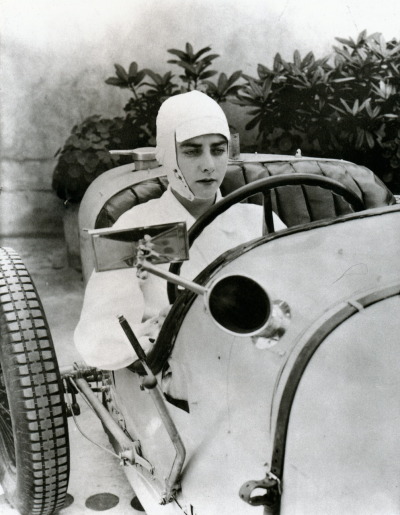
There may not be much about Dame Annie in the press at the moment, but I did wonder about this 12" single cover.

It looks like a posed photo to me, for a start where are her goggles? Don't recognize the pilot or the voiturette. Maybe from an old film or a magazine, like this Vogue shoot from 1927 featuring actress Colette Salomon, who I believe may actually have competed in a race or two.

Saturday, May 28, 2011

Lingogidda?

See, see the wide horizons glorious blaze!
The setting sun descending low,
Beyond the fervid mountain's brow.
And high Carnedda's top reflects the lingering rays:
But now yon russet heath attracts our eyes,
Where sable Lingogidda's vapours rise.

Here oft 'tis said
The wand'ring spirits of the dead,
By magic's awful art confin'd,
Th' affrghted hind and rustic dame
See glowing in the lambent flame,
Hear howling in the wind.

These are the closing lines of the poem Petraeia by the artist Thomas Jones of Pencerrig and published in a book of 1791 "Picturesque Guide to the Beauties of South Wales."

Now the reference to the Carneddau hills is clear enough and on a late summer evening the sun certainly does reflect from its brow as the painter says, but can anyone tell me about Lingogidda? I guess the poem refers to corpse candles, the spontaneous combustion of methane and phosphane you get over bogland and, no doubt, bogland around Pencerrig. Lingogidda? Llyn Gogidda? There's a verb gogyddio - which refers to making millstones but who knows?


Friday, May 27, 2011

Comment is Free ..ish

It's always interesting when readers comment on posts that have disappeared off the front page months or even years before. Since they are moderated, unlike more immediate posts, I get to read them, but who else? I think this recent anonymous comment is the longest one the blog has ever received and it makes some good points. So rather than let it languish in the depths I'm reposting it here:

"I think what the Elystan Glodrydd event at Llanbister last year showed was that there is not enough knowledge of the area's history, and many people outside Wales had not realised how intimately connected they were to Radnorshire, not that this area had been a rich centre of welsh culture or that there had been any local welsh rulers and princes, but assumed it was just pure marcher territory.

This is one of the many reasons why Dai Hawkins' translation of Ffrancis Payne's work is of such importance - he has unlocked a treasure-trove of knowledge and rich welsh culture that was only otherwise available to those who could read Payne's work in Welsh.

The princes and kingdoms of Gwynedd, Powys and Deheubarth are all often quoted by historians, culture experts and tourism promoters, but Rhwng Gwy a Hafren, Mealienydd and Elfael are names almost completely unknown to the vast majority of people in Britain. Go into any major bookshop in Britain and look at the history section allotted to Wales - less than a dozen books are squeezed in, almost as an after-sight. Ireland and Scotland have overflowing shelves. This in part must speak to a lack of connectivity to Welsh roots. If you are a McTavish (etc), you know not only what clan you belong to but exactly where in the world your people came from - not just 'Scotland' but the precise locale. So, consciousness of Scottishness and kinship is easy to gain, and there is interest all over the world. Some may say "oh but its all such bunkum" etc. Some of it may be, but the numbers of people who came from across the planet to share in the celebration of the year of homecoming in Scotland is testament to the power of a sense of a belonging and identity, and the historical threads that bring people together. Each year in Scotland, clan gatherings occur, bringing people from the world to the place, powerfully harnessing history and family together in celebration, to enjoy the ties of kinship.

The day at Llanbister last October had a special quality about it, which only those who were there could fully appreciate. It was not designed to be mournful like the event at Cilmeri, nor nationalistic, but rather a simple celebration of a forgotten history and the bringing together of long-separated branches of a family to mark a thousand year anniversary. It was a chance for people to come from all over Britain, and places as far away as California to visit and learn about a place from where they sprung and have a great time doing so.

Most importantly it was a fun and thoroughly enjoyable warm-hearted, family gathering that connected people to a very old song that hadn't been sung for hundreds of years. When was the last time that the elegy to Cadwallon ap Madog, prince of Maelienydd, written by Cynddelw Brydydd Mawr had been read out in Welsh to such a gathering in Radnorshire? When else have any of the ‘5 Royal Tribes of Wales’ gathered happily together, without coming to blows! It was a quite historical gathering of related families, with a shared history.

We all had an enjoyable time and the day was full of smiles, pleasure, and joy at discovering how good it was to have a shared Welsh origin and a strong connection with a history that has been almost completely forgotten. It was positive, embracing and welcoming, leaving cheerful and pleasurable memories for people to hold forever. It enabled the misty history of the past to catch up with the present in a happy way.

In so doing, it played a part in bringing Radnorshire to the fore and the story of the place’s history to people from afar who had no idea how beautiful the place is, nor how fascinating its history and hospitable its local community.

I’m sure Rebecca didn’t mind that for just one day, the name of Elystan rang out joyfully in the hills around Llanbister, echoing along with the names of people like Cadwallon ap Madog, Einion Clud and Phylip Dorddu, and a wonderfully enjoyable and special day was shared by many."