Monday, September 27, 2010

Around the Radnorshire Blogs

Llandod exiles might be interested in the Radnor Bird blog and their excellent snaps of the feathered inhabitants of the Spa town's famous Lake. Plus, of course, the newly arrived family of otters. See here.

I seem to remember that some of the last otter hunts would have been on the Wye around Builth in the mid 1970s. So some things, at least, have changed for the better.

Y Dysgwr Araf has recently revived his Welsh language blog. While landodlip seems to have called it a day after being threatened with m'learned friend.

Presteigne blogger Ian Marchant was recently lifted for non-payment of parking fines. See his old blog, or the new website. Now I was recently in Presteigne and ended up in the car park above the High Street, off Heol Joe Deakins. The pay and display machine was out of order and, by the look of things, had been for quite a while. Of course there were plenty of the usual signs threatening dire consequences for failure to display the necessary ticket. So what should a visitor do? Risk leaving the car and ending up with a fine or clamped by infallible authority, or just drive on? No wonder the car park was virtually empty.

Sunday, September 26, 2010

Nothing In the Papers

In the summer of 1844 the English papers highlighted a Radnorshire wedding in the parish of Llanstephan. A blind former blacksmith from Glasbury, one William Thomas, aged 87, married Margaret Pugh, a 16 year old local girl. No doubt the papers would have been even more shocked if they had followed the story through, as by the time of the 1851 Census the happy couple had three children.

Unfortunately the Census also informs us that William, who was indeed a blind former blacksmith, was a sprightly sixty four year old, while wife Margaret was thirty eight, ages which are confirmed in census returns both before and after their marriage. I wonder what the marriage certificate says?

Sunday, September 19, 2010

The National Newspaper of Wales

OK let's be fair, maybe they can't do an ลต!

Oh and did Catrin really have a surname? Anyway enough of statues to victims, how about a memorial to Owain's daughter Gwenllian of Cenarth, St Harmon. According to some her household carried on fighting well into the 1420s and she was also the subject of some very fine poems.

The New Remembrancers

"Ripping up the stereotypes" the Western Mail boasts of its new series on the history of Wales. I wonder if at the end of the exercise we'll have to add "and creating some new ones."

It would help if in his introduction Dai Smith would call a spade a spade. "A tsunami of truth-telling unwelcome to myth-makers and know-nothings alike." That sounds great but what does it mean? If the know-nothings include that embarrassing stuff you find on tea-towels such as Welsh being the oldest language in Europe, all well and good. But who are the myth-makers? Gwynfor Evans? I'd like to know.

Anyway exiles and skinflints can read the first contribution "Did we really descend from the Celts?" here. I can't say I was impressed - on the printed page it looked a right mess - and shouldn't an article on Welsh origins at least mention DNA.

I think it's a bit of a scandal that so little DNA testing has been done in Wales. As far as I can see we still seem to be relying on the tiny samples taken during the BBC's "Blood of the Vikings" series a few years ago. The sample sites for that were particularly ill-chosen: Llangefni, Llanidloes - slap bang in the middle of a 16C plantation that gave rise to surnames such as Wigley, Jarman and Peate, and Haverfordwest. All interesting locations in themselves of course but hardly typical. If anyone can point me to some recent work on Welsh DNA please do.

Thursday, September 16, 2010

Drawing Lines On Maps

No doubt Radnorshire always proved a bit of a nuisance to the one-size-fits-all delusions of the Boundary Commission.

Back in the 1940s they wanted to amalgamate the county with Breconshire and Herefordshire. As much as I would like to see the return of those parts of the March lost in 1535, I'm sure the proposal was more about extending the borders of England rather than those of Wales.

By the early Sixties the Commission had come up with another wizard idea, to merge Radnorshire and Breconshire with Monmouthshire. The Times even had an editorial about it, they were worried the proposal might dilute Monmouthshire's Englishness!

In the end of course they created Powys. Why? Because Welsh counties had a lower average population than those in England. Oh and because bigger counties would save cash. Yeh right.

Sunday, September 12, 2010

Cors y Llyn,

The stunted Scots Pines at Cors y Llyn


Old Ad

By 2010 you'd be hard put to purchase a pair of Y-fronts in the Spa town, never mind upmarket, posh stuff. Thank heavens for Tesco's.

Saturday, September 11, 2010

Greater Radnorshire

Since the American Senate functions with just 100 elected members, Powys County Council can hardly complain about the Boundary Commission's proposal to axe 15 councillors and reduce the chamber to 64.

Radnorshire Councillors are to be congratulated on trying to maintain the county's separate identity during this process of redrawing of constituency borders. At the same time merging Aberedw with Erwd has a lot of merit. No doubt our members see it as a Breconshire takeover, but that needn't be so. It was just an oversight of the 1535 Act that Builth Hundred was included in Breconshire in the first place, historically it was always tied much more closely to its Radnorshire neighbours. Simple solution, transfer all the Buallt seats to the Shire Committee for Radnorshire.

Thursday, September 09, 2010

Llandeglau? Where's That Then?

You can't really blame Powys Highways for some of the rather dubious bilingual signs appearing on Radnorshire roads - after all they're only following the advice of Bwrdd yr Iaith's Place-Names Standardization Team.

The latest example I've spotted is Llandeglau/Llandegley. I can see how this name Llandeglau has been created, and it is surely a creation rather than a name with any historical validity. No doubt it originated with the book Rhestr o Enwau Lleoedd / A Gazetteer of Welsh Place-Names (Elwyn Davies, 1967) and comes about from a standardisation exercise where incorrect English spellings ending in ley are Cymricised as lau, for example Dolgelley/Dolgellau. Now Llandegley is an incorrect spelling, but of Llandegle not Llandeglau. Richard Morgan's little book has an example of Llandegle dating back to 1291, while it is also the form used in the 15C bard Lewis Glyn Cothi's praise poem to a local patron, one Ieuan ap Llywelyn Fychan: Hyd Glud a Llandegle wen - to the Radnor Forest and fair Llandegle. The spelling Llandegley appeared much later on the scene in 1557. More recently Ffransis Payne, who lived in the parish, used the form Llandegle in his wonderful volumes about Radnorshire, Crwydro Sir Faesyfed.

The sensible solution would have been to just use the correct Welsh spelling Llandegle on the signs. This would have been cheaper, historically accurate and would not leave Radnorians thinking that their pronunciation of the name was English, when in reality it is Welsh and as old as the hills. Hopefully someone will get it right when they do the bilingual version of this.

Sunday, September 05, 2010

From A Family Album, 1

My great grandparents Charles and Mary Jones and their offspring in a photograph taken around 1897.

Mary was born in Llansawel and brought up in Llandeilo Fawr in Carmarthenshire - she's always shown in the census returns as speaking both Welsh and English. Her husband was born in Llandrindod and is always shown as speaking only English. At the same time my grandfather, he's the lad with his hands in his pockets, said that the two sometimes conversed in Welsh.

Two of Charles' brothers, who moved away from Radnorshire, are shown in the census returns as being able to speak Welsh. One was married to a monoglot Welsh speaker from Llangammarch and the other, with a Radnorian wife, lived in Bargoed where the entire family is shown as being bilingual. I found a similar situation with my mother's family and it does make me wonder if Welsh was quite as dead in Victorian Radnorshire as most suppose.

I once asked my great uncle, the little lad seen sat on his father's knee, about his parents ability to speak Welsh, I might just as well have accused them of being thieves. I think his animus suggests that the situation in Victorian Radnorshire, well in the west, was similar to that in Victorian Limerick where:

"Up to about 1830, or so, the entire Rathkeale countryside spoke Irish. Then the new schools, the pro-English clergy , the influence of the landlords and agents, as well as the political leaders, the use of English in the law-courts, at gatherings and public meetings, in sermons and religious functions, the growing public feeling that Irish was a dying language, a mark of a degraded people who were not 'decent' - all this combined to produce a new people who from youth were pledged to speak no Irish. And so in West Limerick you had many who persisted in trying to speak a broken English and never again uttered a word in the old tongue they knew so well."

I wonder if that last sentence might be echoed in O. M. Edwards' reported comments about Radnorshire speech:

"Such a jumbled up, untidy hybrid language, that isn't proper Welsh or English."

Given the context I think Edwards was speaking about the west of the county next to Builth Hundred rather than the older Herefordshire influenced dialects of the east. I wonder when Edwards formed this opinion? If it was earlier in his life then it would make sense in describing a generation of older Welsh speakers trying to get by in English. A few years later and it wouldn't be an accurate description of west Radnorshire speech at all, in which case he might just have been being rude.

Never Had It So Good

It seems that an A35 van from the Automobile Palace was the machine of choice for many a discerning Radnorshire motorist of the late 50s and early 60s. OK so maybe it might have had to be reversed up the steepest hills but, hey, you didn't have to pay purchase tax! What a pity the photographer failed to focus on that all important FO number plate in this grey example.

The FO plate lasted from FO1 released in 1903 up until OFO 303N, which was no doubt issued by Mr Hinksman from the Gwalia in September 1974. I presume ditching local number plates was another of Ted Heath's great ideas.

This post was inspired by Radnorian blogger in exile Gwenddolen who reminisces about her family's green A35 here. Of course former racing driver James Hunt also used a green A35 van as his road car, his philosophy being that a car was only fun to drive at it's limit and the limit of an A35 wasn't too far over the legal speed limit - I guess it was also useful for transporting his budgies.

Wednesday, September 01, 2010

Welsh Genealogies Online

Back in 2006 I was excited to read a BBC news item announcing that Peter Bartrum's lifetime's work of bringing order to the old bardic genealogical manuscripts was going online. Of course reading the small print of the article was a bit of a dampener, since the project would take three years to complete. It's getting on for four years now and, as far as I can tell, the searchable online database is yet to appear. What has appeared are scans of pages from the 26 volumes of Bartrum's published Welsh Genealogies, I'd guess that around half of the pages of Radnorshire and surrounding interest have appeared so far.

As well as helping family historians, the genealogies make sense of many of the names in the bardic poetry and other historical documents. Take this page for example, which Bartrum designates Elystan Glodrydd 9. Here we find the family background of the great Welsh captain and bardic patron from the 100 Years War, Sir Rhisiart Gethin - a man wealthy enough to loan Joan of Arc's executioner, the Duke of Bedford, a thousand pounds in order to pay the English troops in France. According to a recent book, his father Rhys Gethin of Llanwrtyd was Glyndwr's general and, incidently, the mythical leader of the firebombing campaign of the 1980s.

Without a placename index these scans will be difficult to navigate to those of us unfamiliar with the published volumes. To help any Radnorians with an interest in these old genealogies and who are impatient for the fully searchable resource to appear, the following list - and I'm certain to have missed some - of family groups of local interest might be useful:

Elystan Glodrydd, everything really from 1 to 48 - not all these are up yet, Rhys ap Tewdwr 14 to 26 - not all are up, Bleddyn ap Cynfyn 5 & 46, Cogfran, Y Dean Du, Drymbenog 1 & 2, Einion ap Llywarch 11, Gwirfaeth, Herast, Hywel Athro, Hywel Fain, Ieuan Ddu of Maelienydd, Irien, Llowdden 7, Llywarch ap Bran 9, Madog Cristyn, Padriarc 1 & 2, Paen of Ludlow, Philip Baker, Rhirid Flaidd 2.

Some to look out for as they appear:

Aubrey, Baskerville, Bull, Havard, Heilin Du, Hoby, Holl of Harpton, Hywel Gethin, Knill, Llywarch ap Bran 10, 11 & 12, Philpot, Whitney,

Thursday, August 26, 2010

Next Stop New Radnor

The current issue of MotorSport has this snap of Ferrari 250GTO chassis number 3505GT on the cover.

As I've mentioned before, as well as racing the car at Le Mans and winning the Tourist Trophy for BRP during the summer of 1962, Innes Ireland also used the machine as a roadcar, driving it up to the circuits from his home in Radnorshire. His wife even used it to do her shopping.

How much is the car worth? Well Radio Two DJ Chris Evans recently paid £12 million for a GTO with a lot less sporting history. There again it was red ......

Tuesday, August 24, 2010

Cheers

Danzy Jones is a whisky liqueur named after its originator, a Builth stonemason, and seemingly sold until the 1940s in the town's Fountain Inn. The recipe has recently been revived by Danzy's grandson and is now sold in Harrods, although presumably not to the Duke of Edinburgh.

Like most Builth achievements there's a Radnorshire twist to the tale, since Danzy's father was from Aberedw and, although born in Maesmynis, Danzy himself was brought up in Llanfaredd. But hey, would I want to take anything away from Builth? Certainly not! I'm more interested in the forename Danzy, variously spelt Danzey, Danzie, Dansey, Dansy etc. etc.

If you were looking for a name that could only come from Radnorshire you could do worse than hit upon, say, Danzey Bufton. Although in truth the name is found mainly in the old Radnorshire family, the Sheens. Where there's a Dansey you'll more often than not find a Sheen somewhere in the family tree. A pity that notorious Radnorian murderer and Spitalfields bully Bill Sheen didn't carry the forename, who knows, one of Dickens' most famous characters might have been a Dansey.

The origins of the forename in Radnorshire probably date back to a marriage in Glasgwm in the first decade of the 18C between a Maria Dauntsey and a Thomas Sheen. They had a grandson christened Dantesy and the name, in it's numerous spelling variations, soon found favour in the Colwyn Hundred.

Wednesday, August 18, 2010

Book Review - Elenydd

It might be an idea for some wealthy patriot to buy up all the copies of this pretty little book and pulp them. After all Gwasg Carreg Gwalch's volume will probably sell best to tourists, and before you know it our "last wilderness" will be gone.

Of course this is already happening, with 4x4s churning up mountain tracks and the industrialisation of the skyline with wind-farms of very little environmental benefit.

Anthony Griffiths' photographs prove that if you are prepared to get out and about early, in the morning, especially on bright days in winter, then you'll take excellent photographs. No doubt the pictures' impact are diminished a little by the small format (220x220mm) but the colour reproduction is excellent and at £12 the book is inexpensive.

Despite the bilingual format the further reading list contains no Welsh language books or articles, those by Cledwyn Fychan for example. It does have Erwyd Howells but misses out on Ruth Bidgood. Essentially Elenydd is a tourist book, there are seemingly no people in this wilderness, no ponies, no sheep and no rain. The text is that of an informative visitor's guidebook, there is little room for the old mountain communities and their story here.

Thursday, August 12, 2010

More Normans

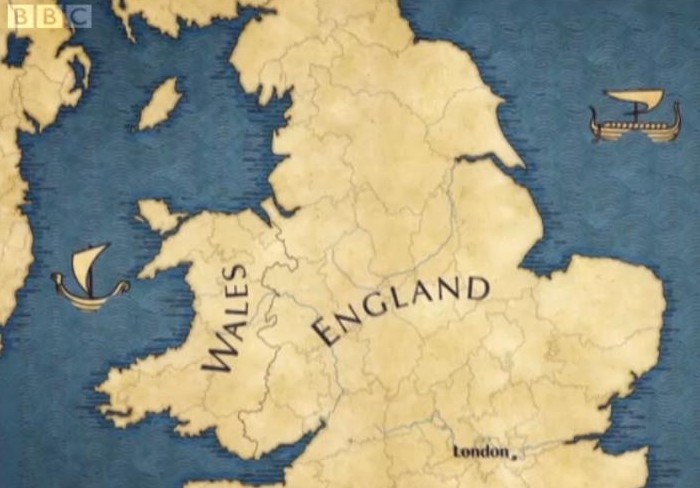
Anyone notice this map used in last night's second episode of Robert Bartlett's The Normans?

Now I know that a few places in Gwent do appear in the Doomsday Book, likewise a handful in Radnorshire, but this can't be mapping that since Flintshire is included in Wales even though numerous places there are in Doomsday. No, this is an attempt to draw the modern border but with Monmouthshire placed in England. An accident or an agenda? Make up your own mind.


Bartlett's BBC2 efforts all seem a bit Arthur Mee, although I'd never heard of the homicidal Alice of Abergavenny, surely an ancestor of Goldie Lookin' Chain's Nutter Missus. The real joy of the series is in the various associated programmes - Nina Ramirez clumping up hillsides and over parquet floors in spiked heels. I know academics on the telly like to have a sartorial gimmick but wouldn't a bow-tie or a deerstalker be less damaging to the environment? Then we had Dan Snow tramping through the Southern March visiting sites chosen for their photogenic qualities rather than their connection with the Norman Invasion. A walk from Wigmore to Abbeycwmhir would have made for a more insightful program - although the perspicacious Radnorians have long-ago recycled the stone from the castles en route. Best bit of Snow's walk was Mrs Lucas-Scudamore of Kentchurch hurriedly directing Dan away from the front door to a gazebo for a chat. She was probably worried about her floors.

Wednesday, August 11, 2010

Blog Watch

Aficionados of women in motorsport should check out this new blog.

As someone who finds modern day rallying and racing about as pointless as bungee jumping, I'm obviously more interested in the old-timers. The pre-war competitors seem much more interesting than their present day sisters. and quite often this is because of their adventures away from the track.

Perhaps this new blog misses out a bit by focusing on the records rather than the characters of those determined individuals - yes, for example, Joan Richmond did compete in the 1932 Monte Carlo Rally, but more interestingly she drove her little Riley to the start ..... overland from Australia.

Have women made any progress at all in motorsport over the last few decades? Back then photographers insisted on taking snaps of the leading racers powdering their noses, nowadays it's soft porn. One group who do have something of the spirit of their predecessors are the female Arab rally drivers from the Middle East featured on the blog. They're certainly challenging the status quo.

Friday, August 06, 2010

Our French Neighbours

While trying to keep up with current events, I found this interesting quote in the 1873 Christmas Eve edition of the Western Mail, it's in a profile of the Breconshire MP Godfrey Morgan:

"It is almost a paradox, but it is, nevertheless, true that Breconshire, throughout the whole of which the Welsh language is constantly in use, is less essentially Welsh than Herefordshire, where the ancient tongue has almost entirely fallen into desuetude. The population of Breconshire consists, in a great measure, of a Norman colony, which has gradually adopted the language of the country in which its lot has been cast, while Herefordshire is a Welsh county whose inhabitants have lost the use of their native tongue."

The writer uses these "ethnological grounds" to explain the Brecknockians supposed aversion to political dissent and "the supremacy of the Conservative cause in the county." Of course the secret ballot soon put paid to that little theory as the Liberals won the seat when Morgan became the 2nd Lord Tredegar in 1875 and held on until it was abolished and merged with Radnorshire in 1918.

Party politics aside there is some truth in lowland Breconshire's French character, after all it was the bard Hywel Dafi who celebrated the French families of Brycheiniog, where he pointed out that "every tribe has the fruit of French blood" - bobllwyth gyda ffrwyth gwaed ffrainc. While French surnames like Havard are still common enough, others, the Bullens and Boys for example adopted the Welsh patronym system to eventually emerge with surnames such as Williams. That excellent little book The Surnames of Wales relates a sad tale of a woman named Walby who sought relief in Crickhowell in the 1880s, her real surname was the fine old Breconshire French name Walbeoff, but her husband had changed it "because people laughed."

Wednesday, August 04, 2010

The Normans

Ever the optimist I'm looking forward to the BBC's new series on the Normans, which starts tonight. Usually my optimism is misplaced, the most recent example being David Dimbleby's anglocentric series Seven Ages of Britain, which informed us that until a few Irish monks turned up in Scotland in the mid 500s, Britain was pagan ...... heaven knows where he thought St Patrick came from. I used to think that such nonsense was born of ignorance rather than deliberate falsification, now I'm not so sure. As Ieuan Brydydd Hir said of an earlier generation of English historians:

The false historians of a polished age
Show that the Saxon has not lost his rage,
Though tamed by arts his rancour still remains:
Beware of Saxons still, ye Cambrian swains.

Monday, July 26, 2010

Bilingual Sign?

We all know that bilingual signs enrage the Colonel Blimp types but isn't this a bit much? First off it isn't a bilingual sign at all - as far as I know the place has never had an English moniker - what it shows are two alternative spellings of the same Welsh name.

Anyone looking at old records knows that until recently placenames and even surnames had no established forms, with folk spelling as the mood took them. I can understand that where a non-standard Welsh spelling has gained wide usage, Rhayader for example, then there's a case for its continued use. Here the sensible thing would have been to stick with the modern standard spelling and ditch the lower one, rather than pretend it's English.