Tuesday, October 19, 2010

Tales from the Riverbank
 It's 58 years to the day since a group of intrepid militants, presumably from the Welsh Republican Movement although no-one was ever convicted, exploded a bomb on that little seen Radnorshire landmark, the Fron aqueduct (see postcard view of its construction.)
A couple of days later the Queen opened the Claerwen reservoir. Somewhere or other I've got some newspaper clippings of your blogger waving the Union Jack outside the W. H. Smith shop in Llandod's Station Crescent. If they turn-up I'll post them!
Sunday, October 17, 2010
Home Front
During the Second World War the elegant Radnorshire Spa town of Llandrindod was seen as something of a safe haven, remote from the bombed cities of England and Wales.
The number of well-to-do folk seeking refuge in the town provided a few local landlords with the opportunity for a spot of war-time profiteering. One local Alderman, for example, bought and furnished a house for £850, which he then let out for the princely sum of 10 guineas a week - the house having previously been let, unfurnished, for 7/6*.
Now there were strict wartime regulations against such profiteering and the Alderman soon found himself before the local bench, of which he was himself a senior member. Unsurprisingly the town's magistrates found him not guilty, a verdict which seemed par for the course for cases of rent racketeering in which they sat in judgement.
Having perhaps given up on the local magistrates, the authorities moved one well-publicised case of black marketeering to a Cardiganshire bench. This involved a retired naval officer who had come to Llandrindod to sit out the war and was receiving groceries from a local shop without being registered to do so. The Commander's wife did not help her husband's cause when she complained to the investigating officer that, "We are not nobodies. We are gentry, and during this war the gentry have had to put up with a lot of rudeness."
Unmoved by the good lady's heartfelt analysis of contemporary social trends the Cardiganshire magistrates fined her husband an eye-watering £380 with £21 costs ..... the grocer got away with a tenner.
* I apologize to any younger readers confused by the terminology of proper money, blame
Saturday, October 16, 2010
Slow News Day
 Somehow I can't see Llandrindod High School's Sports Day featuring in the London papers any time soon. Back in 1929 it made the pages of the Mirror.
Old News
An ex-soldier must have had quite a shock when his 22 year old girlfriend Emelia turned up on his Rhayader doorstep in the summer of 1946. The enterprising young lady having somehow managed to smuggle herself into the country from her native Italy. Local magistrates took pity on the girl and she avoided a prison sentence, although they did recommend deportation, doubtless to the relief of the ex-soldier's wife.
Monday, October 11, 2010
The Winter Assizes of 1897
Something not in short supply in late 19C Radnorshire were explosives - the Birmingham waterworks provided a ready souce of pilferred gelignite and detonators for those intent on causing a bang. One such was a tramp, George Jones, who decided to blow the safe at the New Radnor railway station. Having successfully relieved the Great Western Railway Company of £5 and a bottle of ink, Jones made the common mistake of heading for the pub rather than making good his escape - verdict: eight months with hard labour.
The GWR were also the victims in the next case where three local men - Weaver, Clarke and Powell, were charged with stealing twelve bottles of wine and a quantity of onions from Presteigne railway station. Constable Hitchman, who had secured two of the accused in the cells, reported that Clarke had shouted out, "Stand true, Weaver." To which Weaver, no doubt anxious to prove false Radnorshire's reputation of being a land without poets, replied, "Like a bell of brass which never cracks." - Verdict: Powell and Clarke, four months with hard labour; Weaver, three months.
How would these cases be treated today? Well the safe cracker would surely have been looking at a far longer sentence, while the wine thieves would be looking at community service.
Thursday, October 07, 2010
Radnorshire Trivia
The old wooden bridge across the Wye at Newbridge didn't look too solid. In 1911 it was replaced in reinforced concrete, designed and built by the same people responsible for the banking at the Brooklands motor racing circuit.
Tuesday, October 05, 2010
A Popular Insurrection
 Radnorshire Rebeccaites on the Edw, December 1932.
If the rapid retreat of Welsh in 19C Radnorshire is reminiscent of language shift in Ireland, then the London press were also quick to draw Irish comparisons when reporting the activities of the county's Rebeccaites. Throughout the Victorian period and beyond this body openly challenged the authorities with acts of public lawbreaking, armed marching gangs, intimidations and pranks. Not just in respect of the fisheries but also against profiteering shopkeepers and the like.
Much to the disgust of outsiders the Radnorshire magistrates were loath to hand out heavy fines or even convictions to the handful of rioters brought before the courts. After all the local landlords knew that the Rebeccaites had widespread public support. In most respect Radnorshire was one of the most law-abiding districts in the kingdom - during its 90 year plus existence the Radnorshire Constabulary only investigated four murders for example. But where there was perceived injustice the populace turned to Rebecca.
As far as I know the best account of these activities is "The Second Rebecca Riots: A Study of Poaching on the Upper Wye" by historian David Jones. It was published in the journal Llafur, volume 2 no. 1 - spring 1976. A more recent account can be found in the Keith Parker book Parties, Poll and Riots - Politics in 19C Radnorshire. There is plenty in the contemporary press of course - much of which can be accessed online via our National Library.
NOTE: It should be noted that far from being mere ruthless exploiters of salmon stocks the Victorian Rebeccaites were campaigning against the commercial night-netting activities of landowners such as the Duke of Beaufort, who were taking 6000 fish a season from the Wye between Ross and Hereford.
Monday, September 27, 2010
Around the Radnorshire Blogs
 Llandod exiles might be interested in the Radnor Bird blog and their excellent snaps of the feathered inhabitants of the Spa town's famous Lake. Plus, of course, the newly arrived family of otters. See here.
I seem to remember that some of the last otter hunts would have been on the Wye around Builth in the mid 1970s. So some things, at least, have changed for the better.
Y Dysgwr Araf has recently revived his Welsh language blog. While landodlip seems to have called it a day after being threatened with m'learned friend.
Presteigne blogger Ian Marchant was recently lifted for non-payment of parking fines. See his old blog, or the new website. Now I was recently in Presteigne and ended up in the car park above the High Street, off Heol Joe Deakins. The pay and display machine was out of order and, by the look of things, had been for quite a while. Of course there were plenty of the usual signs threatening dire consequences for failure to display the necessary ticket. So what should a visitor do? Risk leaving the car and ending up with a fine or clamped by infallible authority, or just drive on? No wonder the car park was virtually empty.
Sunday, September 26, 2010
Nothing In the Papers
In the summer of 1844 the English papers highlighted a Radnorshire wedding in the parish of Llanstephan. A blind former blacksmith from Glasbury, one William Thomas, aged 87, married Margaret Pugh, a 16 year old local girl. No doubt the papers would have been even more shocked if they had followed the story through, as by the time of the 1851 Census the happy couple had three children.
Unfortunately the Census also informs us that William, who was indeed a blind former blacksmith, was a sprightly sixty four year old, while wife Margaret was thirty eight, ages which are confirmed in census returns both before and after their marriage. I wonder what the marriage certificate says?
Unfortunately the Census also informs us that William, who was indeed a blind former blacksmith, was a sprightly sixty four year old, while wife Margaret was thirty eight, ages which are confirmed in census returns both before and after their marriage. I wonder what the marriage certificate says?
Sunday, September 19, 2010
The National Newspaper of Wales
 OK let's be fair, maybe they can't do an ŵ!
Oh and did Catrin really have a surname? Anyway enough of statues to victims, how about a memorial to Owain's daughter Gwenllian of Cenarth, St Harmon. According to some her household carried on fighting well into the 1420s and she was also the subject of some very fine poems.
The New Remembrancers
 "Ripping up the stereotypes" the Western Mail boasts of its new series on the history of Wales. I wonder if at the end of the exercise we'll have to add "and creating some new ones."
It would help if in his introduction Dai Smith would call a spade a spade. "A tsunami of truth-telling unwelcome to myth-makers and know-nothings alike." That sounds great but what does it mean? If the know-nothings include that embarrassing stuff you find on tea-towels such as Welsh being the oldest language in Europe, all well and good. But who are the myth-makers? Gwynfor Evans? I'd like to know.
Anyway exiles and skinflints can read the first contribution "Did we really descend from the Celts?" here. I can't say I was impressed - on the printed page it looked a right mess - and shouldn't an article on Welsh origins at least mention DNA.
I think it's a bit of a scandal that so little DNA testing has been done in Wales. As far as I can see we still seem to be relying on the tiny samples taken during the BBC's "Blood of the Vikings" series a few years ago. The sample sites for that were particularly ill-chosen: Llangefni, Llanidloes - slap bang in the middle of a 16C plantation that gave rise to surnames such as Wigley, Jarman and Peate, and Haverfordwest. All interesting locations in themselves of course but hardly typical. If anyone can point me to some recent work on Welsh DNA please do.
Thursday, September 16, 2010
Drawing Lines On Maps
 No doubt Radnorshire always proved a bit of a nuisance to the one-size-fits-all delusions of the Boundary Commission.
Back in the 1940s they wanted to amalgamate the county with Breconshire and Herefordshire. As much as I would like to see the return of those parts of the March lost in 1535, I'm sure the proposal was more about extending the borders of England rather than those of Wales.
By the early Sixties the Commission had come up with another wizard idea, to merge Radnorshire and Breconshire with Monmouthshire. The Times even had an editorial about it, they were worried the proposal might dilute Monmouthshire's Englishness!
In the end of course they created Powys. Why? Because Welsh counties had a lower average population than those in England. Oh and because bigger counties would save cash. Yeh right.
In the end of course they created Powys. Why? Because Welsh counties had a lower average population than those in England. Oh and because bigger counties would save cash. Yeh right.
Sunday, September 12, 2010


Old Ad

By 2010 you'd be hard put to purchase a pair of Y-fronts in the Spa town, never mind upmarket, posh stuff. Thank heavens for Tesco's.
Saturday, September 11, 2010
Greater Radnorshire
Since the American Senate functions with just 100 elected members, Powys County Council can hardly complain about the Boundary Commission's proposal to axe 15 councillors and reduce the chamber to 64.
Radnorshire Councillors are to be congratulated on trying to maintain the county's separate identity during this process of redrawing of constituency borders. At the same time merging Aberedw with Erwd has a lot of merit. No doubt our members see it as a Breconshire takeover, but that needn't be so. It was just an oversight of the 1535 Act that Builth Hundred was included in Breconshire in the first place, historically it was always tied much more closely to its Radnorshire neighbours. Simple solution, transfer all the Buallt seats to the Shire Committee for Radnorshire.
Radnorshire Councillors are to be congratulated on trying to maintain the county's separate identity during this process of redrawing of constituency borders. At the same time merging Aberedw with Erwd has a lot of merit. No doubt our members see it as a Breconshire takeover, but that needn't be so. It was just an oversight of the 1535 Act that Builth Hundred was included in Breconshire in the first place, historically it was always tied much more closely to its Radnorshire neighbours. Simple solution, transfer all the Buallt seats to the Shire Committee for Radnorshire.
Thursday, September 09, 2010
Llandeglau? Where's That Then?
 You can't really blame Powys Highways for some of the rather dubious bilingual signs appearing on Radnorshire roads - after all they're only following the advice of Bwrdd yr Iaith's Place-Names Standardization Team.
The latest example I've spotted is Llandeglau/Llandegley. I can see how this name Llandeglau has been created, and it is surely a creation rather than a name with any historical validity. No doubt it originated with the book Rhestr o Enwau Lleoedd / A Gazetteer of Welsh Place-Names (Elwyn Davies, 1967) and comes about from a standardisation exercise where incorrect English spellings ending in ley are Cymricised as lau, for example Dolgelley/Dolgellau. Now Llandegley is an incorrect spelling, but of Llandegle not Llandeglau. Richard Morgan's little book has an example of Llandegle dating back to 1291, while it is also the form used in the 15C bard Lewis Glyn Cothi's praise poem to a local patron, one Ieuan ap Llywelyn Fychan: Hyd Glud a Llandegle wen - to the Radnor Forest and fair Llandegle. The spelling Llandegley appeared much later on the scene in 1557. More recently Ffransis Payne, who lived in the parish, used the form Llandegle in his wonderful volumes about Radnorshire, Crwydro Sir Faesyfed.
The sensible solution would have been to just use the correct Welsh spelling Llandegle on the signs. This would have been cheaper, historically accurate and would not leave Radnorians thinking that their pronunciation of the name was English, when in reality it is Welsh and as old as the hills. Hopefully someone will get it right when they do the bilingual version of this.
Sunday, September 05, 2010
From A Family Album, 1
 My great grandparents Charles and Mary Jones and their offspring in a photograph taken around 1897.
Mary was born in Llansawel and brought up in Llandeilo Fawr in Carmarthenshire - she's always shown in the census returns as speaking both Welsh and English. Her husband was born in Llandrindod and is always shown as speaking only English. At the same time my grandfather, he's the lad with his hands in his pockets, said that the two sometimes conversed in Welsh.
Two of Charles' brothers, who moved away from Radnorshire, are shown in the census returns as being able to speak Welsh. One was married to a monoglot Welsh speaker from Llangammarch and the other, with a Radnorian wife, lived in Bargoed where the entire family is shown as being bilingual. I found a similar situation with my mother's family and it does make me wonder if Welsh was quite as dead in Victorian Radnorshire as most suppose.
I once asked my great uncle, the little lad seen sat on his father's knee, about his parents ability to speak Welsh, I might just as well have accused them of being thieves. I think his animus suggests that the situation in Victorian Radnorshire, well in the west, was similar to that in Victorian Limerick where:
"Up to about 1830, or so, the entire Rathkeale countryside spoke Irish. Then the new schools, the pro-English clergy , the influence of the landlords and agents, as well as the political leaders, the use of English in the law-courts, at gatherings and public meetings, in sermons and religious functions, the growing public feeling that Irish was a dying language, a mark of a degraded people who were not 'decent' - all this combined to produce a new people who from youth were pledged to speak no Irish. And so in West Limerick you had many who persisted in trying to speak a broken English and never again uttered a word in the old tongue they knew so well."
I wonder if that last sentence might be echoed in O. M. Edwards' reported comments about Radnorshire speech:
"Such a jumbled up, untidy hybrid language, that isn't proper Welsh or English."
Given the context I think Edwards was speaking about the west of the county next to Builth Hundred rather than the older Herefordshire influenced dialects of the east. I wonder when Edwards formed this opinion? If it was earlier in his life then it would make sense in describing a generation of older Welsh speakers trying to get by in English. A few years later and it wouldn't be an accurate description of west Radnorshire speech at all, in which case he might just have been being rude.
Never Had It So Good
 It seems that an A35 van from the Automobile Palace was the machine of choice for many a discerning Radnorshire motorist of the late 50s and early 60s. OK so maybe it might have had to be reversed up the steepest hills but, hey, you didn't have to pay purchase tax! What a pity the photographer failed to focus on that all important FO number plate in this grey example.
The FO plate lasted from FO1 released in 1903 up until OFO 303N, which was no doubt issued by Mr Hinksman from the Gwalia in September 1974. I presume ditching local number plates was another of Ted Heath's great ideas.
This post was inspired by Radnorian blogger in exile Gwenddolen who reminisces about her family's green A35 here. Of course former racing driver James Hunt also used a green A35 van as his road car, his philosophy being that a car was only fun to drive at it's limit and the limit of an A35 wasn't too far over the legal speed limit - I guess it was also useful for transporting his budgies.
Wednesday, September 01, 2010
Welsh Genealogies Online
Back in 2006 I was excited to read a BBC news item announcing that Peter Bartrum's lifetime's work of bringing order to the old bardic genealogical manuscripts was going online. Of course reading the small print of the article was a bit of a dampener, since the project would take three years to complete. It's getting on for four years now and, as far as I can tell, the searchable online database is yet to appear. What has appeared are scans of pages from the 26 volumes of Bartrum's published Welsh Genealogies, I'd guess that around half of the pages of Radnorshire and surrounding interest have appeared so far.
As well as helping family historians, the genealogies make sense of many of the names in the bardic poetry and other historical documents. Take this page for example, which Bartrum designates Elystan Glodrydd 9. Here we find the family background of the great Welsh captain and bardic patron from the 100 Years War, Sir Rhisiart Gethin - a man wealthy enough to loan Joan of Arc's executioner, the Duke of Bedford, a thousand pounds in order to pay the English troops in France. According to a recent book, his father Rhys Gethin of Llanwrtyd was Glyndwr's general and, incidently, the mythical leader of the firebombing campaign of the 1980s.
Without a placename index these scans will be difficult to navigate to those of us unfamiliar with the published volumes. To help any Radnorians with an interest in these old genealogies and who are impatient for the fully searchable resource to appear, the following list - and I'm certain to have missed some - of family groups of local interest might be useful:
Elystan Glodrydd, everything really from 1 to 48 - not all these are up yet, Rhys ap Tewdwr 14 to 26 - not all are up, Bleddyn ap Cynfyn 5 & 46, Cogfran, Y Dean Du, Drymbenog 1 & 2, Einion ap Llywarch 11, Gwirfaeth, Herast, Hywel Athro, Hywel Fain, Ieuan Ddu of Maelienydd, Irien, Llowdden 7, Llywarch ap Bran 9, Madog Cristyn, Padriarc 1 & 2, Paen of Ludlow, Philip Baker, Rhirid Flaidd 2.
Some to look out for as they appear:
Aubrey, Baskerville, Bull, Havard, Heilin Du, Hoby, Holl of Harpton, Hywel Gethin, Knill, Llywarch ap Bran 10, 11 & 12, Philpot, Whitney,
Thursday, August 26, 2010
Next Stop New Radnor
 The current issue of MotorSport has this snap of Ferrari 250GTO chassis number 3505GT on the cover.
As I've mentioned before, as well as racing the car at Le Mans and winning the Tourist Trophy for BRP during the summer of 1962, Innes Ireland also used the machine as a roadcar, driving it up to the circuits from his home in Radnorshire. His wife even used it to do her shopping.
How much is the car worth? Well Radio Two DJ Chris Evans recently paid £12 million for a GTO with a lot less sporting history. There again it was red ......
Tuesday, August 24, 2010
Cheers
 Danzy Jones is a whisky liqueur named after its originator, a Builth stonemason, and seemingly sold until the 1940s in the town's Fountain Inn. The recipe has recently been revived by Danzy's grandson and is now sold in Harrods, although presumably not to the Duke of Edinburgh.
Like most Builth achievements there's a Radnorshire twist to the tale, since Danzy's father was from Aberedw and, although born in Maesmynis, Danzy himself was brought up in Llanfaredd. But hey, would I want to take anything away from Builth? Certainly not! I'm more interested in the forename Danzy, variously spelt Danzey, Danzie, Dansey, Dansy etc. etc.
If you were looking for a name that could only come from Radnorshire you could do worse than hit upon, say, Danzey Bufton. Although in truth the name is found mainly in the old Radnorshire family, the Sheens. Where there's a Dansey you'll more often than not find a Sheen somewhere in the family tree. A pity that notorious Radnorian murderer and Spitalfields bully Bill Sheen didn't carry the forename, who knows, one of Dickens' most famous characters might have been a Dansey.
The origins of the forename in Radnorshire probably date back to a marriage in Glasgwm in the first decade of the 18C between a Maria Dauntsey and a Thomas Sheen. They had a grandson christened Dantesy and the name, in it's numerous spelling variations, soon found favour in the Colwyn Hundred.
Wednesday, August 18, 2010
Book Review - Elenydd
 It might be an idea for some wealthy patriot to buy up all the copies of this pretty little book and pulp them. After all Gwasg Carreg Gwalch's volume will probably sell best to tourists, and before you know it our "last wilderness" will be gone.
Of course this is already happening, with 4x4s churning up mountain tracks and the industrialisation of the skyline with wind-farms of very little environmental benefit.
Anthony Griffiths' photographs prove that if you are prepared to get out and about early, in the morning, especially on bright days in winter, then you'll take excellent photographs. No doubt the pictures' impact are diminished a little by the small format (220x220mm) but the colour reproduction is excellent and at £12 the book is inexpensive.
Despite the bilingual format the further reading list contains no Welsh language books or articles, those by Cledwyn Fychan for example. It does have Erwyd Howells but misses out on Ruth Bidgood. Essentially Elenydd is a tourist book, there are seemingly no people in this wilderness, no ponies, no sheep and no rain. The text is that of an informative visitor's guidebook, there is little room for the old mountain communities and their story here.
Thursday, August 12, 2010
More Normans
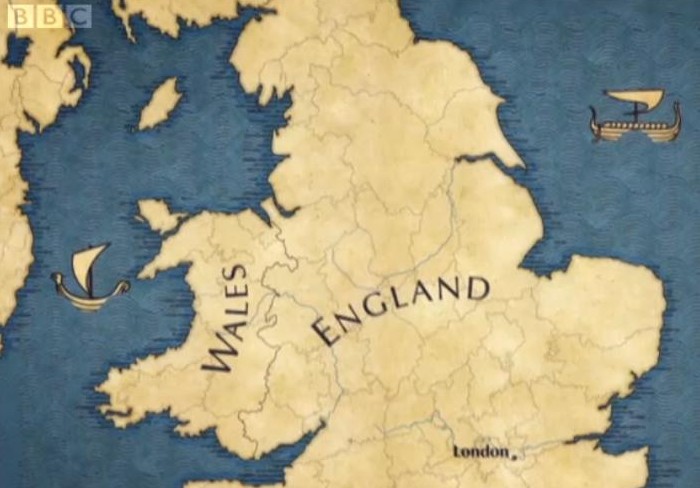 Anyone notice this map used in last night's second episode of Robert Bartlett's The Normans?
Now I know that a few places in Gwent do appear in the Doomsday Book, likewise a handful in Radnorshire, but this can't be mapping that since Flintshire is included in Wales even though numerous places there are in Doomsday. No, this is an attempt to draw the modern border but with Monmouthshire placed in England. An accident or an agenda? Make up your own mind.
Bartlett's BBC2 efforts all seem a bit Arthur Mee, although I'd never heard of the homicidal Alice of Abergavenny, surely an ancestor of Goldie Lookin' Chain's Nutter Missus. The real joy of the series is in the various associated programmes - Nina Ramirez clumping up hillsides and over parquet floors in spiked heels. I know academics on the telly like to have a sartorial gimmick but wouldn't a bow-tie or a deerstalker be less damaging to the environment? Then we had Dan Snow tramping through the Southern March visiting sites chosen for their photogenic qualities rather than their connection with the Norman Invasion. A walk from Wigmore to Abbeycwmhir would have made for a more insightful program - although the perspicacious Radnorians have long-ago recycled the stone from the castles en route. Best bit of Snow's walk was Mrs Lucas-Scudamore of Kentchurch hurriedly directing Dan away from the front door to a gazebo for a chat. She was probably worried about her floors.
Wednesday, August 11, 2010
Blog Watch

As someone who finds modern day rallying and racing about as pointless as bungee jumping, I'm obviously more interested in the old-timers. The pre-war competitors seem much more interesting than their present day sisters. and quite often this is because of their adventures away from the track.
Perhaps this new blog misses out a bit by focusing on the records rather than the characters of those determined individuals - yes, for example, Joan Richmond did compete in the 1932 Monte Carlo Rally, but more interestingly she drove her little Riley to the start ..... overland from Australia.
Have women made any progress at all in motorsport over the last few decades? Back then photographers insisted on taking snaps of the leading racers powdering their noses, nowadays it's soft porn. One group who do have something of the spirit of their predecessors are the female Arab rally drivers from the Middle East featured on the blog. They're certainly challenging the status quo.
Friday, August 06, 2010
Our French Neighbours
While trying to keep up with current events, I found this interesting quote in the 1873 Christmas Eve edition of the Western Mail, it's in a profile of the Breconshire MP Godfrey Morgan:
"It is almost a paradox, but it is, nevertheless, true that Breconshire, throughout the whole of which the Welsh language is constantly in use, is less essentially Welsh than Herefordshire, where the ancient tongue has almost entirely fallen into desuetude. The population of Breconshire consists, in a great measure, of a Norman colony, which has gradually adopted the language of the country in which its lot has been cast, while Herefordshire is a Welsh county whose inhabitants have lost the use of their native tongue."
The writer uses these "ethnological grounds" to explain the Brecknockians supposed aversion to political dissent and "the supremacy of the Conservative cause in the county." Of course the secret ballot soon put paid to that little theory as the Liberals won the seat when Morgan became the 2nd Lord Tredegar in 1875 and held on until it was abolished and merged with Radnorshire in 1918.
Party politics aside there is some truth in lowland Breconshire's French character, after all it was the bard Hywel Dafi who celebrated the French families of Brycheiniog, where he pointed out that "every tribe has the fruit of French blood" - bobllwyth gyda ffrwyth gwaed ffrainc. While French surnames like Havard are still common enough, others, the Bullens and Boys for example adopted the Welsh patronym system to eventually emerge with surnames such as Williams. That excellent little book The Surnames of Wales relates a sad tale of a woman named Walby who sought relief in Crickhowell in the 1880s, her real surname was the fine old Breconshire French name Walbeoff, but her husband had changed it "because people laughed."
Wednesday, August 04, 2010
The Normans
Ever the optimist I'm looking forward to the BBC's new series on the Normans, which starts tonight. Usually my optimism is misplaced, the most recent example being David Dimbleby's anglocentric series Seven Ages of Britain, which informed us that until a few Irish monks turned up in Scotland in the mid 500s, Britain was pagan ...... heaven knows where he thought St Patrick came from. I used to think that such nonsense was born of ignorance rather than deliberate falsification, now I'm not so sure. As Ieuan Brydydd Hir said of an earlier generation of English historians:
The false historians of a polished age
Show that the Saxon has not lost his rage,
Though tamed by arts his rancour still remains:
Beware of Saxons still, ye Cambrian swains.
Monday, July 26, 2010
Bilingual Sign?
 We all know that bilingual signs enrage the Colonel Blimp types but isn't this a bit much? First off it isn't a bilingual sign at all - as far as I know the place has never had an English moniker - what it shows are two alternative spellings of the same Welsh name.
Anyone looking at old records knows that until recently placenames and even surnames had no established forms, with folk spelling as the mood took them. I can understand that where a non-standard Welsh spelling has gained wide usage, Rhayader for example, then there's a case for its continued use. Here the sensible thing would have been to stick with the modern standard spelling and ditch the lower one, rather than pretend it's English.

Thursday, July 15, 2010
Elenydd < Elenid
 I guess this is another book I'll have to think about buying - a photographic essay about the so-called "green desert" that covers the mountainous borderland between Ceredigion and Radnorshire.
Llandrindod blogger in exile Gwenddolen has a post on the book launch in Aberystwyth and raises the interesting question as to whether Elenydd should really be called Elenid. It seems the 13C bards Phylip Brydydd and Iorwerth Fychan plumped for Elenid, which is the clincher as far as I can see - oh and Elenid also won the google fight.
No doubt that fight was swayed by the forename Elenid and Elenydd certainly seems to have gained a wide acceptance in recent years - in any case it's a great improvement on Cambrian Mountains or Mynyddoedd y Cambrian.
No doubt that fight was swayed by the forename Elenid and Elenydd certainly seems to have gained a wide acceptance in recent years - in any case it's a great improvement on Cambrian Mountains or Mynyddoedd y Cambrian.
Friday, July 09, 2010
Slavery in Radnorshire?
When did slavery end in Radnorshire? Well I guess you could argue that it was in 1948 with the closure of the prisoner of war camps in Newbridge-on-Wye and Presteigne. When my father was demobbed in 1946 one of his first jobs was delivering lorry loads of POWS from the Pendre camp to their various workplaces around the district - didn't some work on the construction of the Claerwen reservoir?
Were these POWs really slaves? Technically they were not, although it must have felt like it. Hostilities had certainly long ceased and they were still being held against their will and used as forced labour in a foreign country. The position of the Italian POWs was particularly interesting as, since 1943, Italy had actually been an ally of the UK.
Perhaps many of these POWs, despite the rationing and harsh winter of 1947, have fond memories of their time in Radnorshire. A number married local girls and others returned to the area on holiday, although some had to wait until the fall of the Berlin Wall in order to do so.
If anyone has any information on these forgotten Radnorshire camps please leave a comment.
Friday, July 02, 2010
Elystan Glodrydd
 Now here's a new website the idea of which will gladden the heart of any Radnorian with historical interests. Why it has even made the pages of this week's County Times. The proposed gathering of Elystan's descendants in Llanbister this coming October could be a sizable affair though, as it's doubtful if anyone with the slightest hint of a Radnorian ancestry isn't related many times over to those princes of East Central Wales who claimed descent from old EG.
Of course a lot of folk have no time for heraldry and genealogy, no doubt because of the way it has been hijacked by the likes of the Countess of Wessex. The truth is that they do provide invaluable insights into history. Elystan, his name is actually a Cymicised version of Athelstan, was the patriarch of leaders who led the Welsh resistance, often successfully, for half a millennium, in the lands between the Severn and the Wye.
As that great patriotic bard of the 15C Lewis Glyn Cothi declaimed:
Tarian Elystan fal iâ,
Iddo hon a ddihuna,
Ac ynddi'n meistriol'r drin
Ben baedd yn erbyn byddin.
(The shield of Elystan like ice, is awakening unto itself, and within it mastering the threat, the head of a boar against an army)
That's the ticket.
Wednesday, June 23, 2010
A New Radnor
 It's plain enough that the Radnorians who settled Pennsylvania's Welsh Tract at the end of the 17C named the local creek after the river back home. There's some background here.
Monday, June 21, 2010
Up the Fron
 When I was a young lad living down the Gravel Road, the Fron - and we always called it the Fron, a translation I guess of Y Fron - was a mere suburb of Crossgates. Nowadays, it seems to have graduated into a place that deserves its own roadsign, which is only right and proper, as it surely had an identity long before Crossgates had a gate.
The 15C bard Lewis Glyn Cothi composed a couple of poems to Dafydd Goch ap Maredudd, a local chieftain from the parish of Llanbadarn Fawr - the 1995 edition of Glyn Cothi's work says Llanbadarn Fynydd but that doesn't make much sense. Firstly because Dafydd's descent group - Llywarch ap Bran - had land in Llanbadarn Fawr but not in Llanbadarn Fynydd, secondly because references to the river Cymaron being in the locality - nowadays misspelt Cwmaran by those who should know better - are much more appropriate to Llanbadarn Fawr. The clincher for me is this line in one of the poems - Yn y ty fry ar y fron - OK you could translate that as "in the house up on the hill" but isn't "in the house up on the Fron" more likely?
Oh I just realised that some readers might not know that the Fron and Crossgates are both in the Radnorshire parish of Llanbadarn Fawr - nothing to do with Aberystwyth.
Sunday, June 20, 2010
Nice Work If You Can Get it
Journo Andrew Gilligan makes the following point in today's Sunday Telegraph:
"For bureaucrats of the Welsh Assembly Government, the retirement age is actually lower, at 50, than the average police officer."
Now I'm sure this will come as news to the average toiler at the Assembly where the retirement age - if they can afford to - is actually 60 like everywhere else in theColonial Civil Service.
"For bureaucrats of the Welsh Assembly Government, the retirement age is actually lower, at 50, than the average police officer."
Now I'm sure this will come as news to the average toiler at the Assembly where the retirement age - if they can afford to - is actually 60 like everywhere else in the
One wonders where Mr Gilligan got this information? Down the pub? From a friendly local Taxi driver? From a pal in UKIP?
Seemingly Mr Gilligan is now away on holiday, hopefully someone will put him straight if he ventures west of Offa's Dyke.
UPDATE: The Sunday Telegraph has a circulation of over half a million, so that's a fair number who will have read Mr Gilligan's ridiculous claim last week that Assembly staff retire at 50. Has anyone from the Assembly refuted the assertion, have any of the Welsh political bloggers mentioned it? Not that I can see. Even the redoubtable Robyn Lewis has failed to get a letter published on the matter. The thing is you need to stamp on these false stories before they get legs. Come the referendum there will be thousands of hard-working souls who believe that Assembly staff retire at 50 whereas they are faced with the prospect of working until 70. The Welsh political class really need to wake up and get their act together.
Sunday, June 13, 2010
The Edge of the Forest
Hay Horse Fair was a good place to go if you enjoyed a fight, at least that was the opinion of the old-timers in my local Radnorian pub when I was growing-up. Nowadays locals surely approach the Hay Literary Festival in much the same way as Amazonian Indians view so-called civilisation, peering out at an alien world from the edge of the forest.
Back in the good old days Welsh writers were more likely to be found in prison than in the pages of the Guardian, now it seems that the present generation can't wait to rub shoulders with the London glitterati in Y Gelli. But wait ..... no-one of consequence noticed that they were even there or that Hay on Wye was actually in Wales. It seems we're missing out on a great marketing opportunity by not raising the Welsh profile at Hay - although none of our politicians seemed bothered when the very successful Biker show was hounded out of Builth for no good reason.
Anyway, ever eager to help here's a suggestion .... why don't the Assembly government arrange for a few "Home Rule" slogans to be painted around the town. It was Paul Theroux who said the English only took an Irishman seriously when he was holding a gun and I guess the same thing applies to the Welsh. Give the glitterati the frisson that they are entering a conflict zone and the Welsh profile of the festival could be raised for the price of a couple of cans of Dulux.
Saturday, June 12, 2010
Nothing on the Telly
YouTube is chock-a-block with Andean huaylas and huayno music - marvellous stuff.
Friday, June 11, 2010
Canberry
 Back in the early 1950s when London decided that Wales deserved a capital city, there were those who thought that an out in the sticks sort of place like Llandrindod would make a mighty fine Welsh Canberra.
Now, as young Karen Brockman might say, I've been to Canberra, so I'm glad that Cardiff eventually won out. Stick a few thousand civil servants in the middle of nowhere and pretty soon the main topic of conversation becomes the latest flexitime rules.
Maybe it was Jan Morris who said that Canberra was built for a race of giants, but whoever it was, it's certainly true. Canberra is a great place to cycle but not much fun for a pedestrian, when even marching up to the counter across the huge marble floor of an empty bank is quite a hike.
What fun to point out, after a long stroll to the National Gallery of Australia, that Aussie treasure Sydney Nolan - that's one of his paintings and they're all like that - was actually living back in Presteigne - OK I know The Rodd is a few yards over the border but ... Anyway my last visit there was in 1996, just after another Radnorian resident, Lord Williams of Elvel (and shouldn't that be Elfael) had published his biography of Bradman. Here was a book that contained the great truth that, quite contrary to accepted opinion, it was Englishmen who were cheats and Australians who were whingers. An opinion that, once shared, certainly got Canberrans off the subject of T&S for a while.
Just a Dream on my Mind
I wonder how many people remember the 1986 World Cup in Colombia? OK I know it was actually held in Mexico but originally Colombia had been selected to host the competition. At the time I knew a few Bogotanas - heck I even had a Millonarios football shirt - as well as folk from Barranquilla, Cartagena and even Medellin; finding somewhere to stay would be no problem. Oh and Wales would obviously qualify, having just missed out on Spain in 1982. The great trip was on.
Of course Colombia did had a few problems - guerrillas, drug cartels, murder and kidnapping on the streets. I remember someone telling me that you could hire a hitman for $10 American and after she insisted on showing me her exit wound I was a believer. As it was in early 1983 with no stadium construction underway Colombia admitted defeat and handed the rights to the tournament back to FIFA.
Any hope of Wales qualifying for the rescheduled competition in Mexico ended with another ridiculous penalty decision at Ninian Park the night Big Jock died. I like to think that in some alternate universe Colombia did host the 1986 World Cup, Wales qualified and we were there.
Apologies if you don't like the new-look blog. I was experimenting and have no idea how to get the old settings back.
Apologies if you don't like the new-look blog. I was experimenting and have no idea how to get the old settings back.
Saturday, June 05, 2010
Interlude Musical
Down in the dumps? Sheila ought to be able to cheer you up. Still miserable? ....... a few years later Sheila was transformed into Disco Diva Sheila B Devotion, see here. Well I'm happy now anyway.
Friday, June 04, 2010
Sitting Next to a Strange Man is Liable to Make Me Vomit.
There's a jolly article about Turf eccentric Dorothy Paget in today's Mail, by the way the title of this post is taken from a letter she wrote to the Transport authorities requesting that she be allowed to reserve a railway carriage for her own exclusive use - this during the Second World War!
What the article doesn't touch on is Ms Paget's earlier Motor Sport involvement. Firstly Dorothy was a first cousin of the racing driver Whitney Straight and she was, more importantly, the financial backer of Le Mans winner Tim Birkin and the Blower Bentley project. Paget's interest in motor sport ended with Birkin's death. It is suggested that Paget was infatuated with Birkin but given her dislike of men this is debatable. When she greeted her great steeplechaser Golden Miller in the paddock following another victory, a wag suggested that it was the first time she had kissed a male - yes, Dorothy replied, but he is a gelding.
What the article doesn't touch on is Ms Paget's earlier Motor Sport involvement. Firstly Dorothy was a first cousin of the racing driver Whitney Straight and she was, more importantly, the financial backer of Le Mans winner Tim Birkin and the Blower Bentley project. Paget's interest in motor sport ended with Birkin's death. It is suggested that Paget was infatuated with Birkin but given her dislike of men this is debatable. When she greeted her great steeplechaser Golden Miller in the paddock following another victory, a wag suggested that it was the first time she had kissed a male - yes, Dorothy replied, but he is a gelding.
Thursday, June 03, 2010
A Llandrindod Correspondent
 The time was that non-conformist Wales was one of the more philo-semitic corners of the planet. There's little left of that world now, apart from the names of a few emptying chapels and Old Testament Welsh surnames such as Moses, Israel and Jeremiah. Nowadays Welsh opinion formers are more likely to take a lead from the increasingly anti-semitic London media than from the traditions of their own country.
Given that historic philo-semtism, Tredegar's anti-Jewish riots of 1911 were something of an aberration. Attacking the businesses of unpopular shopkeepers was fairly common in the nascent revolutionary years of 1910 and 1911 in the coalfield. The attacks on specifically Jewish businesses in Tredegar lasted only a couple of days before being subsumed into more general unrest. Still it would be interesting to discover exactly who the anti-Jewish rioters were, given the ethnic and religious hotchpotch of Edwardian Monmouthshire.
The London press made a meal of the whole thing, comparing the riots to the pogroms of Russia, but Jewish correspondents from South Wales were quick to dismiss such sensationalised journalism in letters to the press. Indeed there was only one letter from Wales, it was published in the Jewish Chronicle, which hinted at any wider anti-semitism in the country. This came from a Jewish minister, Herbert Sandheim of Llandrindod Wells who seemingly blamed Jewish comedians in the music hall for the situation!
So was there something about Llandrindod and its entertainments which caused Mr Sandheim to express opinions not generally shared by his co-religionists? Infact a glance at the 1911 Census shows that Mr Sandheim was a 28 year old Glaswegian - he must have been holidaying in Llandrindod when he wrote the letter as he had been living in Swansea, with his Russian born wife, for at least a year. Radnorshire can have played little part in forming Mr Sandheim's opinions. You can read about the Tredegar riots here.
The illustration shows Staniforth's Dame Wales apologizing to a Jewish shopkeeper for the depredations of the rioters. Nowadays the BBC would probably call them peace activists.
Sunday, May 30, 2010
A Radnorian State of Mind
Been reading some articles by Fred Pearce on the over-population myth. this is a good summary. Even more evidence that lovable old David Attenborough is one of the most dangerous individuals in Britain. Seemingly Jeremy Irons is the latest to nail his colours to the Eugenics masthead. Why don't these people take the most obvious step to reducing the world's population?
Talking of superfluous luvvies it's the ghastly Hay Festival and it isn't raining .............. bugger! How will Breconshire's leading artist, the amazing Steffan Powell, ever complete his magnum opus without a steady supply of sodden panama hats from the festival field? His mud entombed SUV taken from the RWAS showground was such a triumph, although the ewes in the Ifor Williams trailer are getting a bit rank now. Think formaldehyde Steffan.
Finally, I've been spending a fair amount of time delving into the 1911 Census looking, amongst other things, at the last few dozen young Radnorians from established Radnorshire families who still spoke Welsh. Some of these individuals even lived on into the 1990s, like Joni said you don't know what you've got 'til it's gone.
Sunday, May 16, 2010
Give 'em an Asbo
Watched a TV programme about drummers and Keith Moon's penchant for driving cars into swimming pools. Of course this was just another example of rock stars copying the anti-social behaviour of an earlier generation of race drivers.
Innes Ireland usually gets the blame for parking a Hertz hire car in a hotel swimming pool in California back in the early 60s, although in reality the culprit was local sportscar driver Augie Pabst. It was seemingly done to settle a bet about headlights working underwater and Hertz weren't very pleased until Pabst pointed out that their advertising slogan of the day was "you park it, we collect it."
At this point I would post a photo of French GP driver Harry Schell's little road car neatly parked in his hotel bedroom, only the copyright police might not approve.
Saturday, May 08, 2010
"Fair Votes"
So what would the House of Commons have looked like if it was actually decided by "fair votes" as Billy Bragg and his mates seem to wish? Something like this:
Tories 235, Labour 188, Lib Dems 149, UKIP 20, BNP 12, SNP 11, Green 6, Democratic Unionists 4, Plaid Cymru 4, Sinn Fein 4, the Rest (around 14 parties) 17
So I guess the BNP would be up for that. Of course there are plenty of PR systems which could be worked to exclude extremist minority parties but then they wouldn't be "fair" would they?
"Fair votes" takes power even further away from communities and puts it more firmly than ever in the hands of the party bosses and the media manipulators, but hey that's just my opinion.
NOTE: I'm not sure if sacking Kay Burley is one of the conditions for Clegg joining the coalition, although it would be a fairly easy one to agree on.
Friday, May 07, 2010
Wednesday, May 05, 2010
Election Round-Up
 I've got a stalker .... his name's Nick Clegg and he keeps sending me letters. It's all a bit unnerving.
I did think of voting for the Tory, especially after watching a determined 70 year old, who normally walks with a stick, scrambling down a cliff face to recover a Suzy Davies placard thrown there by some hater. I thought about it, but then I remembered those poor folk evicted into the snows of Rhos Llanyre in the 1830s and I realised it was too soon, give it another 100 years and maybe.
Years ago candidates actually used to turn up on your doorstep but nowadays campaigning seems to be restricted to the telly. The only one to make it down my garden path was the Labour lad, who is about 15 and hasn't yet sipped too deep at the well of cynicism.
UKIP? I hadn't realised that the only people they hate more than the Continentals are each other. If you enjoy a bit of a snigger then check out this UKIP member's blog.
Back in 1970 I hitch-hiked halfway across the country to cast a vote for Plaid Cymru. Nowadays? Well, the most interesting thing about their campaign is the age of their candidate - is she 56 or 70? In the interest of completeness I should mention that there are three looney candidates standing, one green one, one mad one and one with a silly hat.
Saturday, May 01, 2010
Posh Totty
 It would be a fairly bigoted Labour supporter who refused to admit that Samantha Cameron possessed a decent undercarriage. OK not enough to get one voting for Suzy Davies, but still.
Anyway while perusing today's papers I came across an article detailing some of the gel's blue blooded ancestors and one reference caught my eye, her grandmother was the widow of a racing driver. So who could this be, the article didn't say? Infact a little research revealed it was someone we've already posted about on this blog, Glen Kidston.
Kidston, winner of Le Mans in 1930 and whose various dare-devil exploits earned him the tabloid sobriquet "the man who cannot be killed" finally met his maker flying in the Drakensburg Mountains, he'd recently broken the London to the Cape record. Kidston's funeral service was held at Glasbury Church on June 3rd 1931. I'm not sure if he was buried at Glasbury or at the family estate - does anyone know? Kidston's widow wasted no time finding a new husband, marrying Sam's grandfather later that year.
Thursday, April 29, 2010
Howey was Howey when Llandrindod was a pup, Howey will be Howey when Llandrindod's buggered up!
 It seems that the Radnorshire village of Howey has awakened from its slumbers to seek fame and fortune in the BBC and Big Lottery Fund Village SOS competition. Good luck to them.
Looking at the before and after pictures in the bilingual directory, it's something of a shock to realise that your blogger is more familiar with the village in its late 19th Century guise rather than the present day. Certainly nothing much changed until the 1970s, when the Pentis - the old wooden smithy (middle distance) and the bakehouse (foreground) were knocked down. The less said about the Bridgend Inn being renamed the Laughing Dog the better.
Incidentally, I wonder if the regenerators of Ashfield are aware that the site was originally called Shimne Wen?
Monday, April 26, 2010
Equal Treatment?
I'm trying to avoid this fantasy election but I couldn't help noticing that all the London based parties, including the saintly Nick Clegg, are now demanding that immigrants have to learn English. Can you imagine the kerfuffle if someone suggested that incomers to Meirionydd, for example, should have to learn Welsh?
In a sane country it might happen but in Wales not a chance. Even the Assembly is quite content that 30% of the public servants in it's Caernarfon office can't speak Welsh, while in the Carmarthen and Aberystwyth offices monoglot English speakers make up a whopping 70% of the staff.
In a sane country it might happen but in Wales not a chance. Even the Assembly is quite content that 30% of the public servants in it's Caernarfon office can't speak Welsh, while in the Carmarthen and Aberystwyth offices monoglot English speakers make up a whopping 70% of the staff.
Wednesday, April 21, 2010
Land Speed Record
 click to read
I can't say I'm very interested in modern-day motor sport. Take rallying for example, time was it tested road car reliability, stamina and navigational skills. Nowadays road cars are pretty reliable, you can find your way with satnav and driving for long periods without a break is seen as irresponsible. Modern day rallying has retreated to the forests where a series of short sprints are the order of the day. What is the point?
Formula racing might have a purpose if it contributed to the most important motoring issue of the day - sustainability. As it happens 1950s Grand Prix racing - when the cars ran on ethanol for example- was far more eco friendly than the current over-blown circus.
Formula racing might have a purpose if it contributed to the most important motoring issue of the day - sustainability. As it happens 1950s Grand Prix racing - when the cars ran on ethanol for example- was far more eco friendly than the current over-blown circus.
Perhaps the most pointless exercise of all is the Land Speed Record. Who but a few eccentric Englishman would want to charge around at 700mph? Everyone else gave up when technological development meant landing on the moon, not sitting on the end of a four-wheeled rocket belting across a dried out lake.
Of course it once had a point and the holder of the land speed record at 125mph between 1914 and 1924 was one Ligurd G Hornstead - or was it? Now Ligurd is a pretty rare forename and no such person as Ligurd Hornstead exists in the public records, I once put forward the theory that the speedsters real name was Lydston Hornstedt, a son of a former British consul, born in Moscow. Now the above extract from the 1911 census seems to clinch that identification.
Of course it once had a point and the holder of the land speed record at 125mph between 1914 and 1924 was one Ligurd G Hornstead - or was it? Now Ligurd is a pretty rare forename and no such person as Ligurd Hornstead exists in the public records, I once put forward the theory that the speedsters real name was Lydston Hornstedt, a son of a former British consul, born in Moscow. Now the above extract from the 1911 census seems to clinch that identification.
"the backward and pagan county of Radnorshire"
The Religious Census of 1851 would certainly have added weight to the view of mainstream non-conformist Wales that Radnorshire was a pagan county. The bare figures show just 50% of the population attending a place of worship on 30th March 1851 compared with 105% in devout Cardiganshire.* Even the heathen city of Cardiff managed a 70% turnout. Only the Rhayader district 72% shows a degree of religiosity, while Presteigne 49% and Knighton 37% are firmly in the camp of the damned.
The figures have to be treated with a degree of caution however, because they are based on Registration districts not the administrative county boundaries - it's a difference that continues to catch out researchers today. Ten Radnorshire parishes were counted in the Builth district 61% and nine with Hay 65%. Meanwhile the Knighton district contained seven English parishes while Presteigne contained fourteen Herefordshire parishes including the town of Kington.
The figures from the 1910 Report on Religious Bodies in Wales have been published on an administrative county basis and these show little difference between Radnorshire, 40% of the population shown as being a member/communicant of a religious body, and neighbouring Breconshire 44% and Montgomeryshire 45%. Yes Radnorians still lagged behind the Cardis 64% but were well ahead of Monmouth 24% and Glamorgan 31%.
Radnorshire was no doubt a less chapel frequenting county - in 1910 the Anglicans on 41% of the religious still outnumbered the Baptists on 36% - but was it quite as pagan as the 1851 figures might suggest?
*The figure was arrived at by comparing the number of worshippers with the population, of course some attended more than one service and would be counted twice.
Tuesday, April 20, 2010
We'll Keep a Welcome

I'm probably way out of touch with this but I've finally noticed that Radnorshire is now covered by Google Snooper. Ex-pats especially will welcome being able to check out all those sights they know and love from back home - vandalised shop fronts for example.
Monday, April 19, 2010
Elf and Safety
 There seems to be a bit of an internet campaign against Icelanders at the moment because of their belief in elves - see picture.
I can understand the tendency towards Icelandophobia given the recent history of cash and ash, but, honestly, are we any more rational with our trust that computer simulations can predict chaotic systems?
Anyway, with a population a little over twice that of Powys, Iceland is certainly punching above its weight on the international stage at the moment.


Wednesday, April 14, 2010
Relativity
One thing that gets on my goat are well-off folk who pontificate about the wonderful value for money of the BBC's licence fee.
Maybe it is, although £145.50 is quite a large sum for a low paid worker earning, say, 8K a year. A couple on the average wage would be paying out over £900 if they were charged at the same percentage of their income, while a couple of middle managers in the public service would be forking out £1500. Still good value for money or would we start to hear some squeals?
Maybe it is, although £145.50 is quite a large sum for a low paid worker earning, say, 8K a year. A couple on the average wage would be paying out over £900 if they were charged at the same percentage of their income, while a couple of middle managers in the public service would be forking out £1500. Still good value for money or would we start to hear some squeals?
Wednesday, April 07, 2010
Forgotten Radnorians - Sir Harford Jones
 With a collection of his papers recently selling at Sotheby's for £217k, Presteigne born Harford Jones (1764-1747) can hardly said to be forgotten by those with an interest in the history of Iran and Iraq. An adventurer, linguist, agent of the East India Company, jewel merchant, author and ambassador to the court of the Shah of Persia, Harford Jones spent the years between 1783 and 1811 in places that feature prominently in today's headlines; Basra, Baghdad and Tehran.
Of course Radnorians will be interested in his local connections - what for example happened to the three children, by his Armenian mistress Maria Gorjee, brought back to Boultibrooke by his wife?
In his recent book on Radnorshire politics Keith Parker describes Harford Jones as pompous, yet many will surely sympathise with his enlightened political standpoints. Jones was a supporter of parliamentary reform and of the cottagers in their struggle against the enclosure of the commons, he also opposed tithes and was a campaigner against the abolition of the Court of Great Sessions.*
* Many people seem to think that an independent Welsh legal system ended with the laws of Hywel Dda. Infact the Court of Great Sessions was a separate and powerful Welsh institution until it was abolished in 1830.
Thursday, April 01, 2010
Oh Look It's Snowing!
No doubt there will be plenty of April Fool posts out there on the internet today, but really what is the point when reality is so much more far-fetched. Llanwrtyd's bog-snorkelling listed as one of the world's top 10 events, Llandrindod as the best place to go out in Britain - that's go out, not get out of - and anyway shouldn't it really be Rhayader. Of course Llandrindod does seemingly have four single women for every man, not much point taking them to Rhayader for a curry though, who is going to look after the kids.
Tuesday, March 30, 2010
"Coming from the border means that I feel like I am from Wales."
A couple of months ago I was quite unkind to Ellie Goulding - for any old fogeys reading, she's a rising young pop singer - because, bamboozled by the hopeless Western Mail, I believed she was from Knighton, a fact which she seemed to ignore on her twitter page. Now it turned out that the WM had confused Knighton with Kington, well it is a long way north of the Gabalfa flyover, so apologies to Ellie who actually hails from Lyonshall. What is interesting is that Ms Goulding herself does on occasions express a certain ambiguity about her ethnicity.
Perhaps someone will remind me who it was remarked that the border between England and Wales was a gradual progression, with England proper not starting until east of Llanllieni (Leominster). Anyway, I've always been interested in those snippets of history, uncontaminated by academic veracity, which ordinary folk believe - the kind of thing you read on tea-towels about Welsh being the oldest language for example. One such is the belief that Herefordshire used to be a Welsh county but that every hundred years or so a Welsh county is transferred to England. This belief actually contains a grain of truth, namely that, objectively, the aim of the powers-that-be has always been the destruction of a separate Welsh identity.
According to the historian Percy Enderbie, writing in 1661, Welsh was spoken over a large part of Herefordshire. Not just in the districts of Erging (Archenfield) and Ewias, south of the Wye, but also in the old Marcher lordships of Clifford, Winforton, Willersley, Eardisley, Huntington and Lugharness - the parishes of Stapleton, Willey, Kinsham, Combe, Rodd, Nash, Lttle Brampton and Titley. No doubt Welsh disappeared from these areas fairly soon after Enderbie's time, although a browse through the field names of some of these places north of the Wye will show plenty of examples of Welsh names surviving until the mid-nineteenth century.
Of course the real stronghold of the Welsh language in Herefordshire was south of the Wye in parishes such as Craswell, Clodock, Longtown, Llanveynoe and Michaelchurch Escley. Here eight out of nine defamation cases between 1712 and 1774 were in Welsh and a 19 year old from Michaelchurch Escley who came before a court in 1757 was described as a "strainger to the English tongue." It's usually cited that the last speakers of Herefordshire Welsh died in the mid-nineteenth century and an initial glance at the 1891 Census doesn't show any residual bilingualism amongst folk from Herefordshire parishes who had migrated to the coalfield.
Even before DNA, bloodgroup evidence suggested a divide between the east and west of the county and surnames are another example of the Welsh origins of many Herefordians. How Welsh any of these folk actually feel is debatable however, perhaps someone could research the loyalties of public house boozers during Wales/England rugby matches. Unlike Cornwall, there seems little evidence of Herefordians acknowledging it's old language and culture.
Over the years there have been various half-hearted calls for parts of Herefordshire to be included in Wales. I remember a parish council in the 1960s, Brilley perhaps, voting to join Radnorshire. More recently an NFU official caused a stir by claiming that Herefordshire farmers would be better off in Wales. The subsequent comments on a local BBC website are interesting as some of the most vehement opponents of reunion are those with Welsh surnames, one can hazard a guess as to why.
Monday, March 22, 2010
Forgotten Radnorian
 The former Mrs Gibson-Watt
Favourite tweet on Ms Hewitt's £3K a day price tag " .... is she a perm footballer?"
Sunday, March 14, 2010
Subscribe to:
Posts (Atom)