Tuesday, February 15, 2011

Shebeening

Shebeening isn't a word that you find very often in the popular press nowadays. Back in Victorian times it was common enough and not just in Ireland or the Scottish Gaeldom. Shebeening, the keeping of an unlicensed drinking establishment was also found in Radnorshire during the building of the Elan Valley dams.

Policemen disguised as navvies roamed the hillsides, calling at lonely farmsteads and asking for a glass of ale. Farmers or their wives who obliged and accepted payment were dragged off to court to be fined - £10 plus costs or a month in jail for example- more than £4000 in comparison with today's average earnings.

Monday, February 14, 2011

One for Miss Marple

So is this latest piece of Innes Ireland Memorabilia really worth £35? At least it's genuine, unlike many of the "original" photographs you currently see for sale. Originally copied from magazines and books that is.

Llandrindod Cover Girl

Curigwen Lewis (1936)

Saturday, February 12, 2011

The Spike

It comes as something of a shock to realise that I'm old enough to have worked with a fellow who was born in Rhayader workhouse, or the Spike as they were called. Anyway Radnorshire had an interesting relationship with the New Poor Law responsible for such places, some of which is explored here. Indeed Thomas Frankland Lewis of Harpton, New Radnor was chairman of the gang of three Commisioners who oversaw the operation of the new act in England and Wales, he was succeeded by his son George Cornewall Lewis in 1839.

Edmund Head, who we recently met endorsing the view that the Welsh were a "miserable race of Celtic savages", was the assistant commissioner responsible for Central Wales and Herefordshire. One of his tasks being to set-up the six Poor Law Unions covering Radnorshire - Rhayader, Builth, Hay, Knighton, Kington and Presteigne. Mr Parker's article, linked to above, shows that Head deliberately sought to weaken Radnorshire influence over these Unions:

"The inhabitants of the central part of Radnorshire are exceedingly ill disposed towards the Board ... the only way of enforcing the Act is to unite as many (parishes) as possible with unions in England or on its borders."

By doing so Head hoped to "raise the character of the Radnorshire farmers." elected to serve as Guardians overseeing the Unions and would, presumably, learn from the superior character of their fellow Guardians from east of the border.

Of course Head was correct to mistrust the good folk of Radnorshire who were surely ill-disposed towards the Malthusian world-view which inspired the new laws. Builth Union - which included 10 Radnorshire parishes - resisted building a workhouse for 38 years until forced to do so in 1875, while Rhayader Union resisted until 1878. The Radnorshire guardians seemingly happy to continue with the outdoor relief, often in cash, which our Malthusians saw as an encouragement to the poor to breed.

Sunday, February 06, 2011

thirtysomethings

Here's some jolly correspondence between three thirtysomething pals dating back to 1837, which might provide a clue as to the atmosphere that marked the rapid retreat of the Welsh language in Radnorshire during the early decades of the Nineteenth Century.

First off we have George Clive, future Liberal MP for Hereford, expressing his "fervent prayer" that the devil would fly away with the Welsh or "this miserable race of Celtic savages" as he describes them/us.

"Amen" echoes the recipient of the diatribe Ed Head, a future Privy Councillor and Governor of Canada, who in deference to the third of our correspondents asserts that "Wales begins just beyond New Radnor". Ed does however see some hope for the Welsh since "the railroads .... may civilize them in about three centuries."

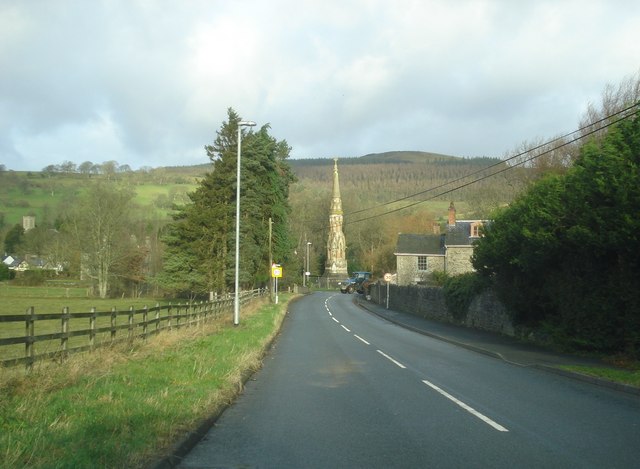
The third of our Liberal pals is George Cornewall Lewis, "Radnorshire's most distinguished son" and a future Home Secretary and Chancellor of the Exchequer, whose monument once dominated the main road into Mid Wales. Of course Lewis lived at Harpton, hence the need for friend Head to push the English border a couple of miles further west. Six generations of marriage to English brides combined with an Eton education had certainly expunged any memory of what had once been a distinguished Welsh family and Lewis is quick to agree with Clive's opinion of the intelligence of the Welsh. However, he laments "how that intelligence is to be raised, while they retain their villainous Celtic language, it is not easy to see."

Cornewall-Lewis considered the Welsh to be cowardly and timid, perhaps he had a point. His letters are available here.

Tuesday, February 01, 2011

Coming Soon - Hopefully

A couple of frustrations this morning, firstly it's impossible to get on to the London government's new site "police.uk" to check out local crime, but more importantly the National Library's Welsh Journals site is playing up. Now for the good news: it's obvious that they have just added the Radnorshire Society Transactions to the journals available online. Hopefully the present search difficulties will be sorted out soon.

I've never been a member of the Radnorshire Society, it always seemed far too bourgeois an organization for a young council house hot-head such as myself. OK no doubt I got that all wrong and it is infact a wonderfully welcoming society open to all. One gripe I still have though, why is it I can pick up a current copy of Brycheiniog - journal of the Brecknock society - in local bookshops, but not the Radnorshire Transactions? Surely it, and especially works as important as the recent translation of Payne's Crwydro Faesyfed, should be available to as wide an audience as possible?

Anyway it looks as if those earlier, hard to find issues of the Transactions will soon be on-line for all to read.

UPDATE: Four of the top ten violent streets in England and Wales turn out to be in Wales. Not very good considering that on a population basis it should be one in the top twenty. Perhaps it's time to hand over law & order to the Assembly.

FURTHER UPDATE: Radnorshire Transactions are there now. See here. Bravo!

Sunday, January 30, 2011

Green Green Grass

I suppose most informed Welsh people will already know that Mrs Mubarak's mother was born in Llwynypia, although obviously not Welsh Office dinosaur David Jones. It's even been said that she once lived in Laura Street, Pontypridd, previously only noted for being the old home of retired hip shaker Tom Jones.

A Google search wouldn't reveal it but Mrs M's nain was a slate worker's daughter from Llanddeiniolen, one Lily Parry, the family originating from Anglesey. Who knows they might even be related to the distaff side of another celebrity couple who have done rather well at the expense of the public purse.

UPDATE: Bit of bad timing here, the Eisteddfod ask Suzanne Mubarak for a pair of shoes for a charity auction. No seriously!

Saturday, January 29, 2011

Penny Note Book - part 2


The first three extracts are from 1899. The Gramophone appears in Aberedw in 1901, probably a model like this. The pretty bird appeared in 1906 - I guess it's too late to report to the Radnor bird blog. In the same year the pious old lady of Llanbadarn y Garreg met with her accident.

Friday, January 28, 2011

Agony Aunt

W.G. of Llanyre writes:

A friend of mine was recently reading a post from Llandod blogger and former Lib Dem councillor David Peter. Ever since she has been fretting about the upcoming referendum on more powers for the Welsh Assembly. Is there anything I can do to set her mind at rest?

Radnorian replies:

Dear W.G. tell your friend not to worry. Although Mr Peter needs "to be convinced that more powers for the Assembly is not merely a milestone on the way to full independence for Wales" the referendum is just about more powers for the Assembly. It could equally be a milestone on the way to the fully federal Britain that the poster advocates. The present vote has nothing at all to do with full independence. Unionists should remember that they were responsible for breaking up the original United Kingdom by continually standing in the way of devolution for Ireland.

Mr Peter also worries that the Assembly has no revising chamber. Well tell your friend that many countries get along fine with a single chamber legislature - New Zealand, Sweden, Finland and Norway for example. Also all the Australian, Canadian and German federal states.

Mr Peter does have a point when he complains about East Wales not having much influence within the current Welsh Assembly Government. No doubt this wouldn't have been the case if the Lib Dems hadn't pulled the plug on the proposed Rainbow coalition. Perhaps local voters should cast their ballot for parties who want to participate in government rather than putting their own internal party bickering before the interests of the people of Powys.

Thursday, January 27, 2011

Bees and Bonnets

A few months ago in the Western Mail, historian Dai Smith worried that what was described as the Renaissance of Welsh History in the second half of the 20C had run out of steam. One author who has certainly courted the controversy and debate which Dai Smith cites as a positive feature of that renaissance is the author of this little book.

Dr Breeze believes that the Four Branches of the Mabinogi were written by a woman and that the author can be identified as Gwenllian, the daughter of King Gruffudd ap Cynan of Gwynedd and wife of Gruffydd ap Rhys, Prince of Dyfed.

Now as one of the mere consumers of history I'm in no position to comment on the validity of Dr Breeze's theory and it certainly hasn't been accepted by his academic contemporaries. At the same time the author makes a lucid, circumstantial case and, although he cannot prove it, challenges his detractors to come up with detail that proves him wrong.

The book is published by a Leominster company called Gracewing who seem to specialize in works of Roman Catholic interest.

Dr Breeze has been described as having a bee in his bonnet about Gwenllian. Perhaps a few of our Welsh academics could be persuaded to unleash some of the bees lurking in their own headgear rather than retreating to what Dai Smith describes as "the cloister of the Learned Journal."

Saturday, January 15, 2011

Dorothy Levitt, Update


Dorothy Levitt was a secretary at the Napier Motor Company around 1903 when proprietor Selwyn Edge hit upon the idea of entering a woman in early Motoring events. Edge probably hoped that this would popularise the car with women and Dorothy soon proved herself an able and spirited driver. You can read about her on the excellent Speedqueens blog - here.

Soon Dorothy was an Edwardian celebrity but around the end of the decade she seems to have disappeared as quickly as she came into view. Despite being something of a feminist icon - check out my post on her only sporting foray into Radnorshire - and the subject of recent television shows, no-one really seemed bothered as to who she was or what became of her.

A couple of years ago I came up with the theory that Dorothy was actually a Jewish typist born Elizabeth Levi - my comment on this post sets out the reasons for the identification.

Now some genealogists with access to the probate records have confirmed the identification (see illustration above) - Elsie Ruby Lewis being shown through the BMD records to be Dorothy's or rather Elizabeth Levi's sister.

What became of Dorothy between 1913, when she had an apartment in Portman Mansions, and her death in 1922 remains a mystery.

Thursday, January 13, 2011

Outlanders

Fed up with no longer being able to bore your workmates and relations with talk of how much your house has gone up in value? Well I don't suppose many Radnorians spent the 1970s buying Welsh language LPs, but if you did you might just have a new topic of conversation. Say about this or this or this or even this.

Friday, January 07, 2011

Did You Ever

Cardiff blogger Babylon Wales has come up with visual proof of Radnorshire songbird Maralene Powell's 1972 musical adventure with Gareth Edwards. I'm guessing Gareth has a better singing voice than current Welsh scrum-half Mike Phillips.


Thursday, January 06, 2011

Penny Note Book


Yesterday while helping to clear out a house, I found a liitle penny note book. It contains occasional diary entries starting on January 17th 1899 and ending on September 23rd 1908. The author was a Nina Price of Pencraig, Llanbadarn y Garreg. At the time of the first entry she was a 15 year old pupil at Llandrindod County School and lodging in the town, the last entry records her father's funeral. The other entries include visits to fairs, concerts and church services, together with reports of local elections, fires, accidents and tragic deaths. Maybe I should send it to the county record office.

I doubt if there's been much skating on Llandrindod Lake this winter - Health & Safety has made cowards of us all - perhaps to the relief of the birds on the excellent Radnor bird blog.

Friday, December 31, 2010

Who They?


A little quiz for any motor sport fan who still checks out the blog. It's the 1962 British Grand Prix - not 1961 - probably the most anglophone race in history and the cameraman obviously couldn't bear to film anyone who drove a non-English car. First eleven are straightforward, you only see the back of driver six but who else wore yellow overalls.

My guesses here:

Friday, December 24, 2010

Merry Christmas

OK I know the BBC and the Met Office both inhabit the wacky-world of AGW. Oh and I do realise they've been grossly underestimating Mid-Wales' temperatures over the last couple of weeks ...... but haven't they over compensated a wee bit on the cold side with their maximum temperature for Christmas Day? A day time max of -13C? I do hope Santa has checked the anti-freeze in his reindeer.

UPDATE: The Met's all time lowest maximum daytime temperature for Wales was -8C. I recorded a high of -8.7C during the day so I wouldn't have been surprised if the official December record (-5.5C) had been broken. Seems it wasn't. Strange that.

Friday, December 17, 2010

Traffic Update

The Hereford to Aberystwyth downmail stagecoach was brought to a halt by the snows on Radnor Forest. Thankfully the passengers had disembarked and the horses been unharnessed when an avalanche swept the coach from the road and left it buried underneath a fourteen foot drift. The stranded party managed to find shelter at the nearby Forest Inn.

In case anyone is worried this was in January 1854, not this morning.

Wednesday, December 15, 2010

Small Earthquake, No-One Hurt.

OK I realise my blog is getting boring now.

Saturday, December 11, 2010

Musical Interlude


Oh dear I'm afraid the sound of all these plummy-voiced Trot students is making me nostalgic for Uncle Joe.

Monday, December 06, 2010

News

Here's a turn-up for the books, Sir Stirling wins the Innes Ireland Trophy. I wonder if they considered giving it to the guy who mugged Bernie? Sir Stirling telling it like it is to the Daily Telegraph here, and a little off-camera tale about Innes at the end.

Monday, November 29, 2010

Where Did You Get That Hat?

Innes Ireland's last two World Championship outings in 1966 were in privateer Bernard White's clapped out BRM P261. BRM seem to have been in the habit of selling on old bangers, talented faux Welshman Jack Lewis ran out of enthusiasm for the sport after he acquired one of the Owen Organisation's sell-ons.

Anyway Innes qualified 17th out of 19 starters in that year's US and Mexican races, both times having to retire with mechanical problems. A career that had promised so much certainly ended with a whimper.

Ages ago, on what was then the premier racing history forum on the net, I asked the question "Bernard White who he?" No-one really knew that much about him, which is rather typical of a scene where the history of cars takes precedence over people. There's gold in them thar cars after all. Well nearly eight years after posing the question my forum query was answered, Bernard was the brother of financial buccaneer Gordon White, the brains behind Hanson PLC.

One day we might get an answer to one or two other puzzlers. Was the first Yank to compete in F1, Robert O'Brien, actually a CIA operative? Did the Vicomtesse de Walchiers really exist or was her team a CIA front? Here we're harking back to the early 50s so I doubt anything is going to turn up on Wikileaks.

Anyway that's a rather chunky Innes with Bernard White, pictured at the 1966 Mexican Grand Prix. Hopefully Ireland was wearing the hat as a joke. A few months later and he would finally move out of Downton to leave New Radnor in peace. Any Ffransis Paine fans who have read this far may be interested to learn that Innes (or at least Innis) gets a couple of passing mentions in Crwydro Sir Faesyfed. I wonder if his name has been spelt correctly in the recent translation?

Friday, November 19, 2010

It's Our History

When I was a kid I don't think Radnorshire had a history at all. I guess someone must have been vaguely aware of one, since we pupils at the local high school wore a blue and yellow uniform, the colours of the Norman claimants to the county - the Mortimers. Come to think of it the school badge was the Mortimer coat of arms as well. A bit of a strange choice really.

Radnorshire didn't have a culture either, it's literary figures were all outsiders - Shelley's brief sojourn at Nantgwyllt, Wordsworth's distant connection with Hindwell. A few years later and Powys County Council was pushing the line that Radnorshire wasn't even Radnorshire, it was Kilvert Country.

Perhaps most insulting of all, Radnorshire in the eyes of many Welsh people from outside the county wasn't even Welsh. In the words of Iorwerth Peate we were: "a deracine people, a people fallen between two stools, a community of half-things." Nice.

Anyway that's the background from which I approach the recent Elystan Glodrydd jamboree in Llanbister. Reader Rob reproaches me for posting a link to that event, "please return to posting about the real Radnorshire of poaching, tai unnos and Rebecca, and ignore this sentimental crap." And of course what he says is true: toffs celebrating some remote link with a man who might never even have existed, God Bless the Prince of Wales toasts etc. But it's not the whole truth as the day seemingly also saw Dai Hawkins flogging copies of his translation of Ffransis Paine's Crwydro Sir Faesyfed and John Davies explaining that the Abbey at Cwmhir was founded by our local princes not the Mortimers. It's bound to have raised awareness of some actual history.

Since I was in school Radnorshire has certainly begun to rediscovered its own history and culture, a history and culture that is part and parcel of mainstream Wales. Our history doesn't have to be the sole possession of any foreign establishment, hyphenated or otherwise.

A Rebeccaite Attack

The Rebeccaite attack in the Claerwen valley on September 10th 1868 is retold in two must-have books, see here and here. At the same time we can add a few more facts with the help of a report in the newspaper Baner ac Amserau Cymru and the census returns.

The Nanteos estate had built a shepherd's cottage on Esgair-garthen in Llanwrthwl parish with the purpose, in part at least, of harassing the stock of local farmers who traditionally grazed sheep and cattle on the open mountain thereabouts. Perhaps the shepherd took his duties a little too seriously, for his home was soon subject to a visit by 15 or so Rebeccaites with blackened faces. As chance would have it the shepherd was away and the house was occupied by his wife, baby son and ten year-old sister-in-law. The family's furniture and clothing were taken out and the house demolished and burnt along with it's stacks of peat and hay. Ms Bidgood reports that the china was put on the dung heap, which seems a mean thing, although in reality it was probably the safest place for them.

Seven of the attackers later appeared in Builth magistrates' court and it is interesting to note that the five easily identifiable individuals all originated from Radnorshire - William Palfrey and his son John from Dyffryn, Llanwrthwl were a Nantmel family, while John Lewis of Dolifor and Thomas Hughes of Cefn were born in Cwmteuddwr. John Scott of Ciloerwynt was also a Cwmteuddwr man. Two others cannot be identified with certainty although David Davies, a servant at Cefn, was most likely a Radnorian while Thomas Jones, a carpenter, was probably a Cardi.

No doubt for the shepherd's family this was as terrifying an experience as for those legally evicted from their homes on the commons. The Esgair-garthen action was part of an on-going very low level insurgency against those members of the ruling class who were seen as over-stepping the mark. To a degree it was a threat that kept the majority of landlords a tad more honest.

The prosecutor in the Builth court complained about the "Irish" character of the attack and like most of the cases where Rebeccaites were brought before the bench, there were no convictions for lack of evidence.

Wednesday, November 17, 2010

When We Were Kings

As Radnorians recover from the devastating news that Kate Middleton appears to have NO Radnorshire connections, readers can at least console themselves with this report on the recent Elystan Glodrydd celebration in Llanbister. See here.

Saturday, November 13, 2010

Spot the Radnorian

Who is that seated behind charismatic President Herman van Rompuy on the European gravy train in today's Daily Mail? Why none other than Radnorshire MEP John Bufton. It's a puzzle as to why the Mail should shine the spotlight on the blameless Mr Bufton. I guess because their reporter spotted him signing the attendance register at 8am one Friday morning. Critics claim that this practice, which allows MEPs to pick up a £260 allowance, is a bit sharp as the MEPs then scoot off home without using the money for the purpose of subsidising an extra night in Brussels. But as Mr Bufton rightly points out, "That's our system."

Of course UKIP have been a bit unlucky, with a couple of their MEPs ending up in the slammer and, yes, their factions do seem to spend a good deal of time trading accusations of financial impropriety, but is that any excuse for the Mail to poke fun at one of the party's honest representatives?

No doubt UKIP will be ranting on about the cost of the Welsh Assembly during next year's votes. One might have a little respect for them if they refused to attend the European Parliament. It would save the taxpayer a fair sum and remove the temptation of these ardent Europhobes becoming part of "the system."

Thursday, November 11, 2010

Late Town Extra

The news that Llandod mayor Gary Price has joined Plaid Cymru roused the town's dormant blogger David Peter from his well-deserved slumber to aim a little dig at Plaid's "xenophobia."

Ex-Councillor Peter (Lib Dem) is also amazed that the BBC's Mid Wales site should find the item "remotely newsworthy". A bit of a puzzle this, as it was obviously newsworthy enough to get Mr Full Pelt blogging again.

Anyway good luck to the industrious Mr Price. He might like to pick up ex-MP Lembit Opik's recently published book (pictured) as a reminder that some Lib Dems, at least, have a sense of their own absurdity.


Monday, November 08, 2010

The Men of Elfael

In Brut y Tywysogion under the year 1252 there is an entry that Elfael - and if you don't know that the cantref of Elfael covered what later became the southern half of Radnorshire, then you should do - was despoiled because the men of Elfael had illegally used the pastures, and here there's some confusion, of either Maelienydd or Elenydd. A couple of centuries or more later and the bard Lewis Glyn Cothi was requesting the gift of a stallion from the men of Elfael.

So who were these men of Elfael? It seems to me that they must have constituted a legal body. If individuals in Elfael had illegally grazed animals on a neighbouring cantref then surely they would have been despoiled rather than a group punishment being imposed. A group punishment suggests a group transgression. Likewise Lewis Glyn Cothi requested gifts from plenty of named individuals in poems where he praises their bloodline. In the poem below he requests a gift from a group and praises their country. He also expects the gift to come from a pound, an institution that would have had to be administered, presumably, by these men of Elfael.

Anyway it makes sense that the men of Elfael constituted some kind of proto-democratic body, along the lines of a Swiss canton perhaps. It is probably the natural organic system of local government that suits Wales. Of course now we're blessed with Powys County Council.


Request For a Stallion from the Men of Elfael by Lewis Glyn Cothi

Blessed God, ‘til my last day,
To the generous land that chases a stag.
Once, long ago, I was young and cheerful,
That was then, today I’m old,
And with age comes bad temper,
I’m an unwelcome pedestrian.

Although I’ve had the gold of the fair lands of Elfael,
Now I desire something more.
I desire a stallion,
One with a coat as black as charcoal.
From the manor to the van, I’m not interested
In some wild-tempered bay,
A slim lion is what I desire,
A strong giant or a rounded stag,
As fair as that great stallion, his sire,
As tame towards me as a sheep.
Today it’s easy work to find him
In the pound of the two Elfaels;
And then like swan feathers,
A smooth saddle to cover the horse,
And a short bit in his nostril
To stop him from jumping.
I am as gentle as a swan,
My stallion is gentle on my backside.
Up top, my saddle is smooth,
Like the van, I’m bald.

The two best lands in all the world,
The cultivated lands of Elfael,
Idnerth Hir and Elystan turned them
Into a land of fields,
And then, full of riches,
They were Einion Clud’s yard.
Elfael has never lent her shoulder,
Like so many lands, to an English tune.
Elfael is greater than a thousand myriad,
More than the fair of Man and her roads.
Troy was broader than Greece,
Wide in one fair whorl,
Yet the Greeks and their turmoil
Broke through the walls of Troy;
The men of Elfael also go
Through the wide lands of the earth.

If there is a musician without
A share of silver or mead,
Let him drop his prices, let him search the Wye
For silver, as far as Clyro;
From Clyro, calling for strength
In his heels, back to Diserth;
From Diserth, and being honoured,
Let him come to the land of Aberedw.
In strength he will have cattle,
In minted gold, in kind words,
In corn, on the banks of the Edw,
In great stallions, in greater happiness.

Over Elfael, the Cross of Tyfaelog,
And the Virgin, and the Cross and the Holy Rood,
Let Dwynwen extend her cross
Over the land of Mael, over fair Elfael,
God’s will be done, below the land of Mael,
And Sulfedd bless Elfael!

Saturday, November 06, 2010

Gone Tomorrow

When I started wilfing around the internet nine or ten years ago one of the few web resources for language shift in Wales and also the English counties of Herefordshire and Shropshire was a site called Gwefan Catalunya-Cymru, indeed it seems to have been on-line since 1995. As far as I can tell the tri-lingual site - Catalan, Welsh and English - has now disappeared except for the odd page and what has been preserved in Google cache.

From what remains of the site here's a letter writer to the journal Seren Gomer in 1845, describing a snippet of conversation illustrating the process of language shift in Newbridge-on-Wye:

“Evan,” meddai un hen ŵr wrth y Bontnewydd, yn swydd Faesyfed, ag oedd yn tybied ei fod yn gryn dalp mewn gwybodaeth Seisnig, “go and fetch me the bar harn from the beudy.”
“Daid,” meddai y bachgenyn, which shall I bring from the beudy, the bar harn bach or the bar harn mawr?”

"Evan," said one old man from by Newbridge, in Radnorshire, who believed he had a fair grasp of English, "go and fetch me the iron bar from the cowshed."
"Grandfather," said the lad, "which shall I bring from the cowshed, the little iron bar or the big iron bar?"

UPDATE: It seems the Catalunya-Cymru site is back on line. Good, hope it stays that way, a lot of interesting info there.

Friday, November 05, 2010

Forgotten Radnorians - Sir John Clanvowe

Look up the soldier, diplomat and Lollard Sir John Clanvowe of Hergest (1341-1391) on Wikipedia and it says that he came from a Herefordshire family - of course his part of the Welsh March did not become part of that county until 1535. In reality the Clanvowes hailed from the lands which later became Radnorshire.

The Clanvowes were an interesting family, harbingers of the kind of gentry family who, a couple of centuries later, would abandoned their loyalty Wales. Although descended from Rhys ap Tewdwr, the Clanvowes, from the time of Hywel ap Meurig of Gladestry who died in 1281, served foreign masters and married foreign brides. Hywel ap Meurig, for example, held Cefnllys Castle for the Mortimers, later he was constable of the castle at Builth. The surname Clanvowe itself - one of the earliest examples of a Welsh family abandoning the patronym system - came from Hywel ap Meurig's wife.

Sir John Clanvowe - if his authorship of the Cuckoo and the Nightingale is correct then he was the first Welshman to write poetry in English - was the great great grandson of Hywel ap Meurig. Recently Clanvowe has become a topic of interest to historians of homosexuality since in 1913, during restoration work at Istanbul's Arap Mosque, workers reportedly uncovered the floor of an earlier Dominican church. Among the gravestones was one in grey-white marble with pink and blue veins. Two helmets faced each other as if kissing, this was the tomb of Sir William Neville and Sir John Clanvowe. Neville died within four days of Clanvowe's death having starved himself, I guess that would mean refusing to drink. Below the helmets on the gravestone the two knights' shields rest on each other, their coats-of-arms are identical, half-Neville, half-Clanvowe, an ‘impalement’, usually used to show the arms of a married couple, with Neville’s saltire on the husband’s half. Not unreasonably this has been taken as evidence that the pair were lovers. There have even been recent claims that Clanvowe created the Robin Hood legend perhaps as some sort of gay propaganda.

It's an interesting place, this borderland with it's Mortimers, Clanvowes, Oldcastles, Cliffords, Crofts, Whitneys etc. and its three cultures - English, Welsh and Norman-French living side-by-side. It needs someone with the appropriate linguistic tools to tell its story.

Sunday, October 24, 2010

Surely Not

While perusing Ian Mortimer's latest page-turner 1415 Henry V's Year of Glory, I came across the aforementioned king's pardon of one Llywelyn ap Madoc Ddu:

"For all treasons, rapes, murders, rebellions, insurrections, felonies, conspiracies, trespasses, offences, negligencies, extortions, misprisions, ignorances, contempts, concealments and deceptions committed by him."

The pardon claims that Llywelyn was from Builth but hang on a minute, does that really sound like an inhabitant of that peaceful little land beside the Wye?

Tuesday, October 19, 2010

Musical Interlude

Tales from the Riverbank

It's 58 years to the day since a group of intrepid militants, presumably from the Welsh Republican Movement although no-one was ever convicted, exploded a bomb on that little seen Radnorshire landmark, the Fron aqueduct (see postcard view of its construction.)

A couple of days later the Queen opened the Claerwen reservoir. Somewhere or other I've got some newspaper clippings of your blogger waving the Union Jack outside the W. H. Smith shop in Llandod's Station Crescent. If they turn-up I'll post them!

Sunday, October 17, 2010

Home Front

During the Second World War the elegant Radnorshire Spa town of Llandrindod was seen as something of a safe haven, remote from the bombed cities of England and Wales.

The number of well-to-do folk seeking refuge in the town provided a few local landlords with the opportunity for a spot of war-time profiteering. One local Alderman, for example, bought and furnished a house for £850, which he then let out for the princely sum of 10 guineas a week - the house having previously been let, unfurnished, for 7/6*.

Now there were strict wartime regulations against such profiteering and the Alderman soon found himself before the local bench, of which he was himself a senior member. Unsurprisingly the town's magistrates found him not guilty, a verdict which seemed par for the course for cases of rent racketeering in which they sat in judgement.

Having perhaps given up on the local magistrates, the authorities moved one well-publicised case of black marketeering to a Cardiganshire bench. This involved a retired naval officer who had come to Llandrindod to sit out the war and was receiving groceries from a local shop without being registered to do so. The Commander's wife did not help her husband's cause when she complained to the investigating officer that, "We are not nobodies. We are gentry, and during this war the gentry have had to put up with a lot of rudeness."

Unmoved by the good lady's heartfelt analysis of contemporary social trends the Cardiganshire magistrates fined her husband an eye-watering £380 with £21 costs ..... the grocer got away with a tenner.

* I apologize to any younger readers confused by the terminology of proper money, blame Ted Heath Harold Wilson.

Saturday, October 16, 2010

Slow News Day

Somehow I can't see Llandrindod High School's Sports Day featuring in the London papers any time soon. Back in 1929 it made the pages of the Mirror.

Old News

An ex-soldier must have had quite a shock when his 22 year old girlfriend Emelia turned up on his Rhayader doorstep in the summer of 1946. The enterprising young lady having somehow managed to smuggle herself into the country from her native Italy. Local magistrates took pity on the girl and she avoided a prison sentence, although they did recommend deportation, doubtless to the relief of the ex-soldier's wife.

Monday, October 11, 2010

The Winter Assizes of 1897

Something not in short supply in late 19C Radnorshire were explosives - the Birmingham waterworks provided a ready souce of pilferred gelignite and detonators for those intent on causing a bang. One such was a tramp, George Jones, who decided to blow the safe at the New Radnor railway station. Having successfully relieved the Great Western Railway Company of £5 and a bottle of ink, Jones made the common mistake of heading for the pub rather than making good his escape - verdict: eight months with hard labour.

The GWR were also the victims in the next case where three local men - Weaver, Clarke and Powell, were charged with stealing twelve bottles of wine and a quantity of onions from Presteigne railway station. Constable Hitchman, who had secured two of the accused in the cells, reported that Clarke had shouted out, "Stand true, Weaver." To which Weaver, no doubt anxious to prove false Radnorshire's reputation of being a land without poets, replied, "Like a bell of brass which never cracks." - Verdict: Powell and Clarke, four months with hard labour; Weaver, three months.

How would these cases be treated today? Well the safe cracker would surely have been looking at a far longer sentence, while the wine thieves would be looking at community service.


Thursday, October 07, 2010

Radnorshire Trivia

The old wooden bridge across the Wye at Newbridge didn't look too solid. In 1911 it was replaced in reinforced concrete, designed and built by the same people responsible for the banking at the Brooklands motor racing circuit.

Tuesday, October 05, 2010

A Popular Insurrection

Radnorshire Rebeccaites on the Edw, December 1932.

If the rapid retreat of Welsh in 19C Radnorshire is reminiscent of language shift in Ireland, then the London press were also quick to draw Irish comparisons when reporting the activities of the county's Rebeccaites. Throughout the Victorian period and beyond this body openly challenged the authorities with acts of public lawbreaking, armed marching gangs, intimidations and pranks. Not just in respect of the fisheries but also against profiteering shopkeepers and the like.

Much to the disgust of outsiders the Radnorshire magistrates were loath to hand out heavy fines or even convictions to the handful of rioters brought before the courts. After all the local landlords knew that the Rebeccaites had widespread public support. In most respect Radnorshire was one of the most law-abiding districts in the kingdom - during its 90 year plus existence the Radnorshire Constabulary only investigated four murders for example. But where there was perceived injustice the populace turned to Rebecca.

As far as I know the best account of these activities is "The Second Rebecca Riots: A Study of Poaching on the Upper Wye" by historian David Jones. It was published in the journal Llafur, volume 2 no. 1 - spring 1976. A more recent account can be found in the Keith Parker book Parties, Poll and Riots - Politics in 19C Radnorshire. There is plenty in the contemporary press of course - much of which can be accessed online via our National Library.

NOTE: It should be noted that far from being mere ruthless exploiters of salmon stocks the Victorian Rebeccaites were campaigning against the commercial night-netting activities of landowners such as the Duke of Beaufort, who were taking 6000 fish a season from the Wye between Ross and Hereford.

Monday, September 27, 2010

Around the Radnorshire Blogs

Llandod exiles might be interested in the Radnor Bird blog and their excellent snaps of the feathered inhabitants of the Spa town's famous Lake. Plus, of course, the newly arrived family of otters. See here.

I seem to remember that some of the last otter hunts would have been on the Wye around Builth in the mid 1970s. So some things, at least, have changed for the better.

Y Dysgwr Araf has recently revived his Welsh language blog. While landodlip seems to have called it a day after being threatened with m'learned friend.

Presteigne blogger Ian Marchant was recently lifted for non-payment of parking fines. See his old blog, or the new website. Now I was recently in Presteigne and ended up in the car park above the High Street, off Heol Joe Deakins. The pay and display machine was out of order and, by the look of things, had been for quite a while. Of course there were plenty of the usual signs threatening dire consequences for failure to display the necessary ticket. So what should a visitor do? Risk leaving the car and ending up with a fine or clamped by infallible authority, or just drive on? No wonder the car park was virtually empty.

Sunday, September 26, 2010

Nothing In the Papers

In the summer of 1844 the English papers highlighted a Radnorshire wedding in the parish of Llanstephan. A blind former blacksmith from Glasbury, one William Thomas, aged 87, married Margaret Pugh, a 16 year old local girl. No doubt the papers would have been even more shocked if they had followed the story through, as by the time of the 1851 Census the happy couple had three children.

Unfortunately the Census also informs us that William, who was indeed a blind former blacksmith, was a sprightly sixty four year old, while wife Margaret was thirty eight, ages which are confirmed in census returns both before and after their marriage. I wonder what the marriage certificate says?

Sunday, September 19, 2010

The National Newspaper of Wales

OK let's be fair, maybe they can't do an ŵ!

Oh and did Catrin really have a surname? Anyway enough of statues to victims, how about a memorial to Owain's daughter Gwenllian of Cenarth, St Harmon. According to some her household carried on fighting well into the 1420s and she was also the subject of some very fine poems.

The New Remembrancers

"Ripping up the stereotypes" the Western Mail boasts of its new series on the history of Wales. I wonder if at the end of the exercise we'll have to add "and creating some new ones."

It would help if in his introduction Dai Smith would call a spade a spade. "A tsunami of truth-telling unwelcome to myth-makers and know-nothings alike." That sounds great but what does it mean? If the know-nothings include that embarrassing stuff you find on tea-towels such as Welsh being the oldest language in Europe, all well and good. But who are the myth-makers? Gwynfor Evans? I'd like to know.

Anyway exiles and skinflints can read the first contribution "Did we really descend from the Celts?" here. I can't say I was impressed - on the printed page it looked a right mess - and shouldn't an article on Welsh origins at least mention DNA.

I think it's a bit of a scandal that so little DNA testing has been done in Wales. As far as I can see we still seem to be relying on the tiny samples taken during the BBC's "Blood of the Vikings" series a few years ago. The sample sites for that were particularly ill-chosen: Llangefni, Llanidloes - slap bang in the middle of a 16C plantation that gave rise to surnames such as Wigley, Jarman and Peate, and Haverfordwest. All interesting locations in themselves of course but hardly typical. If anyone can point me to some recent work on Welsh DNA please do.

Thursday, September 16, 2010

Drawing Lines On Maps

No doubt Radnorshire always proved a bit of a nuisance to the one-size-fits-all delusions of the Boundary Commission.

Back in the 1940s they wanted to amalgamate the county with Breconshire and Herefordshire. As much as I would like to see the return of those parts of the March lost in 1535, I'm sure the proposal was more about extending the borders of England rather than those of Wales.

By the early Sixties the Commission had come up with another wizard idea, to merge Radnorshire and Breconshire with Monmouthshire. The Times even had an editorial about it, they were worried the proposal might dilute Monmouthshire's Englishness!

In the end of course they created Powys. Why? Because Welsh counties had a lower average population than those in England. Oh and because bigger counties would save cash. Yeh right.

Sunday, September 12, 2010

Cors y Llyn,

The stunted Scots Pines at Cors y Llyn


Old Ad

By 2010 you'd be hard put to purchase a pair of Y-fronts in the Spa town, never mind upmarket, posh stuff. Thank heavens for Tesco's.

Saturday, September 11, 2010

Greater Radnorshire

Since the American Senate functions with just 100 elected members, Powys County Council can hardly complain about the Boundary Commission's proposal to axe 15 councillors and reduce the chamber to 64.

Radnorshire Councillors are to be congratulated on trying to maintain the county's separate identity during this process of redrawing of constituency borders. At the same time merging Aberedw with Erwd has a lot of merit. No doubt our members see it as a Breconshire takeover, but that needn't be so. It was just an oversight of the 1535 Act that Builth Hundred was included in Breconshire in the first place, historically it was always tied much more closely to its Radnorshire neighbours. Simple solution, transfer all the Buallt seats to the Shire Committee for Radnorshire.

Thursday, September 09, 2010

Llandeglau? Where's That Then?

You can't really blame Powys Highways for some of the rather dubious bilingual signs appearing on Radnorshire roads - after all they're only following the advice of Bwrdd yr Iaith's Place-Names Standardization Team.

The latest example I've spotted is Llandeglau/Llandegley. I can see how this name Llandeglau has been created, and it is surely a creation rather than a name with any historical validity. No doubt it originated with the book Rhestr o Enwau Lleoedd / A Gazetteer of Welsh Place-Names (Elwyn Davies, 1967) and comes about from a standardisation exercise where incorrect English spellings ending in ley are Cymricised as lau, for example Dolgelley/Dolgellau. Now Llandegley is an incorrect spelling, but of Llandegle not Llandeglau. Richard Morgan's little book has an example of Llandegle dating back to 1291, while it is also the form used in the 15C bard Lewis Glyn Cothi's praise poem to a local patron, one Ieuan ap Llywelyn Fychan: Hyd Glud a Llandegle wen - to the Radnor Forest and fair Llandegle. The spelling Llandegley appeared much later on the scene in 1557. More recently Ffransis Payne, who lived in the parish, used the form Llandegle in his wonderful volumes about Radnorshire, Crwydro Sir Faesyfed.

The sensible solution would have been to just use the correct Welsh spelling Llandegle on the signs. This would have been cheaper, historically accurate and would not leave Radnorians thinking that their pronunciation of the name was English, when in reality it is Welsh and as old as the hills. Hopefully someone will get it right when they do the bilingual version of this.

Sunday, September 05, 2010

From A Family Album, 1

My great grandparents Charles and Mary Jones and their offspring in a photograph taken around 1897.

Mary was born in Llansawel and brought up in Llandeilo Fawr in Carmarthenshire - she's always shown in the census returns as speaking both Welsh and English. Her husband was born in Llandrindod and is always shown as speaking only English. At the same time my grandfather, he's the lad with his hands in his pockets, said that the two sometimes conversed in Welsh.

Two of Charles' brothers, who moved away from Radnorshire, are shown in the census returns as being able to speak Welsh. One was married to a monoglot Welsh speaker from Llangammarch and the other, with a Radnorian wife, lived in Bargoed where the entire family is shown as being bilingual. I found a similar situation with my mother's family and it does make me wonder if Welsh was quite as dead in Victorian Radnorshire as most suppose.

I once asked my great uncle, the little lad seen sat on his father's knee, about his parents ability to speak Welsh, I might just as well have accused them of being thieves. I think his animus suggests that the situation in Victorian Radnorshire, well in the west, was similar to that in Victorian Limerick where:

"Up to about 1830, or so, the entire Rathkeale countryside spoke Irish. Then the new schools, the pro-English clergy , the influence of the landlords and agents, as well as the political leaders, the use of English in the law-courts, at gatherings and public meetings, in sermons and religious functions, the growing public feeling that Irish was a dying language, a mark of a degraded people who were not 'decent' - all this combined to produce a new people who from youth were pledged to speak no Irish. And so in West Limerick you had many who persisted in trying to speak a broken English and never again uttered a word in the old tongue they knew so well."

I wonder if that last sentence might be echoed in O. M. Edwards' reported comments about Radnorshire speech:

"Such a jumbled up, untidy hybrid language, that isn't proper Welsh or English."

Given the context I think Edwards was speaking about the west of the county next to Builth Hundred rather than the older Herefordshire influenced dialects of the east. I wonder when Edwards formed this opinion? If it was earlier in his life then it would make sense in describing a generation of older Welsh speakers trying to get by in English. A few years later and it wouldn't be an accurate description of west Radnorshire speech at all, in which case he might just have been being rude.

Never Had It So Good

It seems that an A35 van from the Automobile Palace was the machine of choice for many a discerning Radnorshire motorist of the late 50s and early 60s. OK so maybe it might have had to be reversed up the steepest hills but, hey, you didn't have to pay purchase tax! What a pity the photographer failed to focus on that all important FO number plate in this grey example.

The FO plate lasted from FO1 released in 1903 up until OFO 303N, which was no doubt issued by Mr Hinksman from the Gwalia in September 1974. I presume ditching local number plates was another of Ted Heath's great ideas.

This post was inspired by Radnorian blogger in exile Gwenddolen who reminisces about her family's green A35 here. Of course former racing driver James Hunt also used a green A35 van as his road car, his philosophy being that a car was only fun to drive at it's limit and the limit of an A35 wasn't too far over the legal speed limit - I guess it was also useful for transporting his budgies.

Wednesday, September 01, 2010

Welsh Genealogies Online

Back in 2006 I was excited to read a BBC news item announcing that Peter Bartrum's lifetime's work of bringing order to the old bardic genealogical manuscripts was going online. Of course reading the small print of the article was a bit of a dampener, since the project would take three years to complete. It's getting on for four years now and, as far as I can tell, the searchable online database is yet to appear. What has appeared are scans of pages from the 26 volumes of Bartrum's published Welsh Genealogies, I'd guess that around half of the pages of Radnorshire and surrounding interest have appeared so far.

As well as helping family historians, the genealogies make sense of many of the names in the bardic poetry and other historical documents. Take this page for example, which Bartrum designates Elystan Glodrydd 9. Here we find the family background of the great Welsh captain and bardic patron from the 100 Years War, Sir Rhisiart Gethin - a man wealthy enough to loan Joan of Arc's executioner, the Duke of Bedford, a thousand pounds in order to pay the English troops in France. According to a recent book, his father Rhys Gethin of Llanwrtyd was Glyndwr's general and, incidently, the mythical leader of the firebombing campaign of the 1980s.

Without a placename index these scans will be difficult to navigate to those of us unfamiliar with the published volumes. To help any Radnorians with an interest in these old genealogies and who are impatient for the fully searchable resource to appear, the following list - and I'm certain to have missed some - of family groups of local interest might be useful:

Elystan Glodrydd, everything really from 1 to 48 - not all these are up yet, Rhys ap Tewdwr 14 to 26 - not all are up, Bleddyn ap Cynfyn 5 & 46, Cogfran, Y Dean Du, Drymbenog 1 & 2, Einion ap Llywarch 11, Gwirfaeth, Herast, Hywel Athro, Hywel Fain, Ieuan Ddu of Maelienydd, Irien, Llowdden 7, Llywarch ap Bran 9, Madog Cristyn, Padriarc 1 & 2, Paen of Ludlow, Philip Baker, Rhirid Flaidd 2.

Some to look out for as they appear:

Aubrey, Baskerville, Bull, Havard, Heilin Du, Hoby, Holl of Harpton, Hywel Gethin, Knill, Llywarch ap Bran 10, 11 & 12, Philpot, Whitney,

Thursday, August 26, 2010

Next Stop New Radnor

The current issue of MotorSport has this snap of Ferrari 250GTO chassis number 3505GT on the cover.

As I've mentioned before, as well as racing the car at Le Mans and winning the Tourist Trophy for BRP during the summer of 1962, Innes Ireland also used the machine as a roadcar, driving it up to the circuits from his home in Radnorshire. His wife even used it to do her shopping.

How much is the car worth? Well Radio Two DJ Chris Evans recently paid £12 million for a GTO with a lot less sporting history. There again it was red ......

Tuesday, August 24, 2010

Cheers

Danzy Jones is a whisky liqueur named after its originator, a Builth stonemason, and seemingly sold until the 1940s in the town's Fountain Inn. The recipe has recently been revived by Danzy's grandson and is now sold in Harrods, although presumably not to the Duke of Edinburgh.

Like most Builth achievements there's a Radnorshire twist to the tale, since Danzy's father was from Aberedw and, although born in Maesmynis, Danzy himself was brought up in Llanfaredd. But hey, would I want to take anything away from Builth? Certainly not! I'm more interested in the forename Danzy, variously spelt Danzey, Danzie, Dansey, Dansy etc. etc.

If you were looking for a name that could only come from Radnorshire you could do worse than hit upon, say, Danzey Bufton. Although in truth the name is found mainly in the old Radnorshire family, the Sheens. Where there's a Dansey you'll more often than not find a Sheen somewhere in the family tree. A pity that notorious Radnorian murderer and Spitalfields bully Bill Sheen didn't carry the forename, who knows, one of Dickens' most famous characters might have been a Dansey.

The origins of the forename in Radnorshire probably date back to a marriage in Glasgwm in the first decade of the 18C between a Maria Dauntsey and a Thomas Sheen. They had a grandson christened Dantesy and the name, in it's numerous spelling variations, soon found favour in the Colwyn Hundred.

Wednesday, August 18, 2010

Book Review - Elenydd

It might be an idea for some wealthy patriot to buy up all the copies of this pretty little book and pulp them. After all Gwasg Carreg Gwalch's volume will probably sell best to tourists, and before you know it our "last wilderness" will be gone.

Of course this is already happening, with 4x4s churning up mountain tracks and the industrialisation of the skyline with wind-farms of very little environmental benefit.

Anthony Griffiths' photographs prove that if you are prepared to get out and about early, in the morning, especially on bright days in winter, then you'll take excellent photographs. No doubt the pictures' impact are diminished a little by the small format (220x220mm) but the colour reproduction is excellent and at £12 the book is inexpensive.

Despite the bilingual format the further reading list contains no Welsh language books or articles, those by Cledwyn Fychan for example. It does have Erwyd Howells but misses out on Ruth Bidgood. Essentially Elenydd is a tourist book, there are seemingly no people in this wilderness, no ponies, no sheep and no rain. The text is that of an informative visitor's guidebook, there is little room for the old mountain communities and their story here.

Thursday, August 12, 2010

More Normans

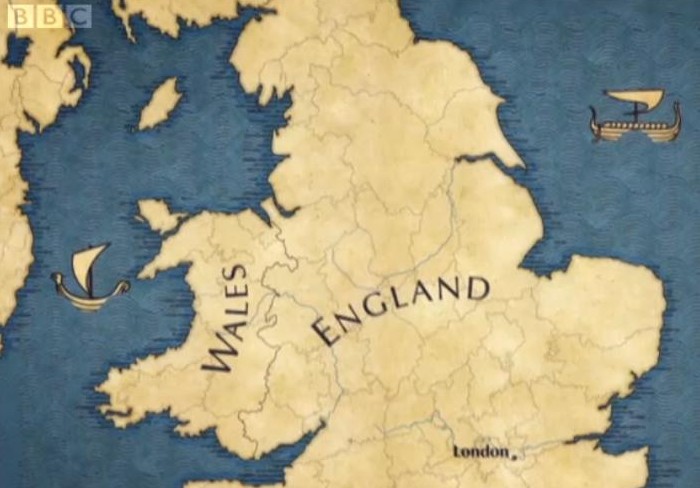
Anyone notice this map used in last night's second episode of Robert Bartlett's The Normans?

Now I know that a few places in Gwent do appear in the Doomsday Book, likewise a handful in Radnorshire, but this can't be mapping that since Flintshire is included in Wales even though numerous places there are in Doomsday. No, this is an attempt to draw the modern border but with Monmouthshire placed in England. An accident or an agenda? Make up your own mind.


Bartlett's BBC2 efforts all seem a bit Arthur Mee, although I'd never heard of the homicidal Alice of Abergavenny, surely an ancestor of Goldie Lookin' Chain's Nutter Missus. The real joy of the series is in the various associated programmes - Nina Ramirez clumping up hillsides and over parquet floors in spiked heels. I know academics on the telly like to have a sartorial gimmick but wouldn't a bow-tie or a deerstalker be less damaging to the environment? Then we had Dan Snow tramping through the Southern March visiting sites chosen for their photogenic qualities rather than their connection with the Norman Invasion. A walk from Wigmore to Abbeycwmhir would have made for a more insightful program - although the perspicacious Radnorians have long-ago recycled the stone from the castles en route. Best bit of Snow's walk was Mrs Lucas-Scudamore of Kentchurch hurriedly directing Dan away from the front door to a gazebo for a chat. She was probably worried about her floors.

Wednesday, August 11, 2010

Blog Watch

Aficionados of women in motorsport should check out this new blog.

As someone who finds modern day rallying and racing about as pointless as bungee jumping, I'm obviously more interested in the old-timers. The pre-war competitors seem much more interesting than their present day sisters. and quite often this is because of their adventures away from the track.

Perhaps this new blog misses out a bit by focusing on the records rather than the characters of those determined individuals - yes, for example, Joan Richmond did compete in the 1932 Monte Carlo Rally, but more interestingly she drove her little Riley to the start ..... overland from Australia.

Have women made any progress at all in motorsport over the last few decades? Back then photographers insisted on taking snaps of the leading racers powdering their noses, nowadays it's soft porn. One group who do have something of the spirit of their predecessors are the female Arab rally drivers from the Middle East featured on the blog. They're certainly challenging the status quo.

Friday, August 06, 2010

Our French Neighbours

While trying to keep up with current events, I found this interesting quote in the 1873 Christmas Eve edition of the Western Mail, it's in a profile of the Breconshire MP Godfrey Morgan:

"It is almost a paradox, but it is, nevertheless, true that Breconshire, throughout the whole of which the Welsh language is constantly in use, is less essentially Welsh than Herefordshire, where the ancient tongue has almost entirely fallen into desuetude. The population of Breconshire consists, in a great measure, of a Norman colony, which has gradually adopted the language of the country in which its lot has been cast, while Herefordshire is a Welsh county whose inhabitants have lost the use of their native tongue."

The writer uses these "ethnological grounds" to explain the Brecknockians supposed aversion to political dissent and "the supremacy of the Conservative cause in the county." Of course the secret ballot soon put paid to that little theory as the Liberals won the seat when Morgan became the 2nd Lord Tredegar in 1875 and held on until it was abolished and merged with Radnorshire in 1918.

Party politics aside there is some truth in lowland Breconshire's French character, after all it was the bard Hywel Dafi who celebrated the French families of Brycheiniog, where he pointed out that "every tribe has the fruit of French blood" - bobllwyth gyda ffrwyth gwaed ffrainc. While French surnames like Havard are still common enough, others, the Bullens and Boys for example adopted the Welsh patronym system to eventually emerge with surnames such as Williams. That excellent little book The Surnames of Wales relates a sad tale of a woman named Walby who sought relief in Crickhowell in the 1880s, her real surname was the fine old Breconshire French name Walbeoff, but her husband had changed it "because people laughed."

Wednesday, August 04, 2010

The Normans

Ever the optimist I'm looking forward to the BBC's new series on the Normans, which starts tonight. Usually my optimism is misplaced, the most recent example being David Dimbleby's anglocentric series Seven Ages of Britain, which informed us that until a few Irish monks turned up in Scotland in the mid 500s, Britain was pagan ...... heaven knows where he thought St Patrick came from. I used to think that such nonsense was born of ignorance rather than deliberate falsification, now I'm not so sure. As Ieuan Brydydd Hir said of an earlier generation of English historians:
The false historians of a polished age
Show that the Saxon has not lost his rage,
Though tamed by arts his rancour still remains:
Beware of Saxons still, ye Cambrian swains.